How high can a dog jump? Most dogs clear between 3 and 6 feet depending on their breed, body size, and fitness level, with some athletic working breeds regularly jumping higher than 6 feet.
Knowing your dog’s jumping potential is more useful than most owners realize. It directly affects what kind of fence your yard needs, how you structure playtime, and whether your current setup is actually keeping your dog safe. A dog that jumps for attention or excitement is using the exact same drive as one that clears a fence to chase a squirrel down the street.
Whether you have an escape artist or a pup that loves leaping on guests, understanding what your dog can physically do gives you the foundation to manage the behavior the right way.
Things to Know Before We Dive In
- Most dogs jump 1 to 3 times their own shoulder height
- Small dogs typically clear 1 to 2 feet, while large breeds often clear 4 to 5 feet
- Working breeds like Border Collies and Belgian Malinois can exceed 6 feet
- A dog’s rear leg muscle development is the main driver of jumping power
- Fence height alone does not stop a highly motivated dog
- Jumping on guests and jumping over fences come from the same behavioral drive
- Consistent training is more reliable long-term than physical barriers alone
Why Understanding Your Dog’s Jump Height Actually Matters
Most people only start thinking about this after something goes wrong. The fence gets cleared. A guest gets knocked over. The kitchen counter becomes fair game.
Getting ahead of it means knowing what your specific dog is physically capable of. A 4-foot fence is a perfectly reasonable choice for a Basset Hound. For a Belgian Malinois or an athletic Border Collie, that same fence is barely a speed bump.
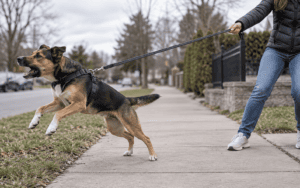
Jumping behavior is also tied to energy levels and lack of structure. A dog that jumps on people at the door is not being aggressive. It is usually an under-structured dog with too much excitement and no clear guidance about what to do instead. The physical drive and the behavioral habit are directly connected.
If your dog is already in the habit of jumping on people, the earlier you work on it, the easier it becomes to fix. Our full guide on how to train dog not to jump walks you through a step-by-step approach that actually sticks.
How High Can the Average Dog Jump?
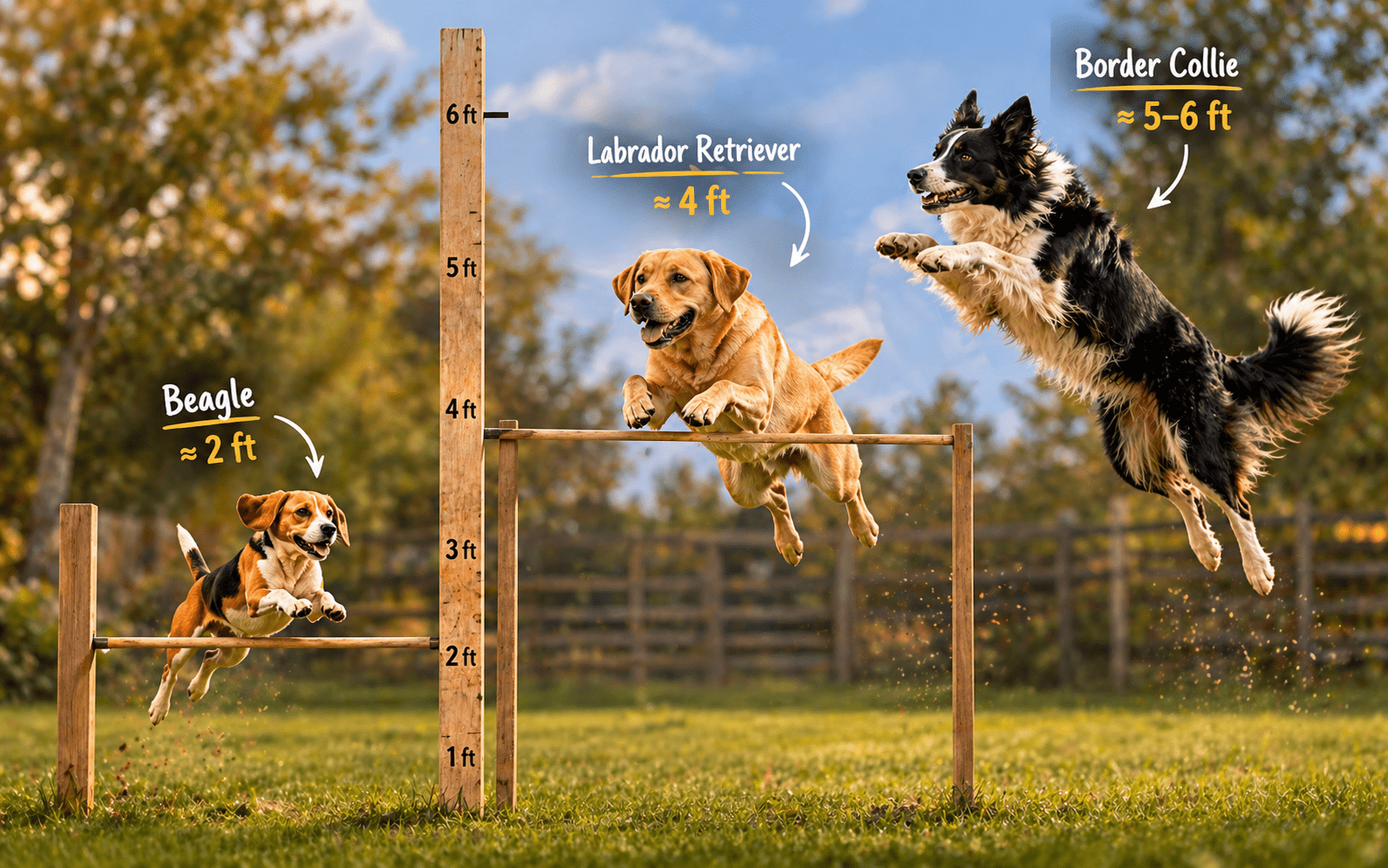
The general rule is that dogs can jump roughly 1 to 3 times their own shoulder height. For a medium-sized dog standing about 20 inches at the shoulder, that puts the realistic jump range somewhere between 3 and 5 feet under normal conditions.
Size plays the biggest role, but it is not the only factor. A dog’s rear leg and hindquarter development is the primary driver of explosive upward movement. Dogs with well-developed stifles and strong hip flexors generate significantly more jumping power than dogs of similar size but lower muscle tone.
Motivation is the other major variable. A dog that wants to reach something on the other side of a fence can often jump noticeably higher than the same dog during a relaxed play session.
| Dog Size | Weight Range | Average Jump Height |
| Small (Chihuahua, Dachshund) | Under 20 lbs | 1 to 2 feet |
| Medium (Beagle, Cocker Spaniel) | 20 to 50 lbs | 2 to 4 feet |
| Large (Labrador, Golden Retriever) | 50 to 80 lbs | 3 to 5 feet |
| Athletic/Working Breeds (Malinois, Collie) | Varies | 5 to 6+ feet |
What Affects a Dog’s Jumping Ability?
Jump height does not come from breed alone. Several factors push a dog’s ability up or down significantly.
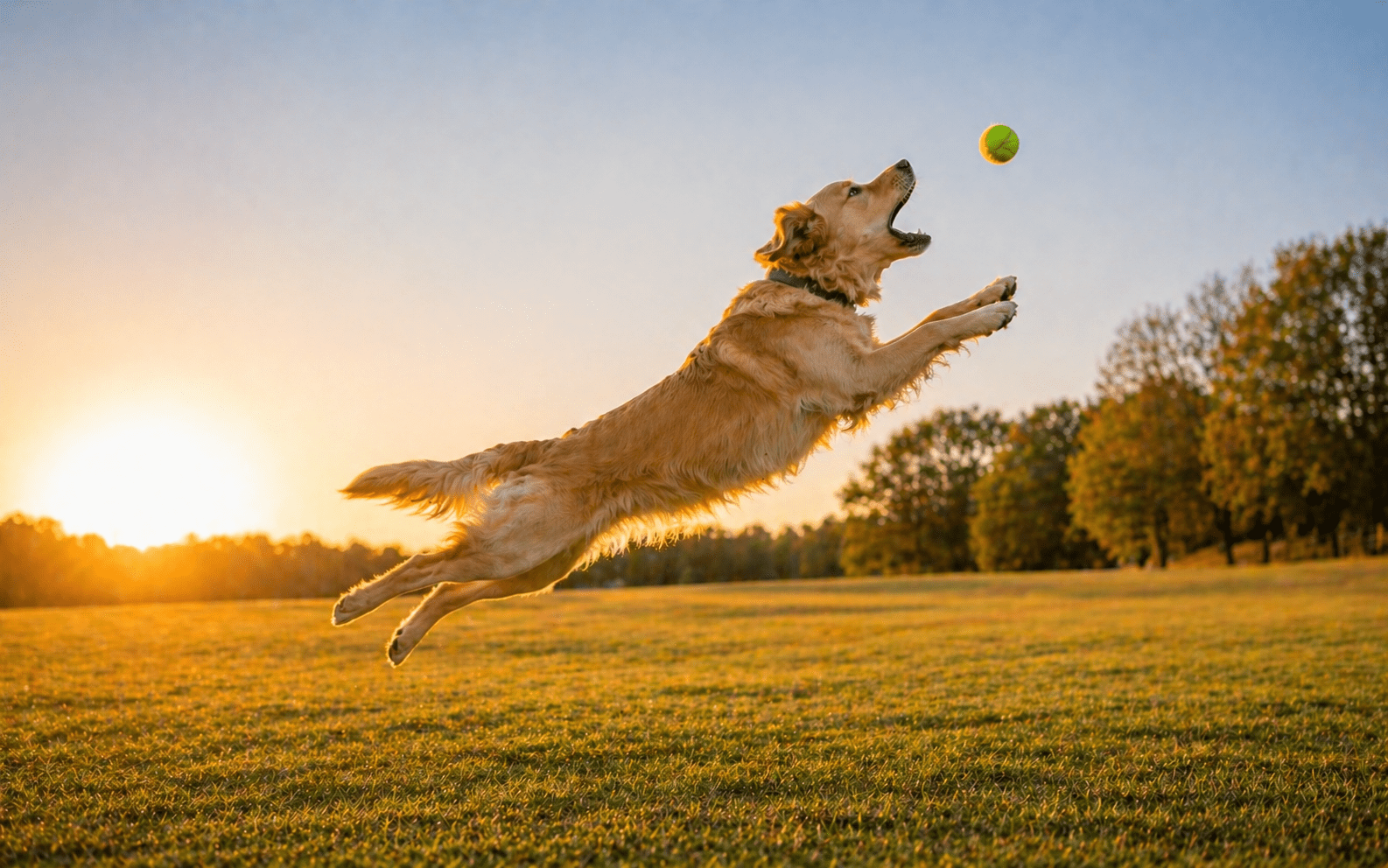
Muscle conditioning. A dog that gets regular exercise builds stronger hindquarters, which directly translates to more explosive power. This is why working or sport dogs that train consistently often clear higher heights than their breed average alone would suggest.
Body weight. Overweight dogs jump noticeably lower than fit dogs of the same breed. Extra weight reduces range of motion, strains joints, and limits the explosive energy needed for a clean launch.
Age. Young dogs in their peak physical years generally jump higher than older dogs dealing with developing joint stiffness. Puppies may also jump surprisingly high because their enthusiasm compensates for underdeveloped muscle.
Motivation. A dog chasing prey or trying to escape a yard can outperform what it shows during calm training sessions by a significant margin. Fence height decisions should always be based on worst-case motivation, not average behavior.
Surface and run-up distance. Dogs gain significantly more height from a running jump than from a standing position. A dog that can take a few strides before reaching a fence has a meaningful advantage over one jumping from a standstill.
High-drive dogs that get constructive outlets for their energy tend to redirect less of that energy toward fence-testing. Games like playing fetch with dog burn physical energy productively and keep your dog in better overall condition.
Which Breeds Jump the Highest?
Certain breeds were developed for work that demanded explosive athleticism, and their jumping ability reflects that directly.
Border Collie. Arguably the highest-jumping breed in regular settings. They are lightweight, powerful through the rear, and intensely driven. Six-foot clears are well-documented in both everyday and competition agility settings.
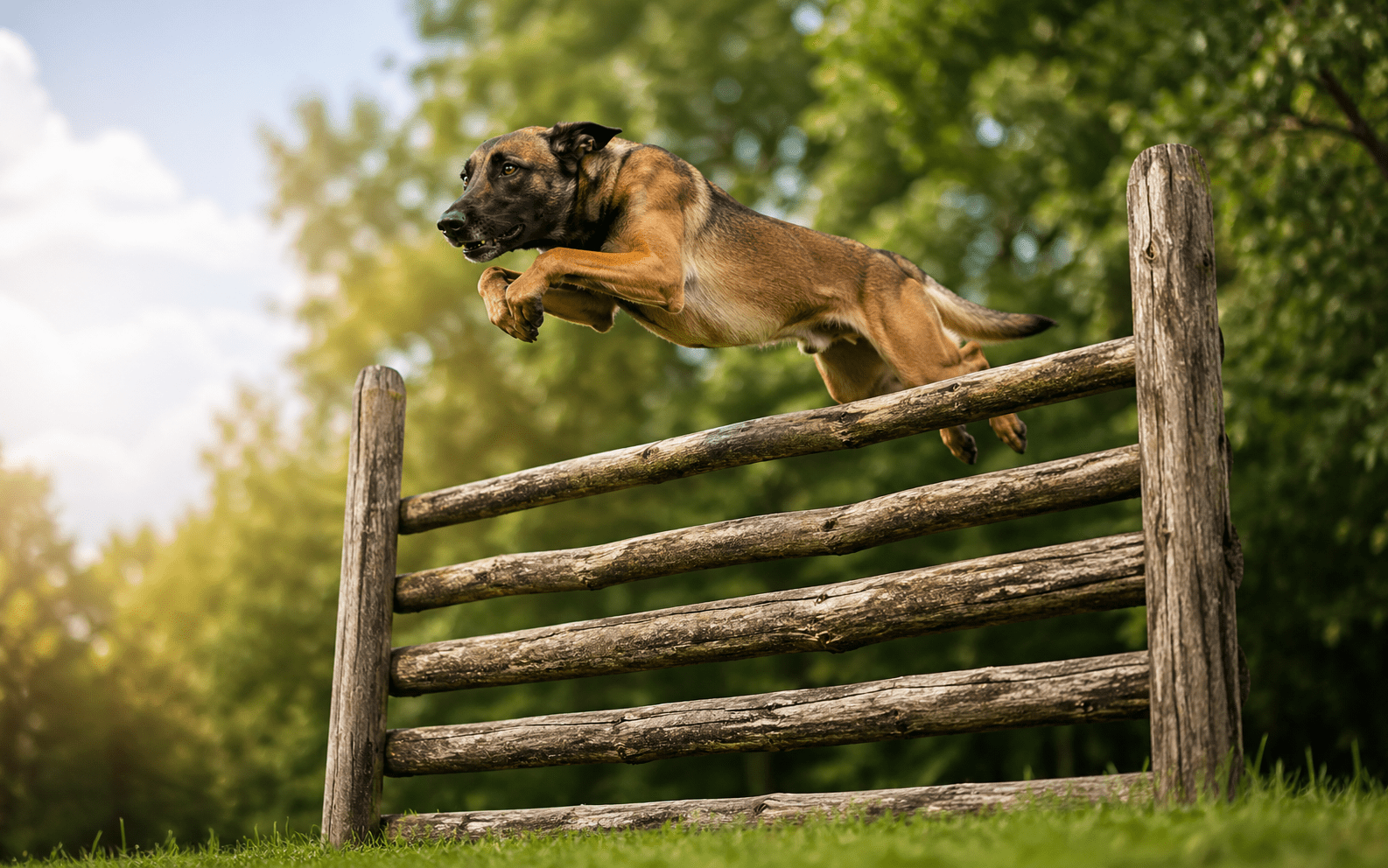
Belgian Malinois. Built for military and law enforcement work, the Malinois combines speed, drive, and raw muscle. They regularly clear 6 feet with a running start and are one of the most physically capable breeds in existence.
Jack Russell Terrier. This is the breed that proves size has almost nothing to do with jumping determination. Despite rarely exceeding 15 pounds, Jack Russells have been documented clearing heights nearly 5 times their own body measurement.

Greyhound and Whippet. These breeds rely on explosive stride mechanics and long rear legs to generate serious clearance, particularly from a running approach.
Kelpie and Australian Shepherd. Both working-dog breeds with strong hindquarters and high drive. Five-to-six-foot jumps are realistic for motivated individuals of either breed.
Can a Dog Jump Over a 6-Foot Fence?
Yes, and some dogs do it regularly. For Border Collies, Belgian Malinois, and other high-drive working breeds, a standard 6-foot privacy fence is not a guaranteed barrier.
Beyond raw height, dogs also use the fence structure itself as an aid. A dog can push off midway up the fence to gain extra height, effectively scaling rather than jumping. Some dogs combine a partial jump with digging to create an escape route from underneath.
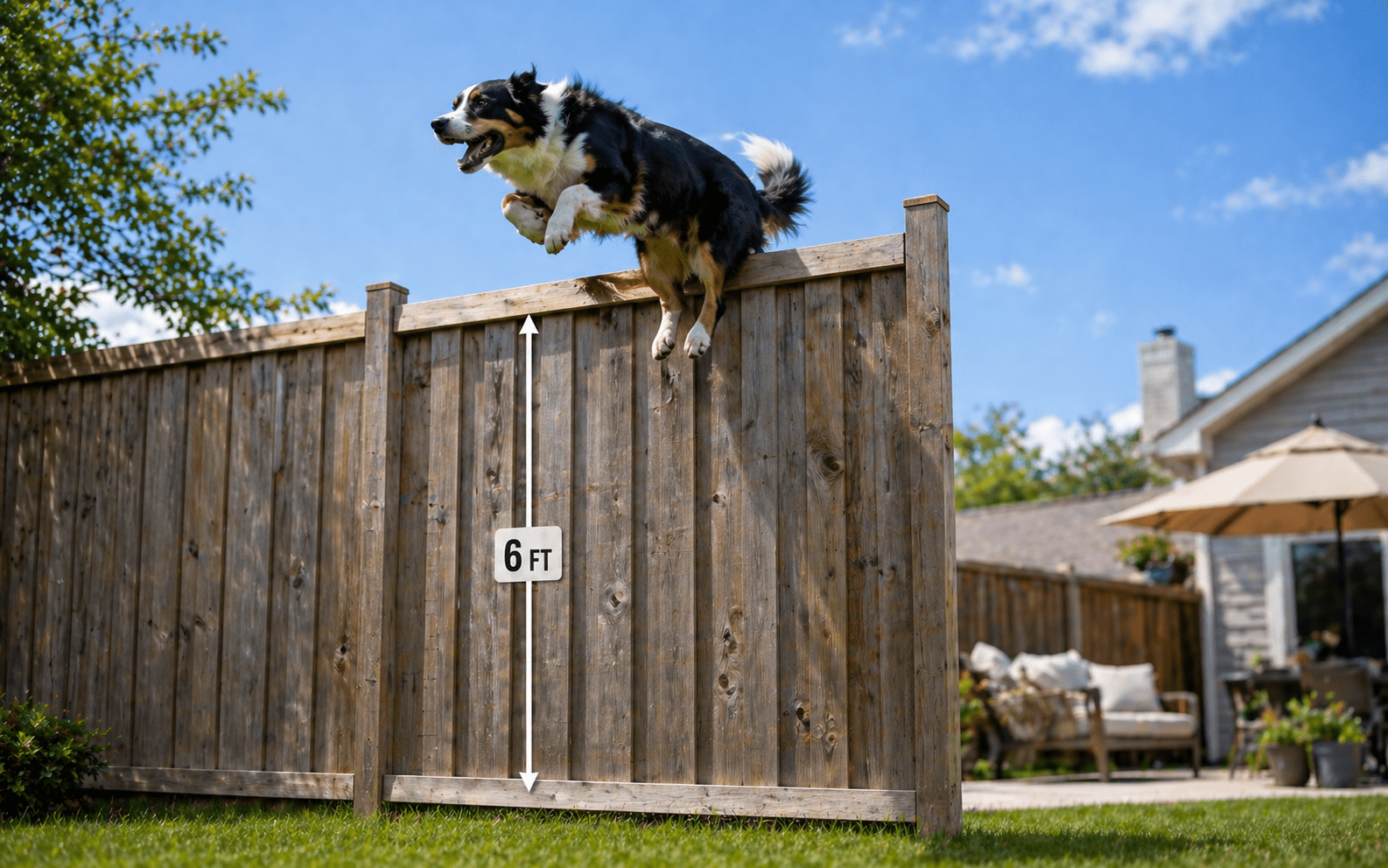
This is exactly why physical containment alone is not a complete solution. Dog jumping training Long Island addresses the behavioral side of jumping so that your dog does not even want to test the fence in the first place.
The same principle applies indoors. If your dog jumps to reach items on the counter, that is the same drive expressing itself in a different environment. Our guide on how to stop dog counter surfing covers that specific behavior in detail.
| Dog Type | Minimum Fence Height | Recommended Fence Height |
| Small breeds (Chihuahua, Shih Tzu) | 3 feet | 4 feet |
| Medium breeds (Beagle, Spaniel) | 4 feet | 5 feet |
| Large breeds (Lab, Husky, Shepherd) | 5 feet | 6 feet |
| Athletic/working breeds (Malinois, Collie) | 6 feet | 6+ feet with angled top |
Practical tip: Adding a lean-in topper or a coyote roller to the upper rail of your fence significantly reduces the advantage a dog gets from pushing off the top during an attempted escape.
How to Address Jumping Behavior Through Training
Knowing what your dog is physically capable of is step one. Consistently addressing the behavior is step two.
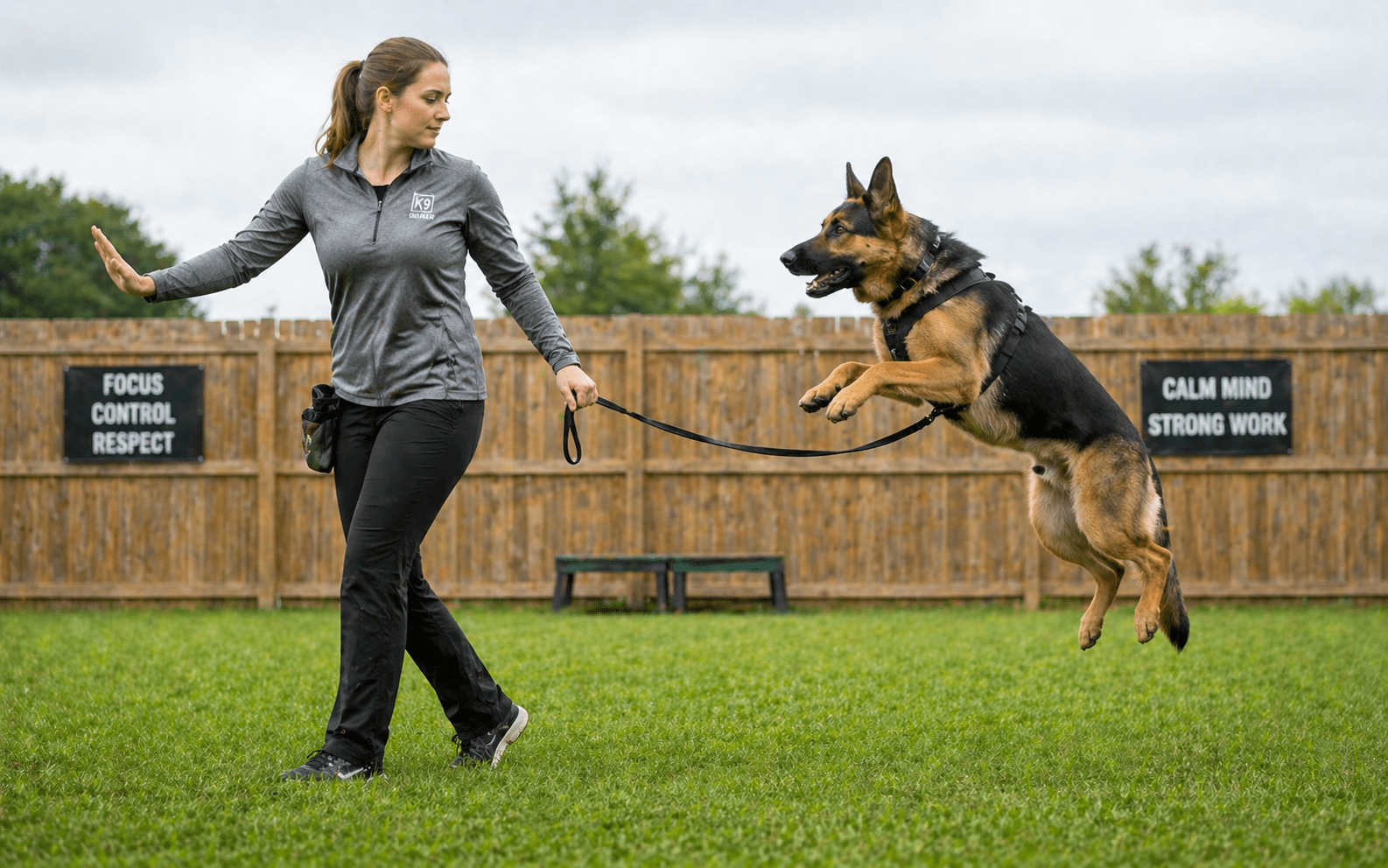
Start with the basics. Every jumping problem starts somewhere small. A puppy that jumps for attention and receives it learns quickly that jumping is effective. Removing that reward and replacing it with a clear alternative, like asking for a sit, builds a different habit over time.
Match exercise to your dog’s drive level. High-drive breeds that do not get enough physical and mental outlet often redirect that energy into jumping, fence-testing, and other frustrating behaviors. Structured physical activity makes training significantly more effective because the dog is not running on excess energy all day.
Bring in professional help when the behavior is stuck. If jumping is persistent, unpredictable, or tied to overexcitement or anxiety, a trained eye makes a real difference. In home dog training Long Island brings expert guidance directly into the environment where the behavior actually happens, which leads to faster and more lasting results.
For dogs that need a deeper level of focused work, board and train Long Island provides daily intensive training in a controlled setting. And for owners who prefer customized one-on-one attention, private dog training Long Island gives you a program built specifically around your dog’s patterns and triggers.
What You Now Know About How High Can a Dog Jump
Understanding how high can a dog jump helps you make smarter decisions about fencing, training, and your dog’s physical needs every day. Most dogs fall in the 3 to 6 foot range, but breed, conditioning, and motivation all push that number significantly higher in the right circumstances.
At K9 Mania Dog Training, Long Island’s leading board and train facility, we help owners work through every kind of jumping challenge, from fence escape behavior to excited greetings gone wrong. Our experienced trainers build customized programs that fit your dog’s drives and your household’s needs. Whatever jumping challenge your dog is throwing at you, we have the tools and the expertise to help you fix it for good. Visit K9 Mania Dog Training today and let’s get started.
You May Also Want to Read
How to Rehome an Aggressive Dog
Frequently Asked Questions About Dog Jumping
How high should a dog be able to jump?
Most healthy adult dogs should comfortably clear at least 1 to 2 times their shoulder height. For a medium-sized dog standing around 20 inches tall, that means clearing 2 to 3 feet without much strain. Dogs bred for athletic work will naturally reach higher, but body weight, joint health, and overall fitness level all affect where any individual dog lands within that range.
Can a dog jump over a 6-foot fence?
Yes, certain breeds absolutely can. High-drive working breeds like Border Collies, Belgian Malinois, and Kelpies can clear 6 feet with a running start or by pushing off the fence structure for extra leverage. For most average family dogs, a 6-foot privacy fence is a strong deterrent, but pairing it with solid behavioral training gives you the most reliable long-term result.
How high can an average dog jump?
The average dog clears somewhere between 3 and 4 feet under normal conditions. This estimate applies to typical medium-to-large breeds without specialized athletic training. A highly motivated dog, one chasing prey or trying to reach something beyond the fence, can often jump noticeably higher than that same dog during a calm play session. Individual fitness and muscle development shift this number for every dog.
What breed of dog can jump high?
Border Collies, Belgian Malinois, Jack Russell Terriers, Kelpies, Greyhounds, Whippets, and Australian Shepherds are consistently among the highest-jumping breeds. These dogs were developed for demanding physical work that required explosive rear leg drive, and that physical trait translates directly into jumping ability. Even within these breeds, individual dogs vary significantly based on conditioning and motivation level.
What is the highest a dog can jump?
The current Guinness World Record for a dog high jump belongs to a Greyhound named Feather, who cleared 75.5 inches (just over 6 feet 3 inches) in 2017. While that represents an elite individual performing in a controlled setting, it demonstrates the upper ceiling of what a well-conditioned, athletic dog is physically capable of reaching.
What Are the Highest Jumping Breeds?
The highest jumping breeds include Border Collies, Belgian Malinois, Jack Russell Terriers, Greyhounds, Whippets, Kelpies, and Australian Shepherds. These breeds share lean builds, well-developed rear quarters, and high work or prey drive that consistently pushes them to generate explosive upward movement. Proper training and structured outlets help channel that athleticism into constructive activities rather than fence-clearing attempts.