
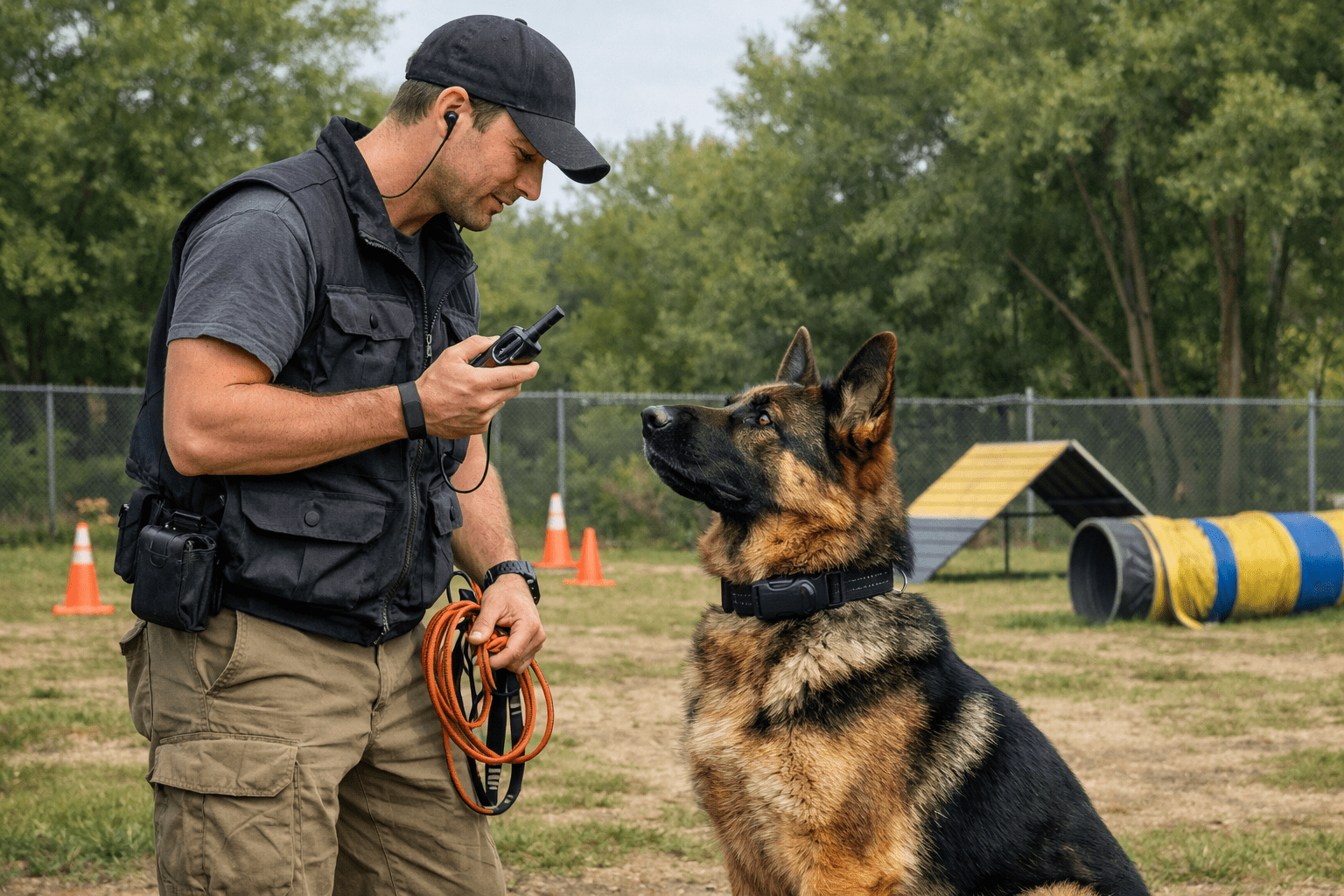
How to train a dog with a shock collar starts with understanding that these devices, properly called e-collars or electronic collars, work through gentle stimulation rather than pain when used correctly. Training with an e-collar requires proper introduction, starting at the lowest effective level, and pairing the stimulation with clear commands to create reliable off-leash obedience.
Many dog owners feel uncertain about using e-collars because of conflicting information and concerns about safety. The truth is, when introduced properly and used at appropriate levels, e-collar training can be one of the most effective tools for teaching recall, stopping unwanted behaviors, and achieving reliable off-leash freedom. This guide will walk you through every step, from choosing the right collar to advanced training techniques that get results without causing stress or fear.
Ready to learn the proven methods that professional trainers use? Keep reading to discover how to use an e-collar safely, avoid common mistakes, and build a stronger relationship with your dog through clear communication.
Master advanced training techniques with our comprehensive e-collar training course designed for lasting results.
What Is Shock Collar (E-Collar) and How Does It Work
A shock collar (e-collar), also known as an electronic collar or remote training collar, is a training tool that delivers a mild electronic stimulation to get your dog’s attention. Modern e-collars are far different from outdated shock collars, offering adjustable levels that range from a barely noticeable vibration to a stronger sensation.
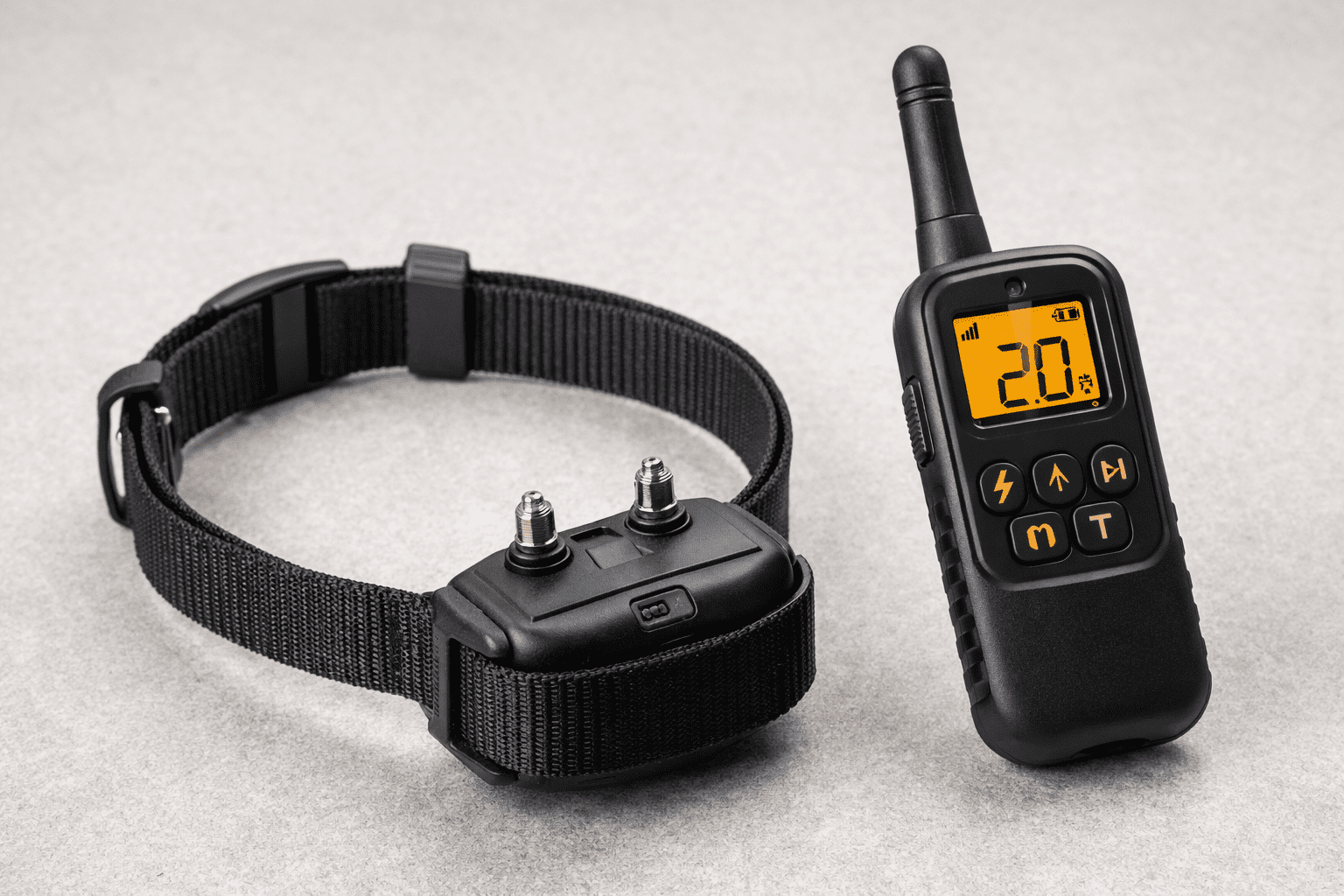
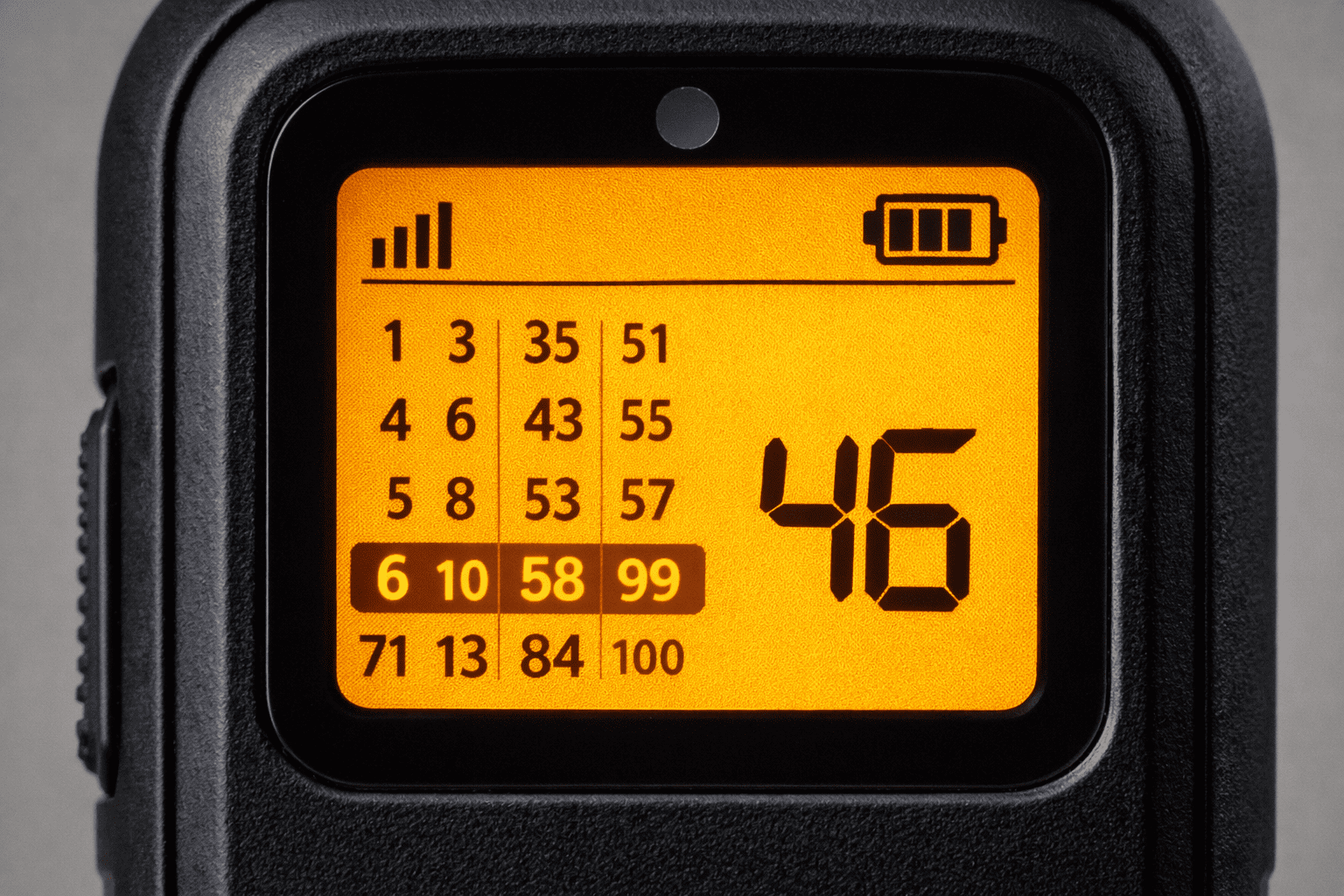
The collar works through two small contact points that touch your dog’s neck. When you press the button on the remote transmitter, it sends a signal that delivers the stimulation you’ve selected. Most quality e-collars offer 100 or more levels, allowing you to find the gentlest setting that your dog notices.
When selecting a dog e-collar for your training journey, quality matters significantly. Browse our dog e-collar collection to find devices with precise level control and safety features that support humane, effective training.
E-Collars vs Traditional Shock Collars
Older shock collars had limited settings and often delivered harsh corrections that could frighten or hurt dogs. Modern e-collars provide precise control with numerous low-level options that feel more like a tap on the shoulder than a shock.
The main differences include:
- Adjustability: Modern e-collars offer 100+ levels vs. old models with 3-5 settings
- Intensity Range: Today’s collars start at barely perceptible levels
- Features: Most include tone and vibration alongside static options
- Safety: Built-in timers prevent prolonged stimulation
Quality matters significantly. Cheap collars often lack the precision and safety features that make training effective and humane.
When to Use Shock Collar (E-Collar) for Dog Training
E-collar training works best for specific behavioral challenges and training goals. Understanding when this tool is appropriate helps you decide if it fits your training plan.
Best Training Scenarios for E-Collar Use
E-collars excel at teaching reliable recall, especially for dogs with high prey drive who ignore verbal commands when chasing wildlife. They create consistent communication at distances where your voice might not reach or when your dog is highly distracted.
Common situations where e-collars prove effective:
- Off-leash reliability: Teaching your dog to come when called regardless of distractions
- Boundary training: Keeping dogs within property lines without physical fences
- Stopping unwanted behaviors: Addressing jumping, excessive barking, or chasing
- Distance training: Communicating with hunting or sporting dogs at long ranges
- Reinforcing commands: Strengthening obedience when other methods have plateaued
For comprehensive training support, consider our board and train Long Island program where professional trainers introduce e-collar work safely.
Dogs That Benefit Most from E-Collar Training
Not every dog needs an e-collar, but certain temperaments and situations benefit greatly from this tool. High-energy breeds like German Shepherds, Belgian Malinois, and sporting breeds often respond exceptionally well to the clear communication e-collars provide.
Dogs with strong prey drive, those who have failed with traditional training methods, or dogs needing reliable off-leash skills are prime candidates. Stubborn or independent breeds sometimes need the added layer of communication that e-collars offer.
However, fearful, anxious, or aggressive dogs require extra caution. These dogs often need professional guidance to ensure e-collar training doesn’t worsen existing issues.
Looking for expert guidance? Explore our private dog training Long Island sessions for personalized e-collar introduction.
How to Train a Dog with a Shock Collar: Step-by-Step Process
Proper e-collar training follows a specific progression that builds your dog’s understanding while maintaining trust. Rushing this process or skipping steps often leads to confusion or fear.
Preparing Your Dog and Equipment
Before your first training session, ensure your e-collar fits correctly. The contact points should touch your dog’s skin without being too tight. You should be able to fit two fingers between the collar and your dog’s neck.
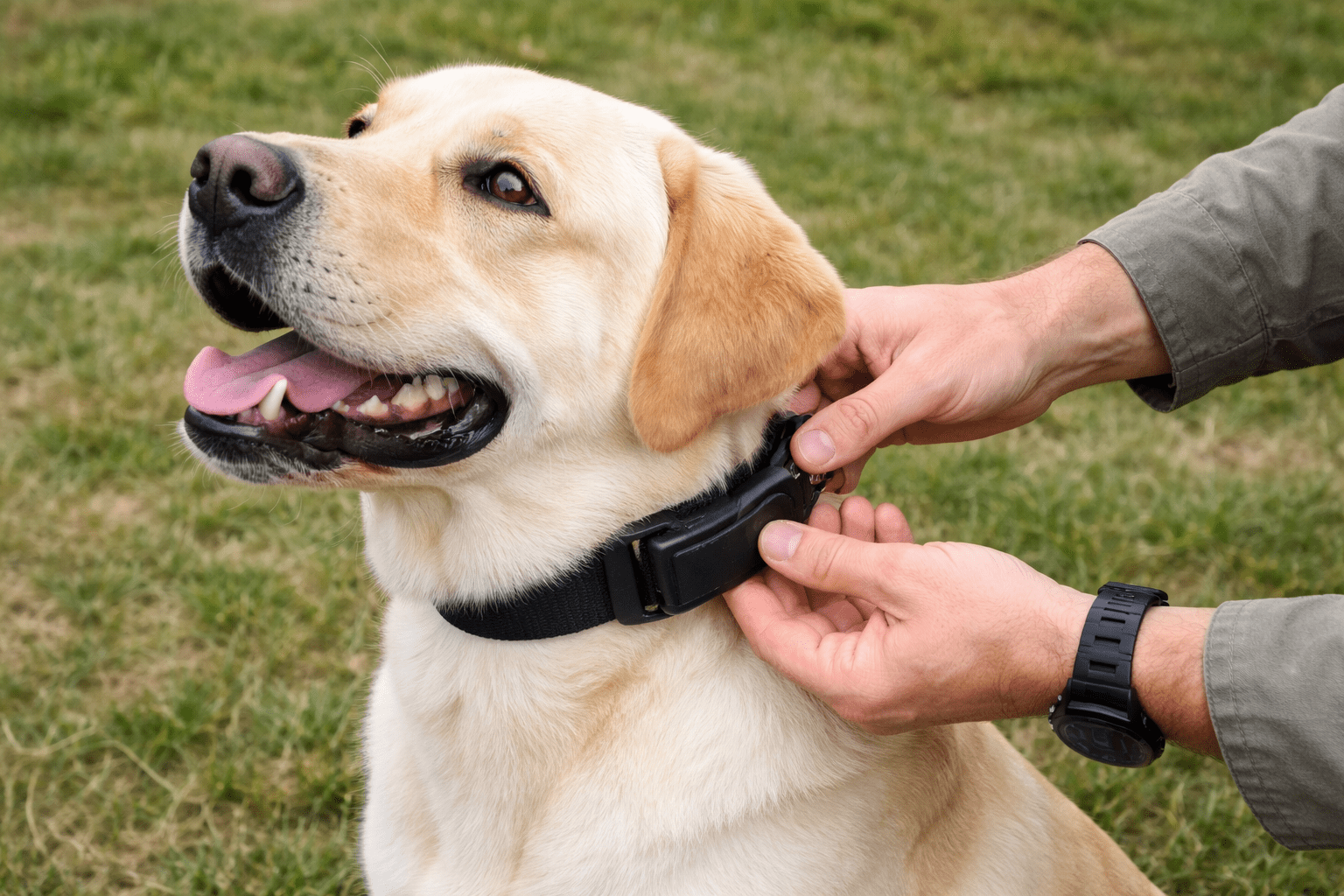
Charge the collar fully and familiarize yourself with the remote. Practice finding buttons without looking so you can keep your eyes on your dog during training. Test the collar on yourself at low levels to understand what your dog will feel.
Start by letting your dog wear the collar during positive activities like meals and playtime for 2-3 days without ever using it. This prevents the dog from associating the collar with corrections.
Finding Your Dog’s Working Level
Set the collar to the lowest level (usually 1 or 0). With your dog standing calmly, press and hold the continuous stimulation button while watching for any reaction. Slowly increase the level one number at a time until you see a subtle response.
Signs your dog notices the stimulation:
- Slight ear twitch or head turn
- Brief pause in movement
- Momentary change in facial expression
- Looking around curiously
The goal is NOT to see your dog yelp, jump, or show distress. If this happens, the level is far too high. Most dogs have a working level between 10-30 on a 100-level collar, though this varies widely.
Introducing the E-Collar Properly
Begin with commands your dog already knows well. Start with “sit” since it’s typically the most solid command. Say “sit” once in a normal tone, then immediately apply continuous stimulation at the working level. The moment your dog’s bottom touches the ground, release the button and give immediate praise and a treat.
The timing is everything. The stimulation acts as gentle pressure that releases the instant your dog complies. This teaches your dog that the stimulation stops when they perform the behavior, creating clear communication.
Practice this pattern with several known commands over multiple sessions before introducing anything new. This builds the foundation that stimulation means “do what I asked” and compliance makes it stop.
| Training Phase | Duration | Focus | Key Actions |
| Collar Conditioning | 2-3 days | Positive association | Let dog wear collar during fun activities, no stimulation |
| Working Level Testing | 1 session | Find appropriate intensity | Start at level 1, increase slowly until subtle response |
| Command Pairing | 1-2 weeks | Link known commands | Apply stimulation, release upon compliance, reward immediately |
| Distraction Training | 2-4 weeks | Build reliability | Practice in varied environments with increasing distractions |
E-Collar Training Techniques for Specific Behaviors
Different behavioral issues require slightly different approaches with the e-collar. Understanding these variations helps you address your dog’s specific challenges effectively.
Stopping Unwanted Behaviors
For jumping, barking, or chasing, use the e-collar as an interrupter. Apply brief stimulation the moment the behavior starts.
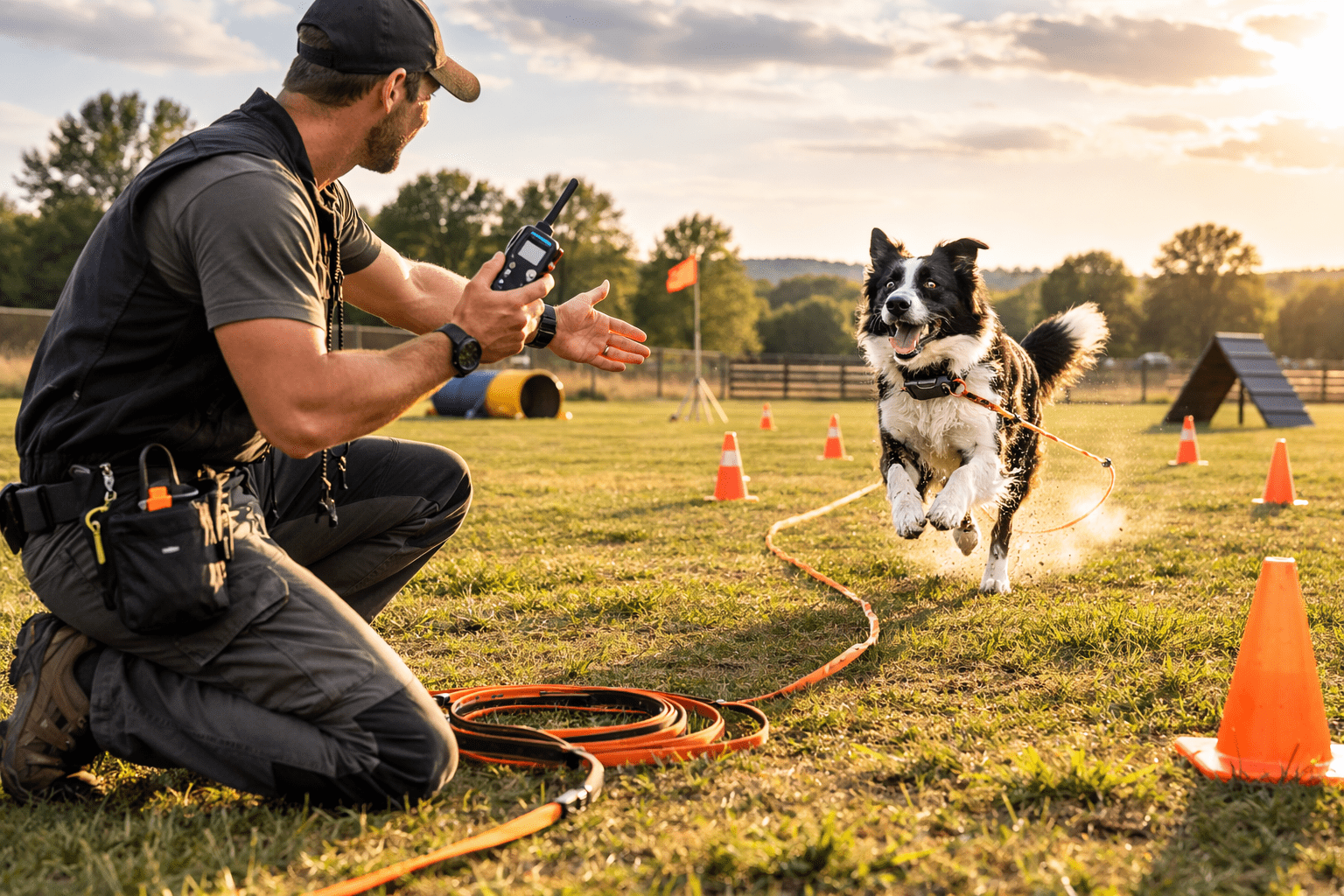
When your dog stops, release immediately and redirect to the correct action. Example: stop jumping → ask for “sit” → reward.
This teaches the alternative behavior, not just suppression.
Stay consistent. Every instance needs the same response, or the behavior becomes a gamble.
Boundary and Containment Training
Boundary training builds respect for limits without fencing. Use clear visual markers like flags.
Walk your dog on leash along the boundary, giving a warning cue near markers. If they push forward, apply stimulation and guide them back. Release once they retreat.
After repetition, test off-leash in a controlled area. Most dogs respond to the warning alone once they understand.
Common E-Collar Training Mistakes to Avoid
Even experienced dog owners make errors when learning how to train a dog with a shock collar. Recognizing these mistakes helps you avoid setbacks and keep your dog’s trust intact.
Using the Wrong Stimulation Level
Setting the level too high is the most common mistake. Your dog should never yelp, cower, or show fear. That means the stimulation is too intense and harms both training and trust.
Too low is also a problem. If your dog doesn’t feel it, they can’t link it to their behavior. The right working level takes patience and careful observation.
Poor Timing and Inconsistent Application
Corrections must happen within 1–2 seconds. Late stimulation confuses your dog and may create anxiety.
Inconsistency weakens results. If you correct a behavior sometimes but ignore it other times, your dog learns to gamble. Consistent responses create clear understanding.
Skipping Foundation Training
An e-collar should reinforce known commands, not replace teaching.
If your dog doesn’t understand the cue, collar pressure only adds stress. Always build solid obedience first, then layer the collar for clarity and reliability.
Discover proven training methods in our guide on effective ways to train your dog that complement e-collar work.
Shock Collar (E-Collar) Training Safety and Best Practices
Responsible e-collar use requires attention to safety details that protect your dog’s physical and emotional wellbeing. Following these guidelines ensures training remains effective and humane.
Proper Fit and Wear Time
Place the collar high on the neck, just behind the ears. This area is more sensitive, allowing lower levels and better contact.
Do not leave it on longer than 12 hours per day. Rotate slightly during use and remove when not training.
Check your dog’s neck daily for redness, irritation, or sores. Pause use if any skin issues appear.
Pairing E-Collar with Positive Reinforcement
Training should stay balanced, not correction-only. The collar provides clarity, while rewards build motivation and trust.
Praise, treats, or toys should follow correct responses immediately.
The goal is confidence and understanding, so your dog sees the collar as communication, not punishment.
| Safety Element | Guideline | Why It Matters |
| Daily Wear Limit | Maximum 12 hours | Prevents skin irritation and pressure sores |
| Collar Placement | High on neck, behind ears | Ensures better contact and lower levels needed |
| Skin Checks | Inspect daily during training | Catches irritation before it becomes serious |
| Reward Ratio | 3-4 rewards per 1 correction | Maintains positive association and motivation |
| Rest Days | 1-2 days off per week minimum | Prevents collar dependency and skin issues |
Recognizing Signs of Stress or Fear
Watch your dog’s body language carefully during e-collar training. Healthy training produces focused, engaged dogs who respond quickly and then relax. Signs that something is wrong include:
- Cowering, tucking tail, or trying to hide
- Excessive panting or drooling
- Refusal to move or shutting down
- Aggression toward you or the collar
- Reluctance to approach you during training
If you see these behaviors, stop immediately and reassess. Your level may be too high, your timing may be off, or your dog may need more foundation work before using the collar. Consider working with a professional trainer who can evaluate your technique.
Progressing from E-Collar Training to Off-Leash Freedom
The ultimate goal of e-collar training is creating a dog who responds reliably even without the collar. This progression takes time and careful planning.

Testing Reliability in Various Environments
Before trusting true off-leash reliability, test gradually. Start in your backyard, then quiet parks, busier areas, trails, and finally high-distraction locations.
Your dog should show consistent compliance for multiple sessions before advancing. If performance slips, step back to an easier setting and rebuild.
Use a long line during this phase for safety. Remove it only when recall is dependable in that specific environment.
Weaning Off the E-Collar Gradually
After several weeks of perfect responses, begin occasional sessions without the collar. Start easy.
If reliability drops, resume collar use and try again later. Some dogs transition quickly, others need periodic reminder sessions.
Many owners keep the e-collar as a backup for higher-risk situations, adding safety without creating dependence.
Learn about different training approaches in our article on how to choose the right training program for your dog’s needs.
Choosing the Right E-Collar for Your Dog
Not all e-collars offer the same quality or features. Selecting appropriate equipment impacts your training success significantly.
Essential Features to Look For
Quality e-collars should offer at least 100 adjustable levels to ensure you can find the perfect working level for your dog. Look for models with a range of at least 400 yards, waterproof design, and long battery life.
Additional helpful features include:
- Vibration and tone options for layered communication
- Rechargeable batteries to avoid constant replacements
- Clear LCD screen showing current level and battery status
- Multiple dog capability if you train more than one dog
- Safety lock to prevent accidental level changes
Reputable brands typically cost between $150-$300 and include warranties and customer support. Cheap collars often fail quickly, lack precision, or deliver inconsistent stimulation that confuses dogs.
Sizing for Different Breeds
Small dogs (under 15 pounds) need collars specifically designed for their size with appropriately sized contact points and gentler stimulation ranges. Standard collars can be overwhelming and uncomfortable for toy breeds.
Medium to large dogs (15-100+ pounds) can use most standard e-collars, though very large or thick-coated breeds may need longer contact points to reach the skin properly. Some manufacturers offer extra-long prongs for dogs with dense double coats.
Understand the benefits of professional training through our article on the effectiveness of board and train programs.
Final Thoughts on E-Collar Dog Training Success
Learning how to train a dog with a shock collar effectively requires patience, proper technique, and a commitment to your dog’s wellbeing. When introduced correctly at appropriate levels, e-collars provide clear communication that helps dogs understand expectations and earn off-leash freedom safely.
The key to success lies in starting slowly, maintaining consistency, and balancing corrections with generous rewards. Dogs trained with this approach typically show confidence, responsiveness, and strong bonds with their owners. Remember that the collar is simply a tool for communication, not a substitute for relationship-building, exercise, or mental stimulation.
At K9 Mania Dog Training, we specialize in helping Long Island dog owners master e-collar techniques and achieve remarkable transformations. Our experienced trainers can guide you through proper introduction, troubleshoot challenges, and create customized training plans for your dog’s specific needs. Visit us to discover how professional support can accelerate your training progress and build the reliable, well-behaved companion you’ve always wanted.
You May Also Want to Read
- Why Do Dogs Run Away? Understanding the Causes and Prevention
- How to Stop a Dog from Chewing Furniture
- How to Train a Hyperactive Dog
- Playing Tug of War With Dog: Complete Guide for Safe & Fun Play
Frequently Asked Questions
What is the hardest command to teach a dog?
The hardest command to teach most dogs is a reliable recall in high-distraction environments, especially for dogs with strong prey drive. “Stay” with duration and distance also challenges many dogs because it requires impulse control against their natural desire to follow their owner or investigate interesting things.
Do vets recommend vibration collars?
Most veterinarians prefer vibration-only collars over static stimulation for basic training needs, particularly for dogs with anxiety or fear issues. However, many vets acknowledge that properly used e-collars with multiple functions, including vibration, can be effective when traditional methods fail.
Is a vibration collar better than a shock collar?
Vibration collars work well for getting attention or marking behaviors but lack the nuanced communication levels that modern e-collars provide. For serious behavior modification or reliable off-leash training, e-collars with adjustable static stimulation typically prove more effective because dogs can distinguish between levels more clearly.
What is an alternative to a shock collar for dogs?
Alternatives include positive reinforcement training with clickers and treats, long-line training for recall work, head halters for walking control, and professional board and train programs that use balanced methods. The best alternative depends on your specific training goals and your dog’s temperament.
How long can you leave a shock collar on a dog?
E-collars should never be left on for more than 12 hours per day to prevent skin irritation. During active training, remove the collar every 2-3 hours, rotate it slightly to change contact point position, and check your dog’s neck for any signs of pressure or irritation.
What is a cool trick to teach your dog?
“Touch” or target training is a useful and fun trick where your dog learns to touch their nose to your hand, a target stick, or other objects on command. This foundation skill can be shaped into dozens of other behaviors and makes training feel like a game your dog enjoys.