
Key Takeaways
- Start crate training slowly with short sessions before expecting your puppy to sleep through the night inside.
- The crate should feel like a reward, not a punishment — never use it as a consequence for bad behavior.
- Puppies under 12 weeks can only hold their bladder for about one to two hours, so overnight expectations need to be realistic.
- Whining in the first few nights is normal; how you respond shapes the habit that follows.
- Consistency between all household members is the single most important factor in how fast your puppy adjusts.
- If your puppy’s anxiety around the crate seems severe, working with a professional trainer early saves weeks of frustration.
Bringing home a new puppy is exciting and exhausting in equal measure. The crate often becomes a flashpoint — the puppy cries, you feel guilty, and the whole process starts to feel cruel. But that reaction usually comes from moving too fast, not from the crate itself. This article walks you through the right approach: what age to start, how to structure sessions, what mistakes to avoid, and how to read your puppy’s behavior honestly.
Why the Crate Is Not a Cage (And Why That Distinction Matters)
The biggest mental block most new puppy owners face is the guilt of confining their dog. It helps to understand what dogs actually are: den animals. In the wild, canines seek out enclosed spaces for rest and security. A properly introduced crate satisfies that instinct rather than fighting it.
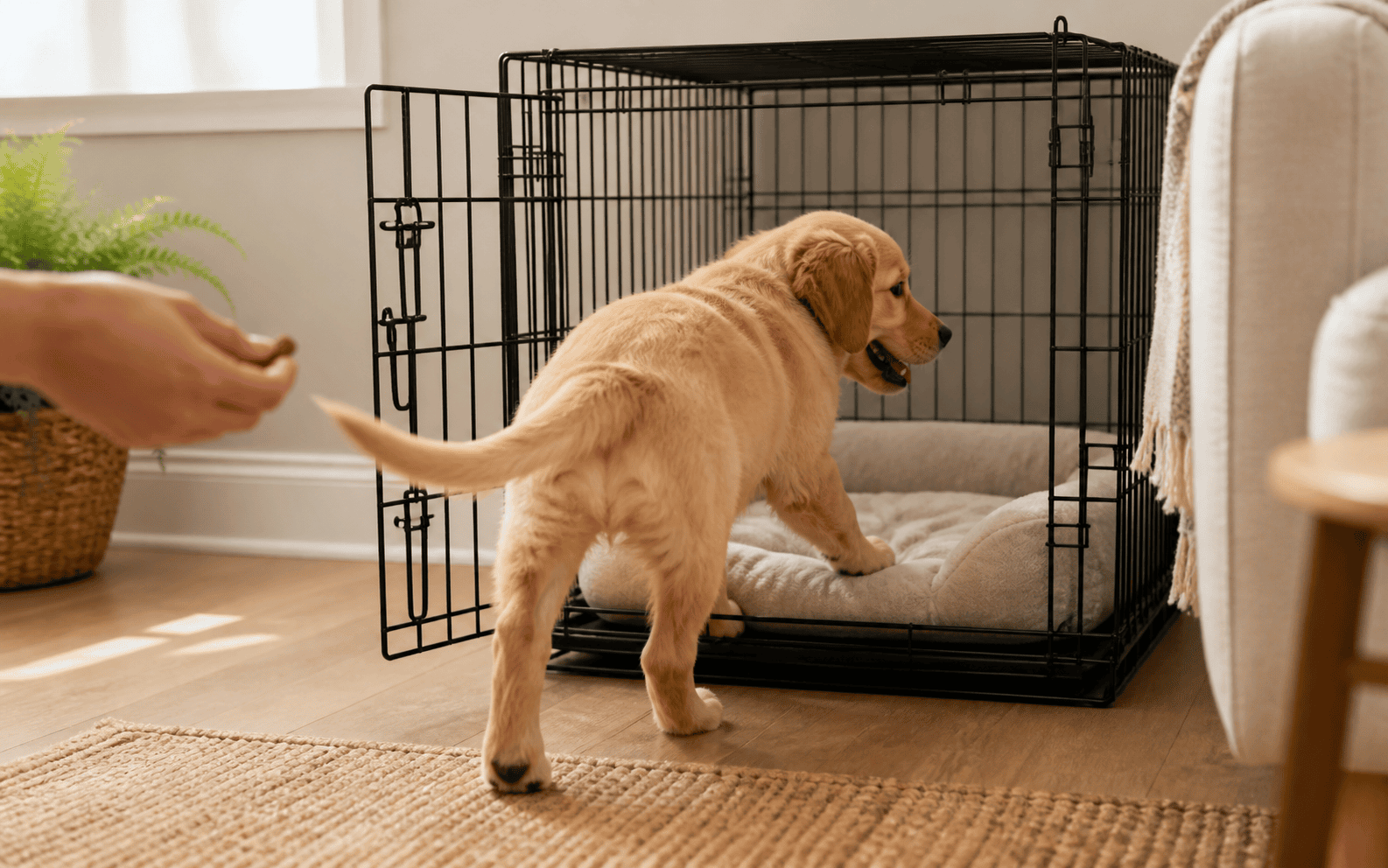
The key phrase is “properly introduced.” A puppy thrown into a crate on night one with the door locked will panic. A puppy guided into a crate over several days, with treats, meals, and calm reinforcement, begins to see it as their spot.
This distinction matters practically because it changes how you measure progress. You are not trying to get your puppy to tolerate the crate. You are trying to get your puppy to want to be in it. Those are very different goals, and they require very different timelines.
If you are working with an older rescue rather than a young puppy, the same principles apply but the timeline often differs, and reading up on how to crate train an adult dog before you begin will help you calibrate your expectations appropriately.
Choosing the Right Crate Size and Type
Before you even bring your puppy home, the crate setup matters. Too large a crate is one of the most common early mistakes. Dogs instinctively avoid soiling their sleeping area, but if the crate has enough room to sleep in one corner and eliminate in another, that instinct does not kick in.
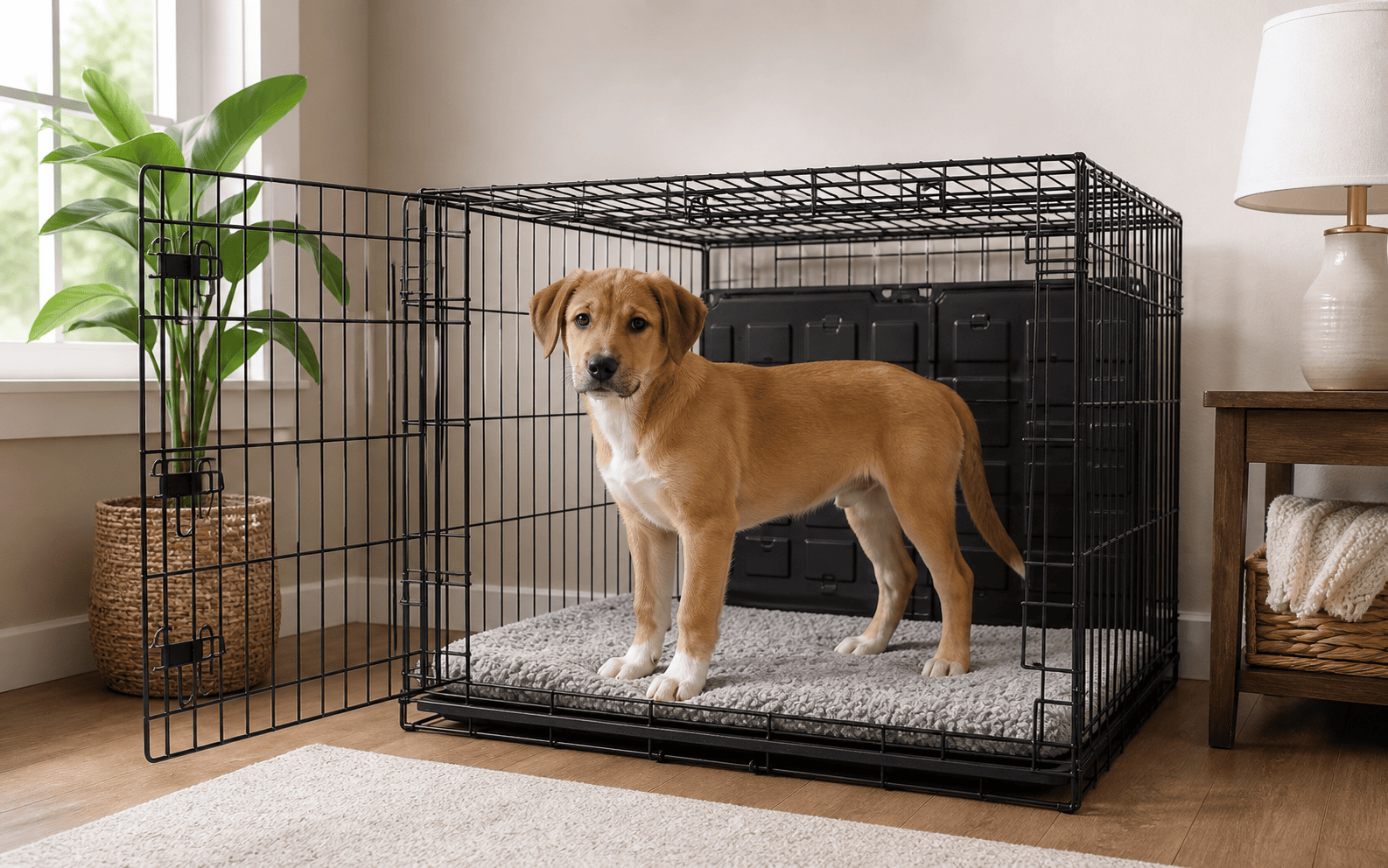
General sizing rule: Your puppy should be able to stand up, turn around, and lie flat. That is it. If you have a breed that will grow significantly, buy a crate with a divider panel so you can expand the space as your puppy grows without buying a new crate every few months.
Crate types at a glance:
Crate Type | Best For | Trade-Off |
Wire crate with divider | Most puppies; adjustable size | Foldable but visually busy |
Plastic airline crate | Dogs who prefer enclosed spaces | Less airflow in warm climates |
Soft-sided crate | Travel or calm adult dogs | Not chew-proof for young puppies |
Heavy-duty steel crate | Escape artists or anxious dogs | Expensive; significant weight |
For most American households with a young puppy, a wire crate with a divider is the practical starting point, and it is easy to clean, adjustable, and gives you visibility into how your puppy is settling.
The First Week: Building the Association Step by Step
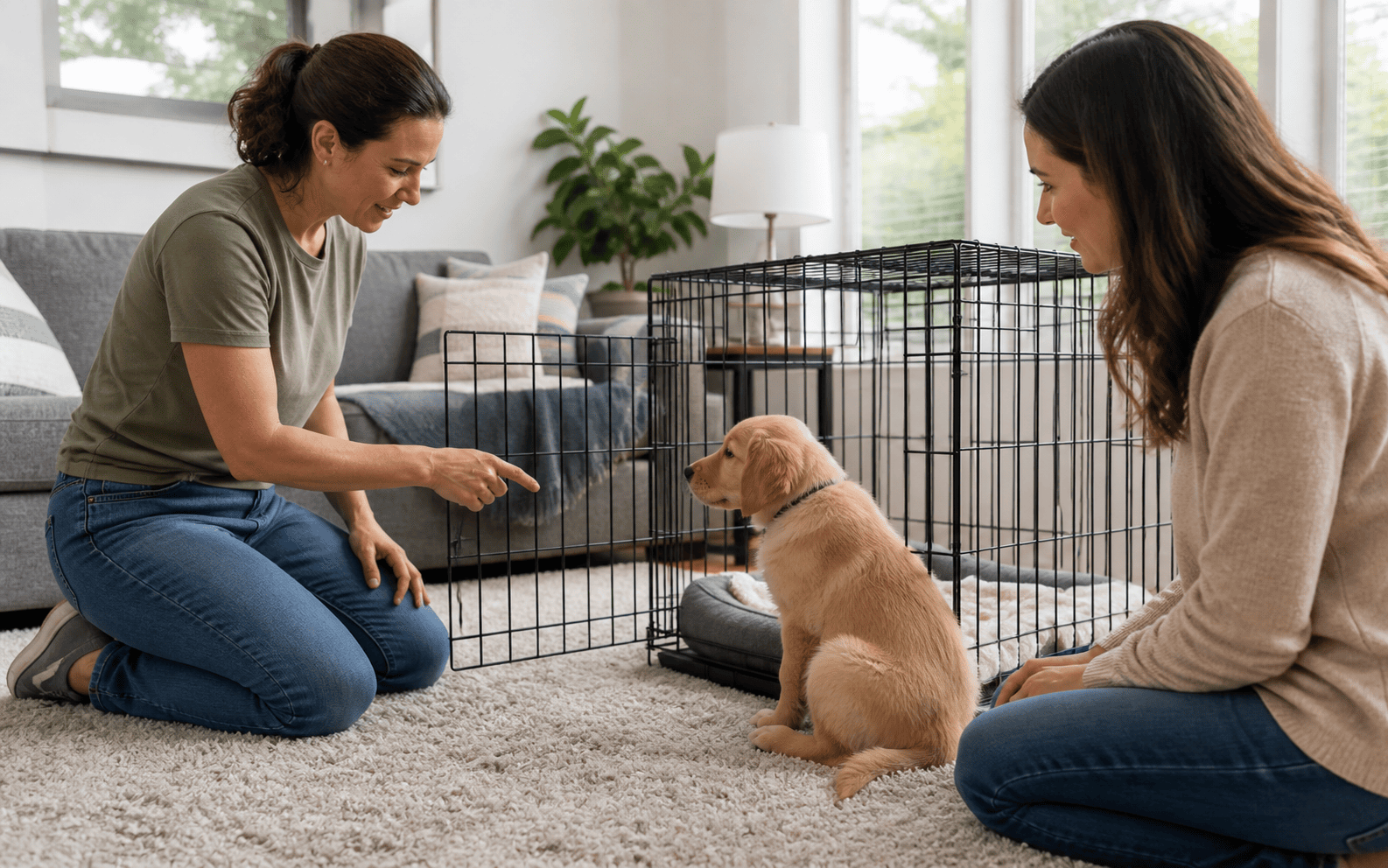
The first week of crate training your puppy is entirely about association building. You are not trying to achieve long confinement periods yet. You are building the neural link between “crate” and “good things happen.”
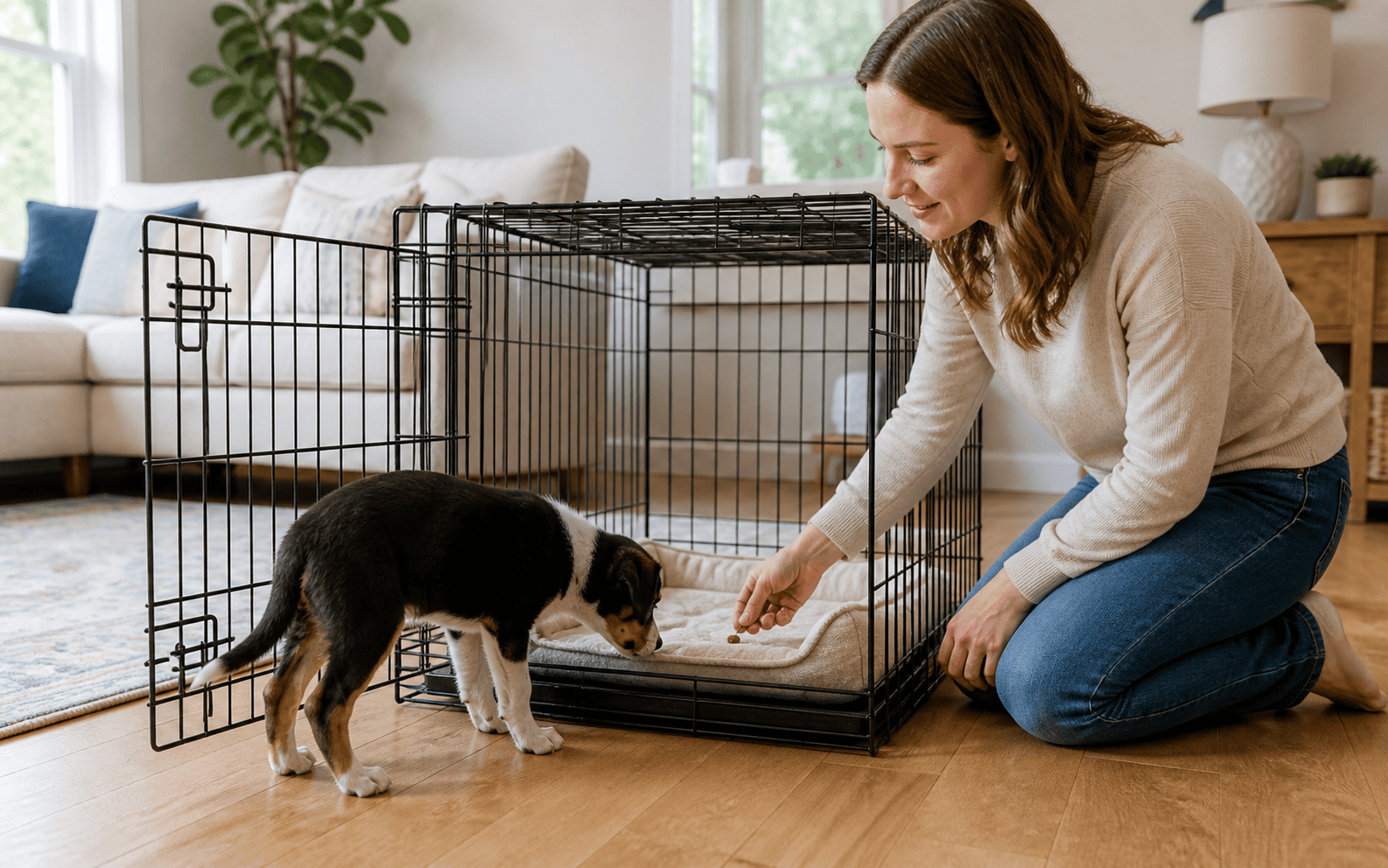
Day one through three:
- Place the crate in a common area, not a back bedroom.
- Leave the door open and let your puppy explore freely.
- Toss high-value treats inside several times throughout the day without closing the door.
- Feed one meal inside the crate, still with the door open.
Day four through seven:
- Begin closing the door for one to two minutes after your puppy finishes eating inside.
- Sit nearby and speak calmly if your puppy whines. Do not open the door during the whine. Wait for a two-to-three second quiet moment before releasing.
- Gradually extend closed-door time to five, then ten, then fifteen minutes.
This is also a good time to review the best ways to train a puppy so that crate work is layered into a broader, consistent training approach from the start.
Overnight Crate Training: Managing the First Few Nights
The first night is usually the hardest. Your puppy has just left their littermates, is in a completely new environment, and cannot understand why they are alone. Some crying is completely normal and does not mean you are doing something wrong.
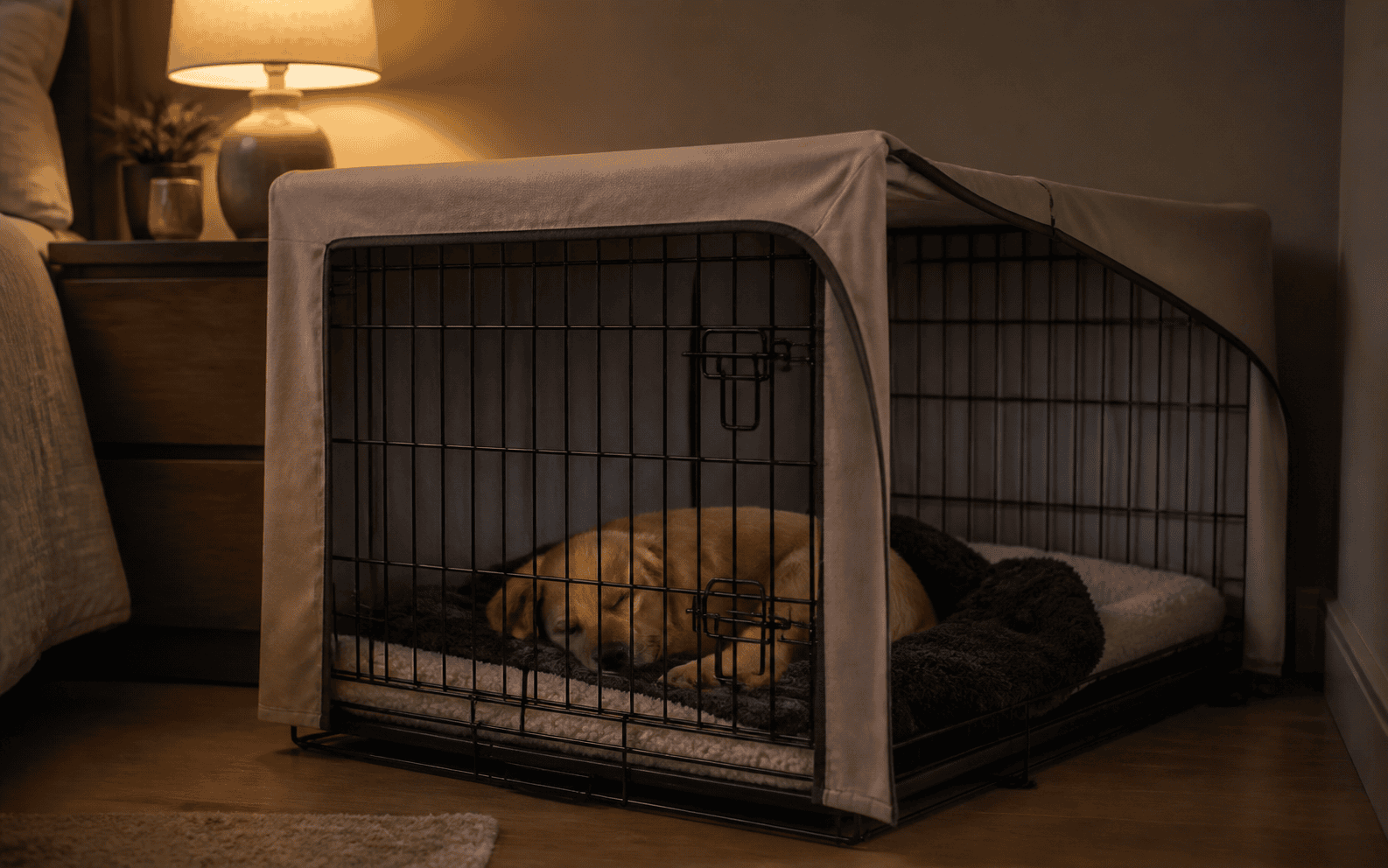
Practical steps that help:
- Place the crate in your bedroom or directly beside your bed for the first week. Proximity reduces panic.
- Put a worn t-shirt or blanket with a familiar scent inside.
- Avoid giving water in the two hours before bedtime to reduce overnight accident risk.
- Set an alarm to take your puppy out once or twice overnight during the first few weeks. Puppies under twelve weeks cannot reliably hold their bladder for more than a couple of hours.
One area that trips up many owners: responding to potty needs versus attention-seeking. If your puppy cries in the middle of the night and you take them outside, relieve them, and return them directly to the crate with minimal interaction, that is appropriate. If you bring them into your bed, you have just taught them that crying gets a bed upgrade.
Accidents inside the crate are sometimes a sign that the crate is too large, the puppy was left too long, or that puppy potty training regression is occurring due to stress or inconsistency. Identifying which of those is the cause changes your solution.
The Emotional Side: Separation Anxiety vs. Normal Protest
There is a meaningful difference between a puppy who cries for ten minutes and settles, and a puppy who escalates for an hour, drools excessively, scratches frantically, and does not calm down. The first is normal protest behavior. The second is closer to genuine separation anxiety.
Signs your puppy may be experiencing anxiety beyond normal adjustment:
- Crying that escalates rather than diminishes over thirty or more minutes
- Physical symptoms: drooling, panting, trembling inside the crate
- Complete refusal to take high-value food inside the crate
- Attempts to escape that leave marks on the wire or plastic
If these signs appear consistently after two weeks of patient, gradual introduction, the issue is not a training failure — it is a behavioral pattern that needs specific intervention, and understanding crate training a dog with separation anxiety will give you a more targeted roadmap for that scenario.
Common Mistakes That Slow Down the Process
Even well-intentioned owners make errors that add weeks to the process. Here are the most frequent ones:
- Moving too fast. Trying to achieve an eight-hour overnight on night three is a setup for failure and panic.
- Using the crate as punishment. The moment your puppy connects the crate with being in trouble, the association you have been building is damaged.
- Inconsistency between family members. If one person lets the puppy out every time it cries, that person undoes the training of everyone else in the house.
- Crate that is too large. As mentioned earlier, this undermines the housebreaking benefit entirely.
- Covering the crate incorrectly. A cover can help some puppies feel more secure, but covering all four sides can also trap heat, especially in a warmer home during summer months. Leave one side open.
- Quitting too early. Most puppies adjust to their crate within two to three weeks of consistent work. Many owners give up at day five.
When to Bring in Professional Help
Not every puppy adjusts easily, and not every owner has the time or bandwidth to work through every setback alone. If you have been consistent for three weeks and your puppy is still showing significant distress, or if you have a puppy with particular behavioral challenges layered on top of crate resistance, a professional trainer makes a real difference.
For families on Long Island, puppy training long island is a practical next step if you want structured guidance tailored to your specific dog and home environment. A trainer can assess your puppy’s temperament directly and adjust the approach in ways that a general article cannot.
Alternatively, if you want the training to happen without coordinating your entire schedule around it, in home dog training long island brings professional hands-on support directly into the space where your puppy actually lives and sleeps. Training in the actual environment matters: a puppy who learns crate behavior in your home generalizes that behavior much more reliably than one trained elsewhere.
How to Know Your Puppy Has Actually Accepted the Crate
Progress markers are not dramatic. They are quiet and easy to miss if you are not looking for them:
- Your puppy walks into the crate on their own without being directed.
- Your puppy settles and stops vocalizing within five minutes of the door being closed.
- Your puppy uses the crate voluntarily during the day even when the door is open.
- Overnight crying has reduced to zero or near zero.
- Your puppy eats calmly inside the crate without rushing to exit.
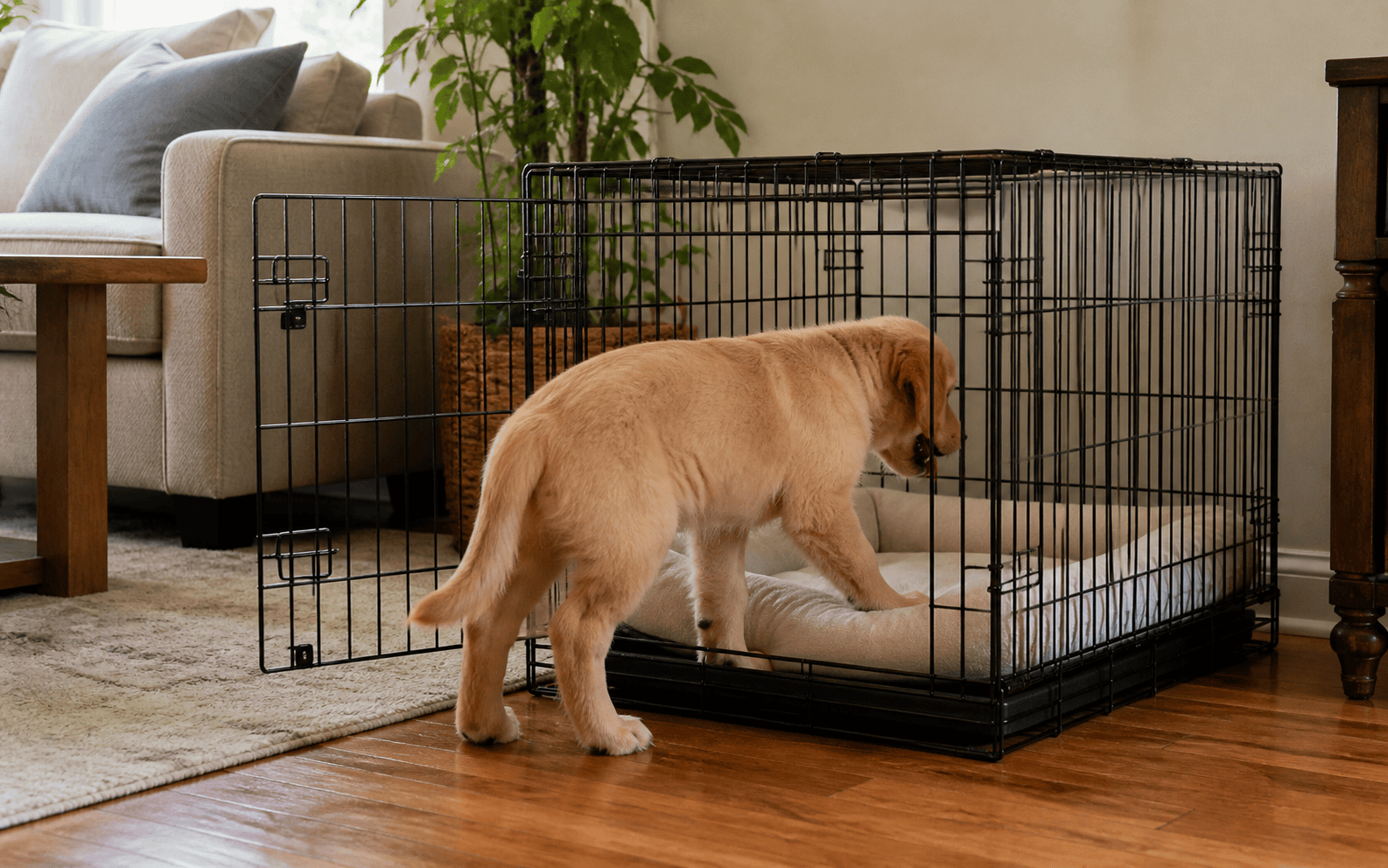
When you start seeing two or three of these consistently, you have successfully completed the core of crate training your puppy. At that point, the crate becomes a long-term resource rather than a training project — a place your dog goes for rest, for calm, and for security throughout their adult life.
Things to Know
- Puppies should never be crated for more hours than their age in months plus one. A three-month-old puppy maxes out at around four hours during the day before a bathroom break is needed.
- The crate location matters more than most owners realize. Puppies placed in isolated rooms adjust much more slowly than those crated in shared living spaces where they can see and hear family activity.
- High-value treats used only for crate training, such as small pieces of chicken or freeze-dried liver, create a stronger positive association than everyday kibble.
- A puppy that was kept in unsanitary conditions at a breeder or shelter may have already lost the instinct to keep their sleeping area clean, which means housebreaking inside the crate will require more patience and a different approach.
- Crate training is not a permanent management tool. The goal is to use it heavily during the first several months and gradually reduce reliance on it as your puppy earns more freedom through consistent behavior.
- Never leave a collar or harness on your puppy inside the crate unsupervised. Tags and hardware can catch on wire openings, creating a serious safety risk.
Start Crate Training the Right Way With Expert Support
If you have been working through the steps and your puppy still isn’t settling, or if you want to get it right from the beginning without the trial and error, professional guidance makes the entire process faster and far less stressful for both of you. Every puppy is different, and a one-size-fits-all approach often misses the specific temperament and behavioral patterns your dog actually has.
Reach out to K9 Mania Dog Training today and let an experienced trainer assess your puppy and build a crate training plan that works for your home, your schedule, and your dog.
You May Also want to Read Latest Posts
Board and Train for Leash Reactive Dogs
Is Board and Train Right for a Reactive Dog
How to Train Your Dog Not to Bark
Frequently Asked Questions
How old should my puppy be to start crate training?
You can begin crate training as early as eight weeks old, which is typically when puppies are brought home from a breeder.
Start with very short, positive sessions focused entirely on building a good association with the crate rather than achieving confinement. At this age, bladder capacity is limited, so overnight expectations should be modest. A puppy under ten weeks will likely need at least two bathroom breaks during the night.
What are common mistakes in crate training?
The most common mistakes are moving too fast, using the crate as punishment, and being inconsistent across household members.
Each of these errors damages the positive association you are working to build. Moving too fast causes panic before the puppy has built confidence. Using the crate as a consequence teaches the puppy to fear it. Inconsistency means the puppy receives conflicting signals and never fully learns what the expectation is. Correcting all three simultaneously is where most families see the fastest improvement.
Should I put a pee pad in my puppy’s crate at night?
In most cases, no — placing a pee pad inside the crate actively works against housebreaking by giving the puppy permission to eliminate where they sleep.
The core principle of crate training is that dogs avoid soiling their den, which motivates them to hold their bladder until they are taken outside. A pee pad removes that motivation entirely. The better solution is to take your puppy out at a set time overnight rather than building in an indoor elimination option that becomes a hard habit to break later.
How long to let puppy cry in crate first night home?
There is no fixed time limit — the key is distinguishing between normal protest crying, which typically fades within ten to twenty minutes, and escalating distress that does not settle.
If your puppy cries and gradually quiets down, that is normal adjustment. If the crying intensifies, becomes frantic, or is paired with physical symptoms like heavy panting or drooling, check on your puppy without making it a reward. Placing the crate beside your bed on the first night dramatically reduces the intensity of crying because your puppy can hear and smell you nearby.
What is the fastest way to crate train a puppy?
The fastest approach is a consistent, accelerated positive association protocol: feed every meal in the crate, use high-value treats exclusively for crate rewards, and build duration in small increments every single day without skipping sessions.
Consistency is the actual accelerator here, not any single trick or shortcut. Puppies trained twice a day with clear, calm reinforcement typically accept a closed crate within seven to ten days. Working with a professional trainer from the start compresses that timeline further because the approach is customized to your puppy’s temperament from day one rather than adjusted after early setbacks occur.
The Bottom Line on Crate Training Your Puppy
Crate training your puppy is one of the highest-return investments you will make in your dog’s long-term behavior. A puppy who learns to settle calmly in a crate becomes an adult dog who travels easily, recovers from vet visits without excessive stress, and gives you peace of mind during the hours when supervision is not possible. The process takes patience and consistency, but it is straightforward when the steps are followed in the right order.
If you are on Long Island and want hands-on support rather than working through it alone, K9 Mania Dog Training offers professional puppy training that covers crate work within a complete, structured approach. Contact K9 Mania today to schedule your first session and give your puppy the clearest possible start.