

The 7-7-7 rule for dogs refers to two different guidelines, and most people searching for it only get told about one.
The first is the Rule of 7s, a puppy socialization checklist. It says that by about 12 weeks old, a puppy should have met seven examples in each of seven categories: surfaces, objects, locations, people, challenges, food containers, and eating spots.
The second is a rescue dog adjustment timeline. It describes how an adopted dog settles in over its first 7 days, 7 weeks, and 7 months in a new home.
Which version applies depends on your dog. If you just brought home an 8-week-old puppy, you need the first. If you adopted a 3-year-old from a shelter, you need the second.
TL;DR: Key Takeaways
- The “7-7-7 rule” means two things: a puppy socialization checklist and a rescue adjustment timeline.
- The puppy version aims for 49 positive exposures (7 × 7) before about 12 weeks of age.
- The rescue version sets expectations: 7 days to decompress, 7 weeks to learn routines, 7 months to fully settle.
- Neither version is a strict scientific formula. Both are practical rules of thumb.
- A calm, positive exposure is worth more than a long list of stressful ones.
What Is the 7-7-7 Rule for Dogs?
Both versions exist for the same reason: dogs handle new things better when those things arrive gradually. Here is what each one covers.
Version 1: The Puppy Rule of 7s
This checklist is commonly attributed to breeder Pat Schaap. It has circulated among breeders and trainers for decades. The classic version says that by 12 weeks of age, a puppy should have:
- Walked on 7 different types of surfaces
- Played with 7 different types of objects
- Been in 7 different locations
- Met and played with 7 new people
- Been exposed to 7 challenges
- Eaten from 7 different containers
- Eaten in 7 different locations
Many modern blogs swap the last category for “sounds” or “experiences.” That’s a reasonable change. The goal stays the same: variety, delivered positively.
Version 2: The Rescue Adjustment Timeline
This version works like the better-known 3-3-3 rule (3 days, 3 weeks, 3 months), but it uses longer stretches of time. It breaks a rescue dog’s transition into three phases:
- First 7 days: The dog is overwhelmed and decompressing.
- First 7 weeks: The dog is learning your routines and starting to show its real personality.
- First 7 months: The dog feels secure and trusts the household.
The longer timeline suits dogs with unknown histories, multiple rehomings, or noticeable fear. For those dogs, three months often isn’t enough time to settle.
Why the 7-7-7 Rule Matters Right Now
For puppies, timing is the whole point. Research going back to John Paul Scott and John Fuller’s work in the 1960s identified a sensitive socialization period from roughly 3 to 12–14 weeks of age. During that window, puppies accept new things easily. After it closes, new things are more likely to cause fear.
Most puppies go home at around 8 weeks. That leaves you only four to six weeks of that window. The Rule of 7s gives you a concrete target so those weeks don’t slip by.
For rescues, the pressure runs the other way. In our experience, the first few weeks are when new adopters most often decide a dog “isn’t working out.” Usually that decision is based on behavior that is really stress, not personality. Knowing the 7-day, 7-week, 7-month timeline helps owners stay patient through the rough early stretch.
Breaking Down the Puppy Rule of 7s (With Real Examples)
The checklist only helps if you know what counts in each category. Below are practical examples for each one.

Surfaces: Grass, gravel, tile, carpet, a wobbly cushion, a metal grate, wet pavement. Slippery and unstable surfaces matter most. Dogs who never practiced on them often struggle later with vet exam tables and stairs.
Objects: Squeaky toys, rope toys, a cardboard box, a crinkly water bottle (supervised), a metal bowl, a tennis ball, a rubber puzzle toy. Different textures and sounds build curiosity instead of wariness.
Locations: Your front yard, a friend’s home, a pet-friendly store, the car, a quiet park edge, the vet’s lobby for a “happy visit,” a porch at dusk.
People: Children (supervised), a person in a hat, someone with a beard, a person using a cane, a delivery driver, older adults, a person wearing sunglasses. Puppies generalize poorly, so “people” to a puppy means the specific kinds of people it has actually met.
Challenges: Climbing a low step, going through a short tunnel, being briefly separated from littermates or you, getting past a small obstacle, handling a mild sound like a vacuum running in another room.
Food containers: Metal, ceramic, plastic, a paper plate, a puzzle feeder, a snuffle mat, a hand-held scatter feed.
Eating locations: The kitchen, a crate, the yard, a different room, the car (parked), a friend’s porch, a training mat.
Seven items in seven categories adds up to 49 exposures. That sounds like a lot, but spread over four weeks it’s fewer than two new things a day.
If your puppy still hasn’t had its vaccines, the American Veterinary Society of Animal Behavior (AVSAB) says socialization can safely start 7–8 days after the first set of vaccines. Carry your puppy in public spaces and avoid high-traffic dog areas until your vet clears full exposure. Our puppy fear periods guide explains why some weeks call for extra gentleness.
The Rescue Timeline: 7 Days, 7 Weeks, 7 Months
For adopted dogs, the rule is a set of expectations, not a checklist.
The First 7 Days: Decompression
Expect a dog that is quiet, clingy, or avoidant. It may skip meals, sleep a lot, or pace. This is not the dog’s real personality yet.

What to do: keep the environment boring on purpose. Use short walks on the same route, set feeding times, and skip visitors, dog parks, and big outings. A crate or quiet corner helps. Our guide on how to crate train a rescue dog shows how to introduce one without pressure.
Weeks 1–7: Learning the Routine
Now the dog starts figuring out how your house works. Personality comes out, and so do problem behaviors such as leash pulling, barking at the window, or testing house rules.
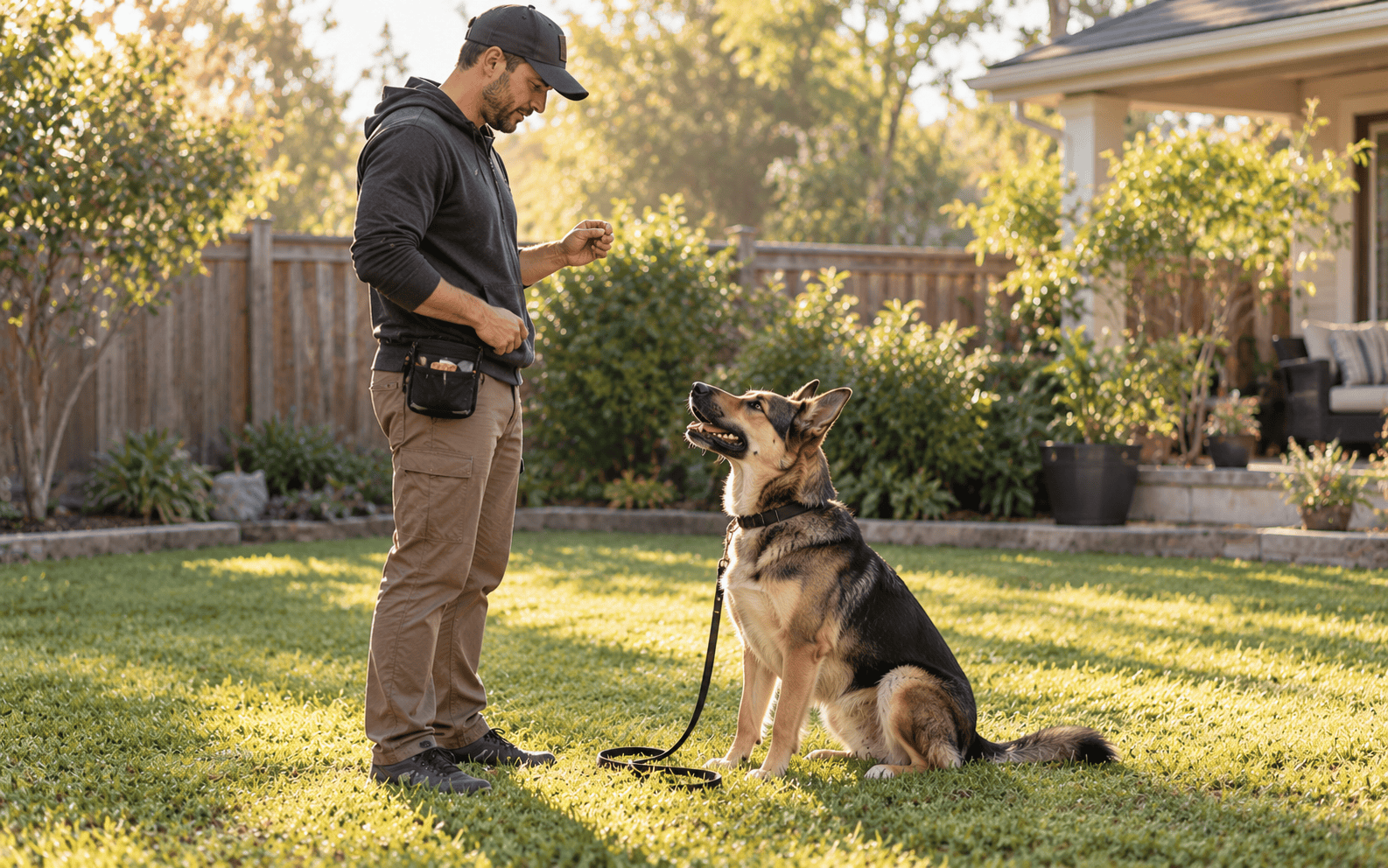
This is the best time to start structured training. Keep sessions short, around 5–10 minutes. Start gradual exposure to new places here, not in week one. For a detailed week-by-week look, see rescue dog adjusting to new home.
Months 2–7: Settling In
By this stage, most dogs trust the household and have bonded with you. Some behaviors that seemed fixed in month one fade on their own. Others, like reactivity or resource guarding, become clearer and may need professional help.
7-7-7 Rule vs 3-3-3 Rule: Which Should You Use?
| 3-3-3 Rule | 7-7-7 Rescue Timeline | Puppy Rule of 7s | |
| Best for | Well-adjusted rescues, straightforward histories | Fearful, rehomed, or unknown-history dogs | Puppies under ~12 weeks |
| Type | Adjustment timeline | Adjustment timeline | Socialization checklist |
| Time frame | 3 days / 3 weeks / 3 months | 7 days / 7 weeks / 7 months | Before ~12 weeks of age |
| Main job | Set expectations | Set longer expectations | Build confidence through exposure |
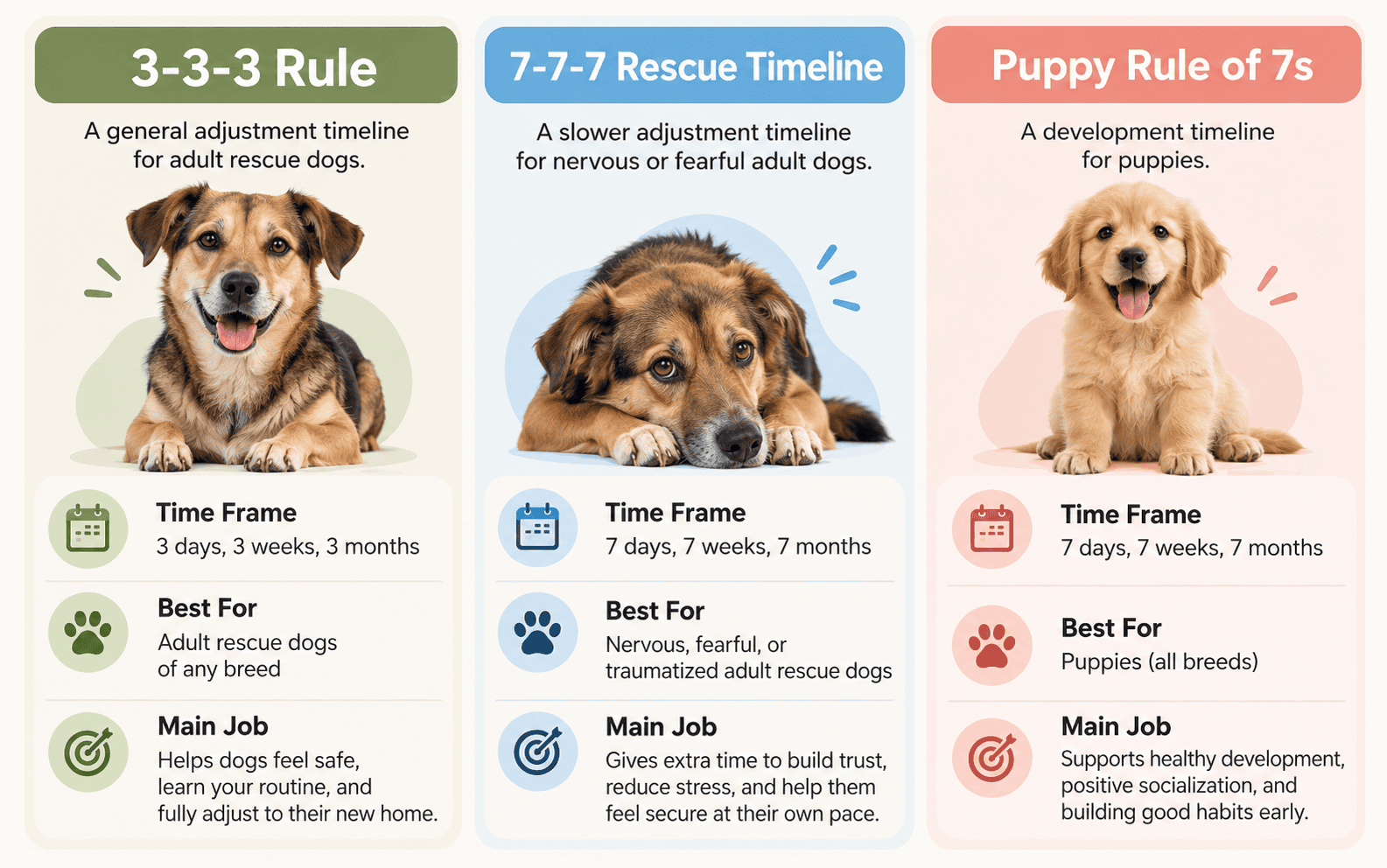
If you’re unsure which timeline fits your rescue, use the 7-7-7 version. Setting the expectation longer than you need costs you nothing. Setting it too short leads to frustration and rushed exposure.
How to Tell If Exposure Is Helping or Hurting
Exposure only helps when the dog stays under its stress threshold. Before you check anything off the list, watch for these signs:
- Good signs: Loose body, relaxed tail, sniffing, approaching on its own, taking treats easily
- Warning signs: Lip licking, yawning out of context, whale eye (the whites of the eyes showing), tucked tail, refusing food, freezing
If your dog won’t take a treat it normally loves, you’re past its threshold. Increase the distance or end the session on something easy. Our guide to dog body language covers these signals in detail.
Also watch for trigger stacking, where small stressors add up until the dog reacts to something it would normally handle. A new location, a loud truck, and a stranger reaching over its head, all in one outing, can add up to a snap. Read more about what is trigger stacking in dogs.
Common Mistakes and Misconceptions
“More exposure is always better.” It isn’t. One scary experience can undo several good ones. Three calm exposures beat ten overwhelming ones.
“The rule is scientifically proven.” It isn’t. The socialization window is well researched, but the number seven is a convenient benchmark, not a biological threshold.
“Exposure means interaction.” Watching a skateboard go by from 30 feet away while eating chicken counts as exposure. Your puppy doesn’t need to be petted by every stranger.
“My rescue is fine after a week, so we’re done.” Many dogs are quiet at first because they’re shut down, not because they’ve settled. Behaviors often show up around weeks 3–6.
“If I miss the 12-week window, it’s too late.” Adult dogs can still learn confidence. It just takes longer and needs more structure. See how to socialize an adult dog for a slower approach.
Step-by-Step: A Simple Way to Apply the Rule This Week
- Figure out which version applies. Puppy under 12 weeks: use the Rule of 7s. Newly adopted dog: use the timeline.
- Make a 7 × 7 grid. Put the categories across the top and leave seven blank slots under each. Write the date and the dog’s reaction each time you fill a slot.
- Plan one or two new exposures a day. Pick ones that are easy to set up: a new surface in the morning, a new food bowl at dinner.
- Pair every new thing with something good. Use food, play, or calm praise. The dog should connect the new thing with a good outcome.
- Keep sessions under 10 minutes. Always end while the dog is still comfortable.
- Rate each exposure. Use a simple 1–3 score (1 = relaxed, 3 = stressed). If you get a 3, repeat that item later at an easier level before moving on.
- Review at the end of the week. If a whole category keeps scoring 2s and 3s, that’s your training priority, and possibly a sign to bring in help.
When the Rule Isn’t Enough
Some dogs need more than a checklist. Call a professional if your dog:
- Growls, snaps, or lunges during exposures
- Still refuses food or hides after several weeks
- Reacts to more and more things instead of fewer
- Is past the socialization window and fearful in many situations
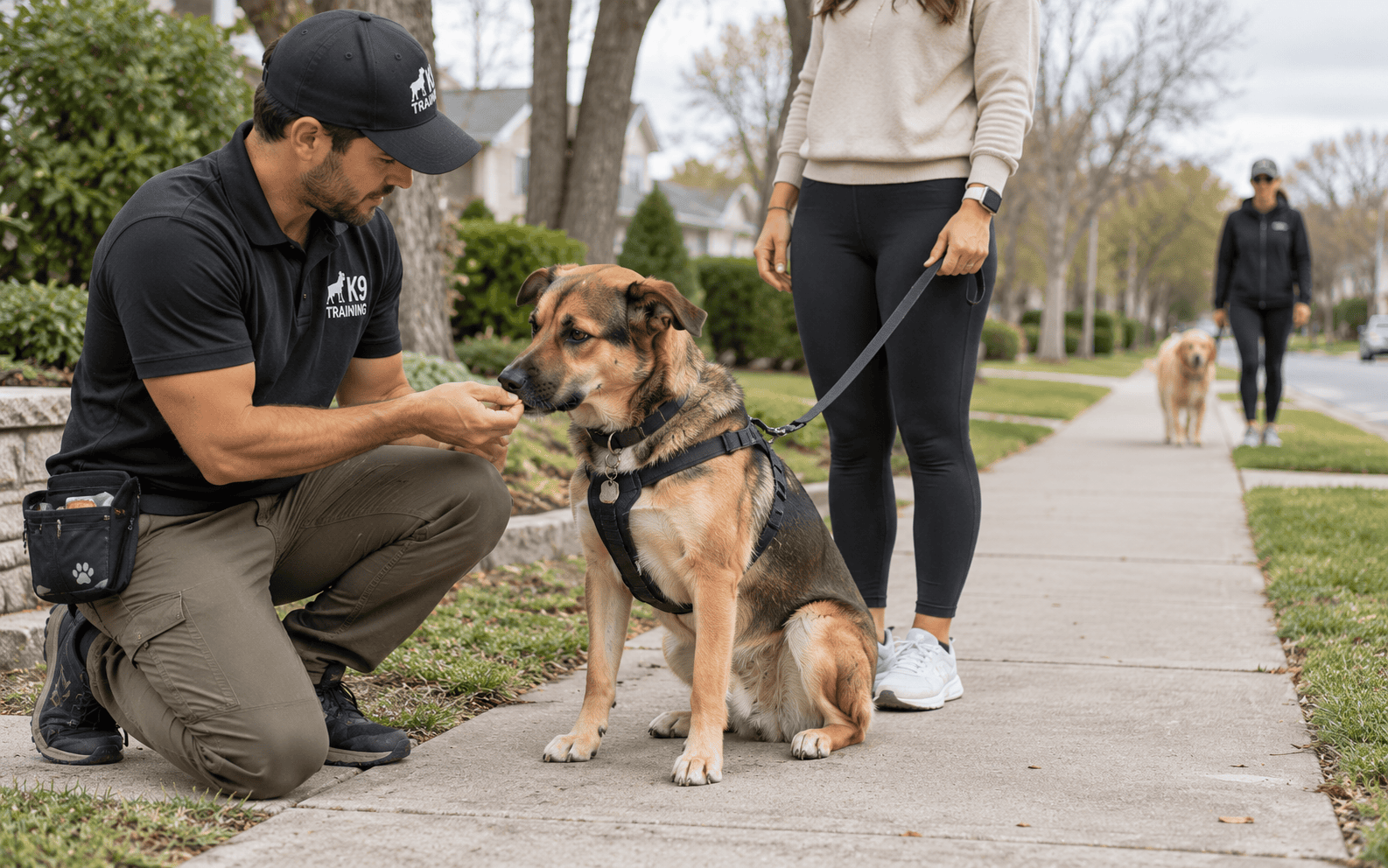
A structured program such as puppy training on Long Island can set up the Rule of 7s correctly from the start. Adult rescues that are reactive often do best with dog reactivity training in Long Island, where the trainer controls distance and triggers. Training at home works well for dogs whose problems show up mainly in their own environment.
You May Also Want to Read
Rescue Dog Adjusting to New Home
How to Crate Train a Rescue Dog
Signs of a Poorly Socialized Dog
Frequently Asked Questions
What does 7-7-7 mean for a puppy?
For puppies, it’s the Rule of 7s. By roughly 12 weeks old, a puppy should have seven positive experiences in each of seven categories: surfaces, objects, locations, people, challenges, food containers, and eating spots. That’s 49 small experiences during the most impressionable stage of its life.
Is the 7-7-7 rule the same as the 3-3-3 rule?
Not exactly. The rescue version of 7-7-7 has the same structure as 3-3-3 but covers a longer period: 7 days, 7 weeks, and 7 months instead of 3 of each. Trainers often suggest the longer version for dogs with fearful or unknown backgrounds. The puppy version of 7-7-7 is unrelated to 3-3-3. It’s a socialization checklist, not a timeline.
Can I use the 7-7-7 rule on an older dog?
Yes, with changes. The 12-week target doesn’t apply, but the seven categories still work as a guide for gradual exposure. Expect slower progress, and pay close attention to stress signals. Adult dogs are less forgiving of overwhelming experiences than young puppies.
What if my puppy isn’t fully vaccinated yet?
You can still socialize safely. AVSAB guidance supports starting puppy classes 7–8 days after the first vaccines. Until your vet clears your puppy, carry it in public places, avoid areas with unknown dogs, and set up exposures at home or in clean, controlled spaces.
How do I know if my rescue dog is past the adjustment period?
Look for consistency, not a date on the calendar. A settled dog eats reliably, sleeps well, recovers quickly from small scares, and engages with the household on its own. If behaviors are getting worse around month three instead of improving, bring in a trainer.
Final Thoughts
The 7-7-7 rule for dogs works because it gives owners a clear target during a stretch that otherwise feels shapeless. For puppies, it’s 49 positive exposures before the socialization window closes. For rescues, it’s permission to be patient for seven days, seven weeks, and seven months. Either way, how well each exposure goes matters more than checking every box.
If your puppy or rescue is struggling with new experiences, K9 Mania Dog Training can help. Our trainers build confidence plans around your dog’s actual behavior, not a generic checklist. Contact K9 Mania to schedule an evaluation and get a plan that fits your dog.
This article is reviewed and updated regularly to reflect the latest information.