Key Takeaways
- Huskies are not stubborn — they’re independent. Training methods built for biddable breeds (Labs, Goldens) often fail with Huskies because the motivation structure is different.
- Recall and containment come before commands. A Husky’s prey drive and escape instinct mean off-leash reliability and yard security are higher priorities than “sit” and “stay.”
- Crate training in the first 2–3 weeks prevents months of destructive behavior later, especially during teething and adolescence.
- Punishment-based correction backfires badly with this breed — it tends to increase shutdown, avoidance, or escalated vocalization, not compliance.
- Weeks 8–11 (the fear period) and months 4–8 (adolescence) are the two hardest stretches — most owners give up training during one of these windows because they assume something is “wrong” with the dog.
What Does “Training a Husky Puppy” Actually Involve?
Training a Husky puppy means building reliable recall, leash manners, crate comfort, and house manners using positive reinforcement — while specifically managing the breed’s high prey drive, vocal tendencies, and escape-artist reputation. It is not the same process as training a Golden Retriever or Labrador puppy, even though most generic puppy guides treat all breeds identically.
The Siberian Husky was bred for endurance work and independent decision-making on sled teams, not for taking direction from a single handler in close quarters. That history shows up in every training session: a Husky puppy that ignores a recall cue isn’t being defiant, it’s running a cost-benefit calculation, and right now chasing the squirrel wins.
Why This Matters More in the First 16 Weeks Than People Realize
Most behavioral problems reported by Husky owners — digging, fence-jumping, excessive howling, destroyed drywall — trace back to gaps in the first 16 weeks of the puppy’s life, not bad genetics. By the time a Husky hits 6 months old, default behaviors are largely locked in.
I’ve worked with three Husky rescues this year alone that were surrendered specifically for “escaping constantly” or “won’t listen.” In every case, the owners had skipped structured recall and containment training as puppies and tried to retrofit it onto a 60-pound adolescent. That’s a much harder fix than starting early.
Understanding Husky Temperament Before You Train
High Prey Drive Changes Your Training Priorities
Huskies were never bred to herd or guard — they were bred to run, and that prey drive doesn’t discriminate between a rabbit and your neighbor’s cat. Recall training has to compete with a genetically hardwired urge to chase, which means standard “come” training timelines (often 2–3 weeks for other breeds) can take 2–3 months with a Husky.

Vocalization Is Communication, Not Disobedience
Huskies “talk” — they howl, woo-woo, and vocalize far more than most breeds. Punishing vocalization as if it’s a behavior problem usually increases it, because the dog is stressed and stress increases vocal output. The fix is teaching a quiet cue through reinforcement, not suppression through correction.
Independence Isn’t the Same as Low Intelligence
Huskies consistently rank low on obedience-based intelligence tests (like Stanley Coren’s rankings) but that measures willingness to repeat a command on cue, not problem-solving ability. I’ve watched Husky puppies figure out how to open baby gates, unlatch crate doors, and dig under fences in places no other breed in the household even attempted. Train for the brain you have, not the brain you wish you had.
Crate Training and House Manners
Start crate training the day the puppy comes home — not after the first accident. Feed meals in the crate, keep early sessions under 20 minutes, and never use the crate as punishment.
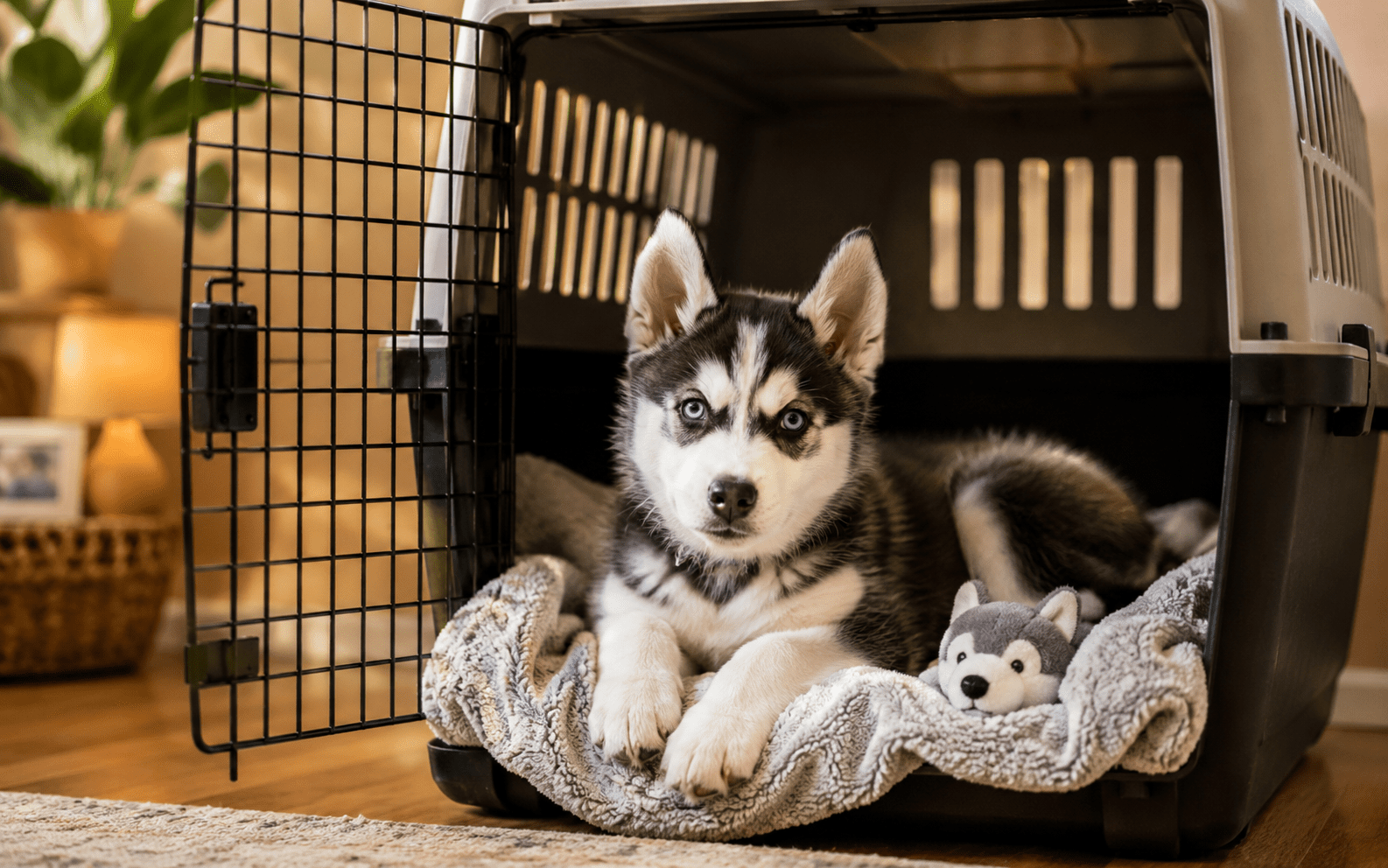
A simple progression that works well with Husky puppies specifically:
- Days 1–3: Crate door open, feed all meals inside it, no pressure to stay.
- Days 4–7: Close the door during meals only, open immediately after eating.
- Week 2: Add short naps with the door closed, gradually increasing duration.
- Week 3+: Overnight crating, with a potty break scheduled around 3–4 a.m. for puppies under 12 weeks.
Huskies are notorious for destructive chewing during teething (roughly weeks 12–24), so the crate also functions as damage control while the puppy can’t be supervised.
Leash Training and Preventing Pulling
Huskies were bred to pull — it’s the literal job description — so leash training has to actively counter instinct rather than just redirect attention. The most effective approach I use:
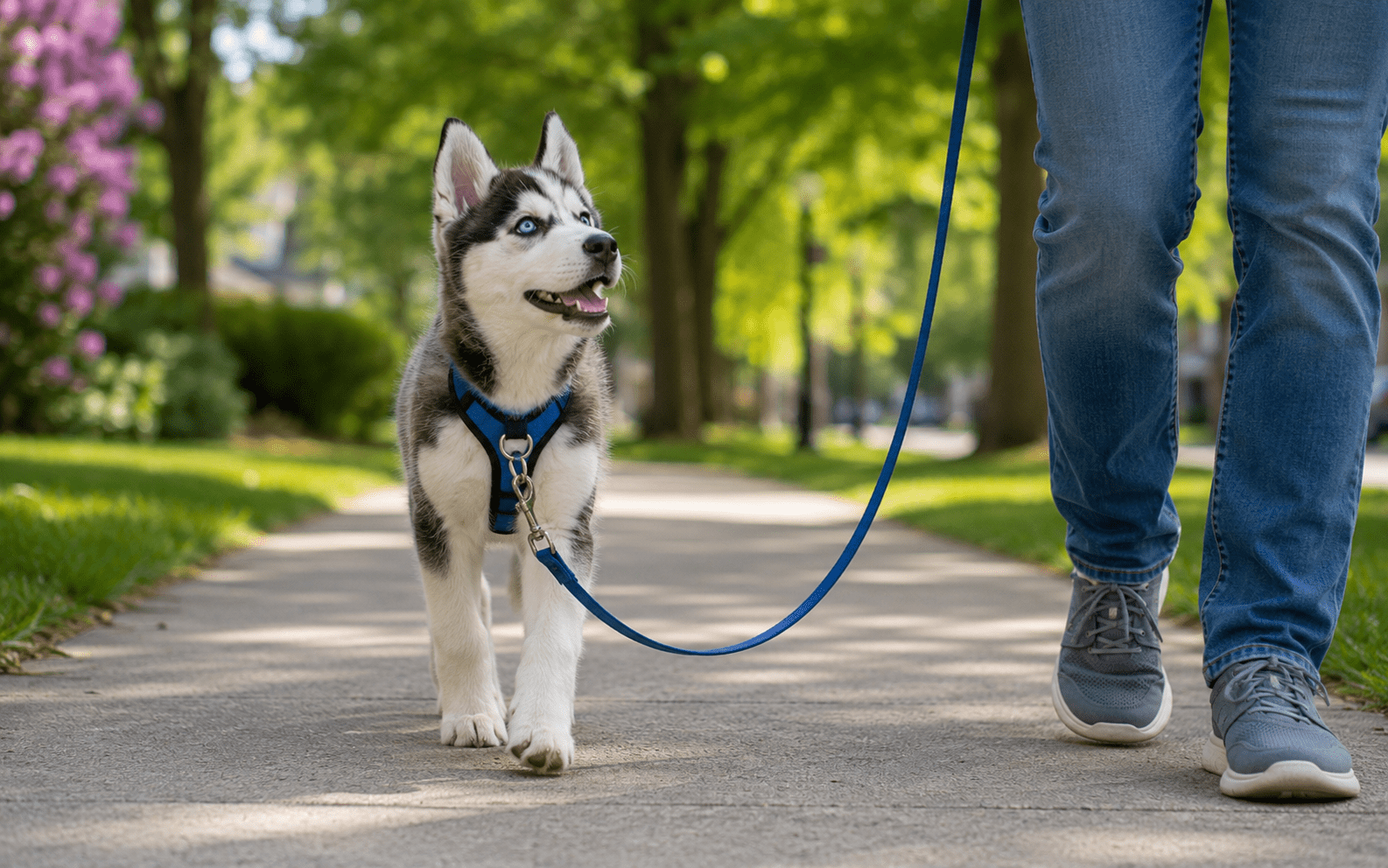
- Stop moving the instant the leash tightens. No forward progress while pulling, ever — this has to be 100% consistent or the puppy learns pulling sometimes works.
- Reward heavily for voluntary check-ins — Husky puppies that glance back at you without being asked should get a treat within 1–2 seconds.
- Use a front-clip harness, not a flat collar, for puppies under 6 months — it reduces the mechanical advantage of a breed built to pull sleds.
Recall Training: The Non-Negotiable Skill
Recall is the single highest-priority skill for this breed because a loose Husky with prey drive engaged will not stop for traffic, fences, or distance. I tell every client the same thing: assume your Husky will never be 100% reliable off-leash, and train recall as a safety net, not a guarantee.
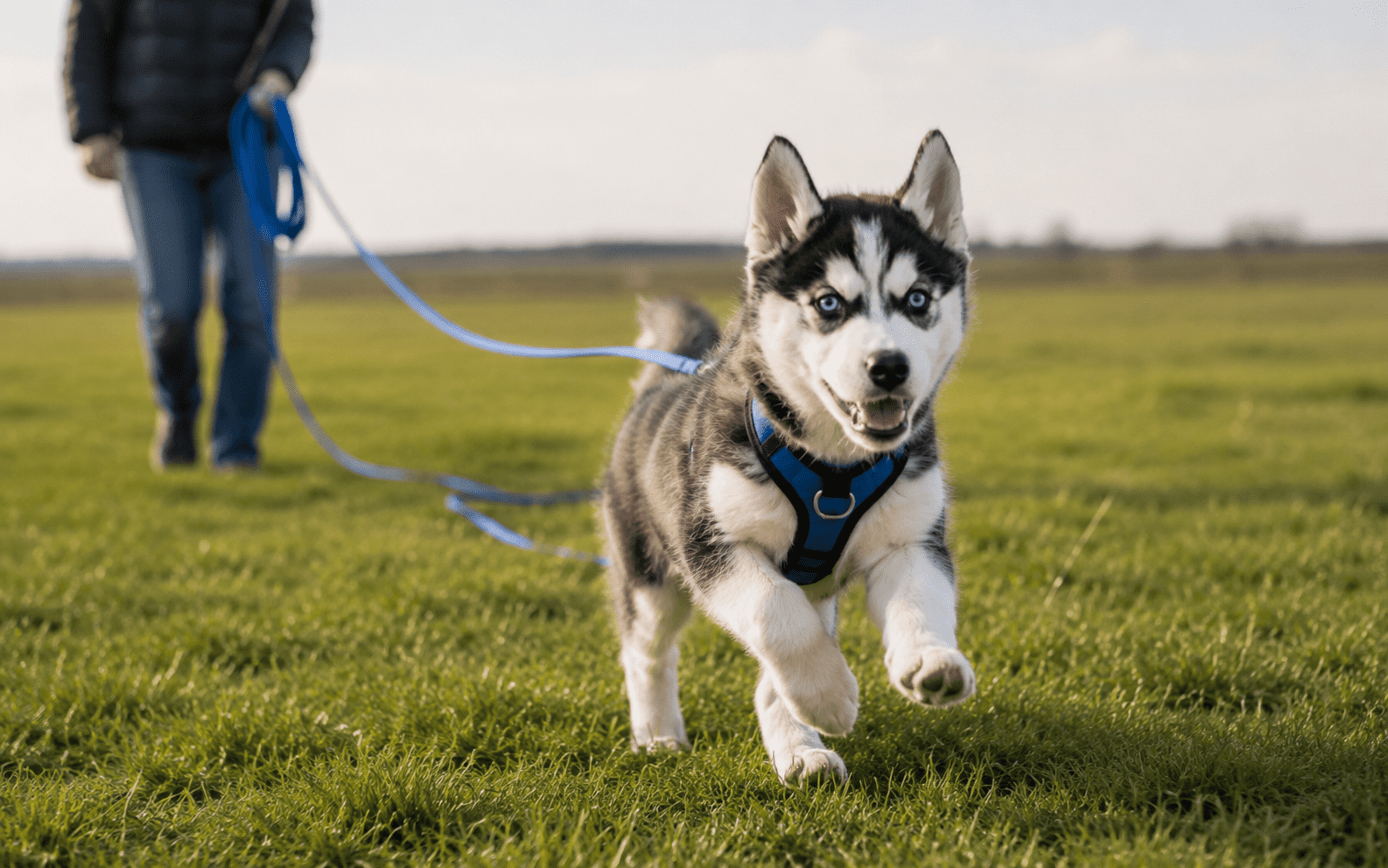
Build it in stages:
- Practice “come” indoors with zero distractions, rewarding with high-value food (not kibble).
- Move to a fenced yard, then a long line (15–30 ft) in low-distraction outdoor spaces.
- Only attempt off-leash recall in enclosed areas after 3+ months of consistent long-line success.
Common Mistakes and Misconceptions
- “He’s just stubborn, he’ll grow out of it.” Independence is a fixed trait, not a phase — training has to work with it, not wait it out.
- Using physical correction for howling or pulling. This breed tends to escalate under pressure rather than comply, often producing more vocalization or avoidance behavior.
- Skipping containment upgrades. Standard 4-foot fences are not adequate — Huskies dig under and jump over with ease; many owners need buried wire or taller fencing they didn’t budget for.
- Assuming a tired Husky is a trained Husky. Physical exercise alone doesn’t build obedience; mental engagement (puzzle toys, scent work, structured training reps) matters just as much as mileage.
- Comparing progress to other breeds. A friend’s Golden Retriever puppy mastering “stay” in a week isn’t a fair benchmark — see our guide on how to train a Golden Retriever for a sense of how differently that breed’s training timeline runs.
Step-by-Step Framework: The First 16 Weeks
- Weeks 8–10: Crate introduction, name recognition, gentle handling exercises, exposure to new sounds/surfaces.
- Weeks 10–12: Begin leash desensitization indoors, start “sit” and “come” in a distraction-free room.
- Weeks 12–14: Short outdoor leash walks, introduce a “quiet” cue for vocalization, continue crate overnights.
- Weeks 14–16: Long-line recall practice begins, structured socialization with other vaccinated puppies, fence/yard security audit.
- Months 4–8 (adolescence): Expect regression — this is normal, not a sign training has failed. Maintain consistency rather than adding new corrections.
Frequently Asked Questions
Are Husky puppies easy to train?
Not in the way most first-time owners expect. Huskies are intelligent and food-motivated, but their independent streak means they don’t default to pleasing their handler the way breeds like Labs or Rottweilers often do. Training is absolutely achievable — it just requires more patience and higher-value rewards than “easy” breeds.
What not to do with a Husky puppy?
Don’t use physical corrections, prolonged isolation, or yelling to stop howling or pulling — these tend to increase stress-driven behaviors rather than reduce them. Also avoid letting the puppy off-leash in unfenced areas before recall is rock-solid; a Husky that bolts after prey can cover hundreds of yards in seconds.
How do you discipline a Husky puppy?
“Discipline” works best as interruption and redirection, not punishment. Use a calm “no” or a sound interrupter, redirect to the correct behavior, and reward the correct version immediately. Removing access (closing a door, ending play) is more effective with this breed than verbal scolding.
What is the 7-7-7 rule for puppies?
It’s a socialization guideline suggesting puppies be exposed to 7 new surfaces, 7 new people, 7 new sounds, 7 new environments, and similar categories by 7 weeks of age (with variations citing slightly different timing). For Huskies specifically, this exposure window matters even more because under-socialized Huskies tend to develop heightened reactivity to novel stimuli as adults.
What is the hardest month of a puppy?
For most Husky owners, month 5 or 6 is the hardest — this is peak adolescence, when hormones spike, the fear period from earlier months has passed, and the puppy starts testing boundaries it previously respected. It typically eases by 9–10 months if training stays consistent through the regression.
Conclusion
Training a Husky puppy is less about teaching obedience and more about managing a breed that was never built to prioritize obedience in the first place. Get recall, containment, and crate training right in the first 16 weeks, and the rest of the behavioral toolkit comes together far faster than most owners expect.
If you’re in the New York area and want hands-on help getting ahead of escape attempts, pulling, or vocalization before they become entrenched habits, our trainers work specifically with high-drive breeds across Manhattan, Brooklyn, and Nassau County. Reach out and we’ll build a training plan around your puppy’s actual temperament, not a generic breed checklist. If you’ve got a different breed at home, our guide on training a French Bulldog covers a very different (and in some ways easier) set of challenges.