
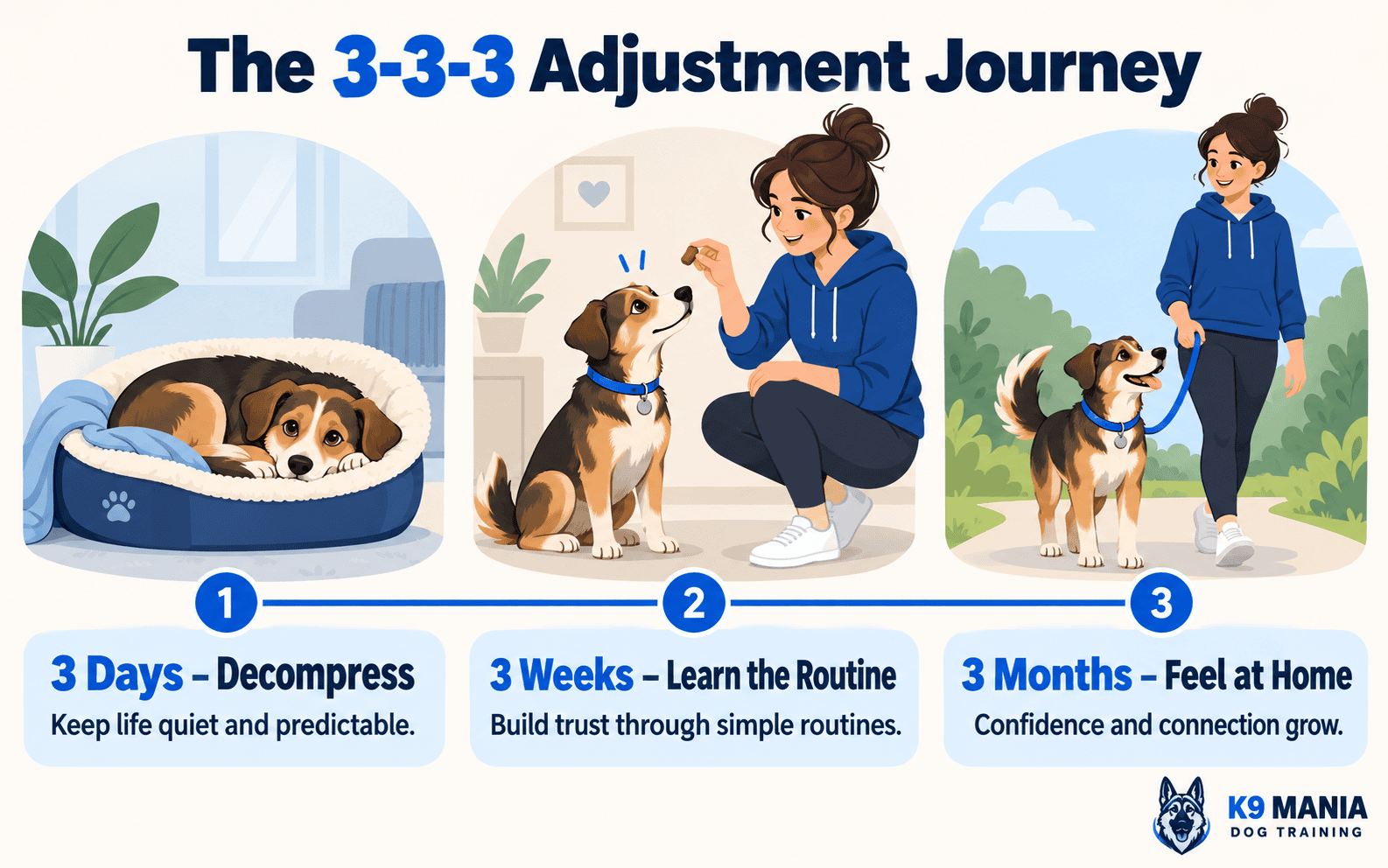
The 333 rule for dogs is a simple timeline for how a rescue dog adjusts to a new home. It takes about 3 days to decompress, 3 weeks to learn your routine, and 3 months to feel truly at home. It isn’t a strict schedule. It’s a realistic expectation that keeps new owners from panicking when their dog hides under the table on day one, or from relaxing too early when the dog seems perfect in week two.
We use this framework with nearly every rescue family we work with. That’s because the most common problems we see in newly adopted dogs come from rushing these stages, not from the dog itself.
TL;DR: Key Takeaways
- 3 days: Your dog is overwhelmed. Expect hiding, low appetite, and little personality. Keep things quiet.
- 3 weeks: Your dog starts learning the routine and testing boundaries. This is when real training begins.
- 3 months: Your dog trusts you and feels at home. Their true personality is fully visible.
- Every dog moves at a different pace. Fearful, older, or under-socialized dogs often take longer.
- Most “returned rescue” problems start with too much, too soon in the first few weeks.
What Is the 333 Rule for Dogs?
The 333 rule is an adjustment guideline used widely by shelters, rescues, and trainers. It breaks a rescue dog’s transition into three stages: decompression (first 3 days), learning (first 3 weeks), and settling in (first 3 months).
It’s worth being clear about what it is and isn’t. The rule isn’t a scientific formula, and no research sets those exact numbers. It’s a practical rule of thumb built from what rescue workers and trainers see over and over again.
Think of it the way you’d think about starting a new job in a new city. Day one, you’re just trying to find the bathroom. By week three, you know the routine. By month three, you have opinions about the coffee.
The 3-3-3 rule is often confused with the 7-7-7 rule for dogs, which covers different ground. If you’ve seen both online, that article explains how they differ.
Why the 333 Rule for Dogs Matters for New Adopters
Shelter environments are loud, unpredictable, and stressful, even good ones. A dog leaving a shelter has usually been through several major changes in a short time: losing a previous home or being found as a stray, intake, kennel life, possibly transport, and now your house.
That stress doesn’t vanish when the dog walks through your front door. A dog who looks calm at the shelter may be “shut down” rather than relaxed. A dog who seems quiet for the first week may show very different behavior once they feel safe enough to be themselves.
This is where expectations matter. Owners who don’t know about this adjustment curve often misread normal behavior as a problem. Some think their dog is “broken.” Others think they adopted the perfect dog, then feel blindsided in week four when barking, pulling, or guarding shows up.
The rule gives you a map, so you can respond to what your dog actually needs at each stage.
The First 3 Days: Decompression
During the first 72 hours, your dog is processing a flood of new sights, smells, sounds, and people. Most dogs aren’t showing you who they are yet. They’re just trying to figure out whether they’re safe.

What You’ll Likely See
- Hiding in a crate, under furniture, or in a corner
- Eating little or nothing (skipping a meal or two is common)
- Sleeping a lot, or the opposite: restless pacing at night
- House-training accidents, even from dogs listed as “house-trained”
- Shutting down: no tail wags, no interest in toys, no response to their name
What to Do
Keep life boring on purpose. That means no welcome party, no dog park, no trip to the pet store, and no meeting the neighbors’ dogs.
- Set up one quiet “home base” room with a crate or bed, water, and a few chews.
- Take them out on a leash to the same potty spot every time.
- Feed meals at the same times each day, even if they don’t eat much.
- Let them come to you. Sit on the floor, talk softly, and toss a treat without staring.
- Keep handling to a minimum: no forced hugs, baths, or grooming.
If you plan to use a crate, introduce it gently from the start rather than shutting the door on day one. Our guide on how to crate train a rescue dog walks through the setup.
The First 3 Weeks: Learning the Routine
Somewhere in the first few weeks, most dogs start to relax. They figure out when meals happen, where they sleep, and who in the house hands out treats. This is also when you’ll see more of their real personality, including the parts that need work.

What You’ll Likely See
- More energy, play, and curiosity
- Following you from room to room
- Testing boundaries: jumping on furniture, counter-surfing, ignoring cues
- Early signs of issues that were hidden before, such as leash reactivity, barking at windows, or guarding food and toys
- Some anxiety when left alone
What to Do
This is the window to start structured, low-pressure training. Short sessions of 5 to 10 minutes, a couple of times a day, work far better than one long session.
- Teach name recognition, “sit,” and a reliable potty routine first.
- Reward calm behavior constantly, not just commands.
- Start short, boring walks in quiet areas before busy streets.
- Practice brief alone time (stepping outside for a few minutes) to prevent separation problems from forming.
- Watch body language closely: lip-licking, whale eye, a tucked tail, or freezing all mean “I’m uncomfortable.”
If your dog panics when you leave, address it now rather than hoping it fades. Here’s how to train a dog with separation anxiety using gradual steps.
This is also the stage where many Long Island families bring in help. Training in the dog’s own environment tends to work well for rescues, since the house is where the new habits need to stick. That’s the main reason families choose in-home dog training in Long Island during this phase over sending a still-settling dog somewhere new.
The First 3 Months: Feeling at Home
By around the three-month mark, many dogs have built genuine trust. They understand the household rules, recognize their family, and feel secure enough to fully be themselves.

What You’ll Likely See
- A settled, predictable daily rhythm
- A clear bond with one or more family members
- Confidence: greeting you at the door, choosing to nap near you
- Full personality, including quirks, preferences, and any lasting behavior challenges
What to Do
Now you can widen your dog’s world gradually. Try new walking routes, carefully planned introductions to calm dogs, car rides, and visitors.
Build on the basics with more reliable obedience: recall, loose-leash walking, and a solid “place” or settle. A structured program like our obedience training course helps turn the early foundation into dependable behavior.
Pay attention to anything that hasn’t improved, or has gotten worse, by month three. Behavior that’s still present once your dog feels safe usually isn’t just adjustment stress. It’s a pattern that needs a training plan.
Common Mistakes and Misconceptions About the 3-3-3 Rule
Mistake 1: Treating the Numbers as a Deadline
Three days, three weeks, and three months are averages, not deadlines. A confident young dog from a foster home may settle in a week. A fearful dog from a hoarding case or puppy mill can take six months or longer.
Mistake 2: Mistaking a Shut-Down Dog for a Calm Dog
A dog who doesn’t react to anything in the first week isn’t necessarily easygoing. Many are simply too stressed to respond. This is often called the honeymoon period, and it ends once the dog relaxes.
Mistake 3: Too Much, Too Soon
Dog parks, family gatherings, and meeting every relative in week one are the fastest way to create fear or reactivity. The single most common thing we hear from struggling adopters is some version of “we took him everywhere the first weekend.”

Mistake 4: Waiting Three Months to Start Any Training
Decompression doesn’t mean zero structure. Routine is training. Potty schedules, meal times, and calm rewards should start on day one. Formal training ramps up in weeks two to three.
Mistake 5: Punishing Early Accidents or Fear Behaviors
Scolding a dog for an accident or growling during week one teaches them you’re unpredictable. Growling is communication. Suppressing it removes your warning system.
For a deeper look at the behaviors you may see along the way, our article on a rescue dog adjusting to a new home covers the more common ones in detail.
Step-by-Step: Applying the 333 Rule With Your Rescue Dog
Here’s the framework we give adopters, broken into the decisions you’ll actually face.
- Before pickup: Set up a quiet home base room, a crate or bed, a leash and collar or harness with an ID tag, and the same food the shelter was using.
- Day 1: Drive straight home. Take a leashed potty break, then show them the home base. Keep visitors at zero.
- Days 1–3: Stick to a fixed schedule for meals, potty, and sleep. Let the dog approach on their terms. Short, quiet walks only.
- Days 4–7: Introduce short, fun training games (name recognition, hand targeting). Keep resident pets separated or closely supervised.
- Weeks 2–3: Add basic cues, brief alone-time practice, and calm walks in low-traffic areas. Note any triggers: other dogs, strangers, noises, or handling.
- Weeks 4–8: Introduce controlled new experiences one at a time. Work on leash manners and recall in a quiet area.
- Months 2–3: Expand outings, structured dog introductions, and obedience reliability. Reassess any behavior that hasn’t improved.
- Ongoing: If you see reactivity, guarding, or fear that’s getting worse instead of better, get professional help before it becomes a habit.
When to Bring in a Professional Trainer
Most adjustment behaviors fade on their own with time, routine, and patience. Some don’t. Reach out to a trainer if you see:
- Growling, snapping, or biting directed at family members
- Lunging or barking at other dogs or people on walks
- Guarding food, toys, furniture, or people
- Panic when left alone, including destruction, self-injury, or nonstop barking
- Fear that’s worsening after the first few weeks instead of easing
Leash reactivity is one of the most common issues to show up around the week-three mark, once a dog feels confident enough to react. If that sounds familiar, our dog reactivity training in Long Island is built for exactly this situation.
For families who want one-on-one attention tailored to their dog’s history and pace, private dog training in Long Island lets us build the plan around where your dog is in the adjustment process.
You May Also Want to Read
Signs of a Poorly Socialized Dog
What Is the 7-7-7 Rule for Dogs?
Types of Dog Training: Methods, Goals, and Programs Explained
Frequently Asked Questions
Does the 3-3-3 rule apply to puppies?
Partly. Puppies still need a quiet first few days and a predictable routine, but they usually adapt faster than adult rescues. The bigger priority with a young puppy is safe, gradual socialization during their early developmental window, so don’t wait three full months to introduce new experiences.
What should I do if my rescue dog still isn’t settled after three months?
That’s more common than people think, especially with dogs who had little early socialization or a traumatic past. Look for steady progress rather than a finish line. If your dog is improving week to week, keep going. If they’ve stalled or are getting worse, it’s time for a trainer or a veterinary behavior consult.
Can I start training my rescue dog in the first three days?
Yes, but keep it light. Daily routines, rewarding calm behavior, and a consistent potty spot all count as training. Save formal obedience work and new environments for once your dog is eating normally and starting to explore.
Is the 3-3-3 rule backed by research?
No, not as a specific formula. It’s a practical guideline that grew out of shelter and rescue experience. Its general idea, that dogs need time and stability to recover from the stress of rehoming, lines up with how dog behavior professionals approach new adoptions.
When can my rescue dog meet my other dog or cat?
Hold off on full introductions during the first few days. Start with scent swapping and seeing each other through a baby gate, then move to short, leashed, supervised meetings once the new dog is calmer. For most households that means somewhere in the first one to two weeks, adjusted to how both animals respond.
Conclusion
The 333 rule for dogs isn’t about hitting dates on a calendar. It’s about giving your rescue dog the time and structure they need to go from overwhelmed to secure. Keep the first three days quiet, use the first three weeks to build routine and basic skills, and let the first three months show you who your dog really is.
If issues start showing up along the way, or you’d like a clear plan from day one, K9 Mania Dog Training works with rescue families across Long Island and New York. Contact us to set up a training consultation, and we’ll help you and your new dog get through every stage with confidence.
This article is reviewed and updated regularly to reflect the latest information.