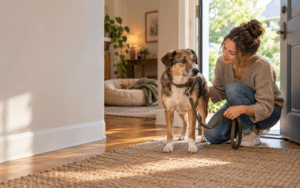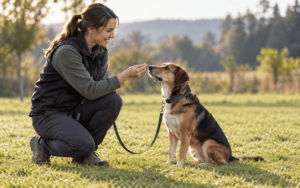
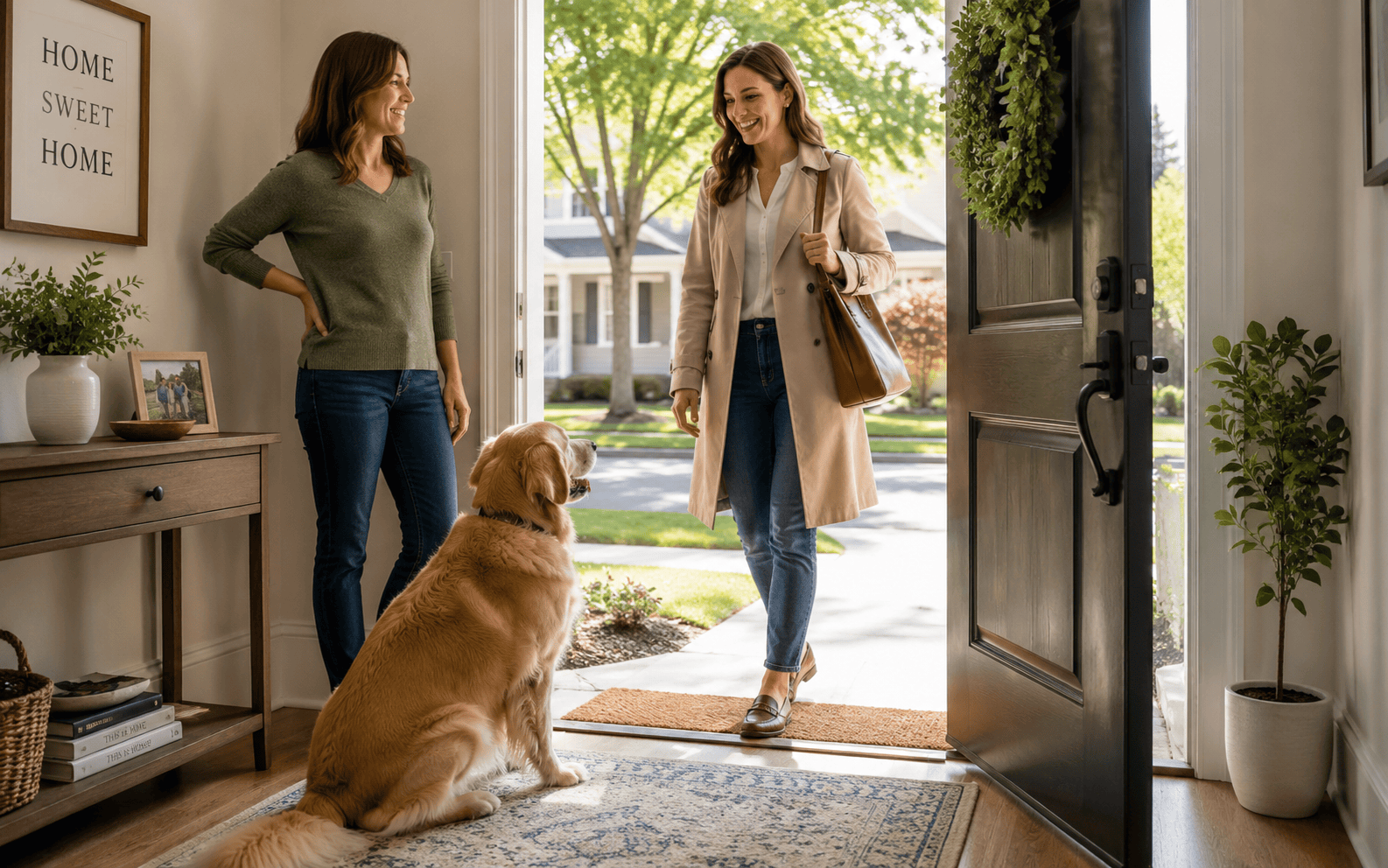
Dog training for house guests focuses on teaching your dog to stay calm, greet politely, and respect boundaries when unfamiliar people enter your home. With the right approach, most dogs can learn reliable guest-friendly behaviors within a few weeks of consistent practice.
Key Takeaways
- Jumping, barking, and door dashing are the three most common problems dogs display when guests arrive, and all three are trainable.
- Counter-conditioning and positive reinforcement work faster than punishment for guest-related behaviors.
- Practice “place” commands and calm greetings daily, not just when guests are actually at the door.
- Consistency between all family members is the single biggest factor in whether training sticks.
- Some dogs need structured professional support, like in home dog training long island, to break deeply ingrained habits.
- Setting your guests up with clear instructions makes your training efforts far more effective.
Why Dogs Misbehave Around House Guests (And Why It’s Not Their Fault)
If your dog goes into overdrive every time the doorbell rings, you are not alone. According to the American Veterinary Medical Association, approximately 65 million U.S. households own at least one dog, and guests triggering bad behavior is one of the most commonly reported complaints from owners, with issues like board and train long island programs often recommended for severe cases. The root causes are almost always predictable.
Dogs are social animals. Excitement, territorial instinct, and a lack of clear communication from their owners combine to produce chaos at the front door. Your dog is not being defiant. They simply have not been taught what the correct response looks like. The arrival of a stranger activates arousal, and without a trained default behavior, that arousal comes out as jumping, barking, spinning, or bolting out the door.
Several specific triggers make the situation worse:
- The doorbell or a knock functions as a conditioned cue for excitement after months of association.
- Guests who reach down to pet a jumping dog accidentally reinforce the behavior.
- Irregular visitor schedules mean your dog rarely gets enough repetitions of the correct behavior to build a habit.
- Children visiting can trigger prey drive or play arousal in certain breeds.
Understanding the “why” makes training much more strategic. You are not correcting bad character. You are replacing a strong, rehearsed behavior with a new, incompatible one.
The Core Skills Every Dog Needs Before Guests Arrive
Solid dog training for house guests builds on a small handful of foundational behaviors. These do not require fancy tricks or months of preparation. They do require consistency and deliberate practice.
The “Place” Command
The single most effective behavior you can teach your dog for guest situations is a reliable “place” command. This means your dog goes to a designated mat, dog bed, or crate and stays there until released. When a guest walks in, your dog has a clear job: go to your spot.
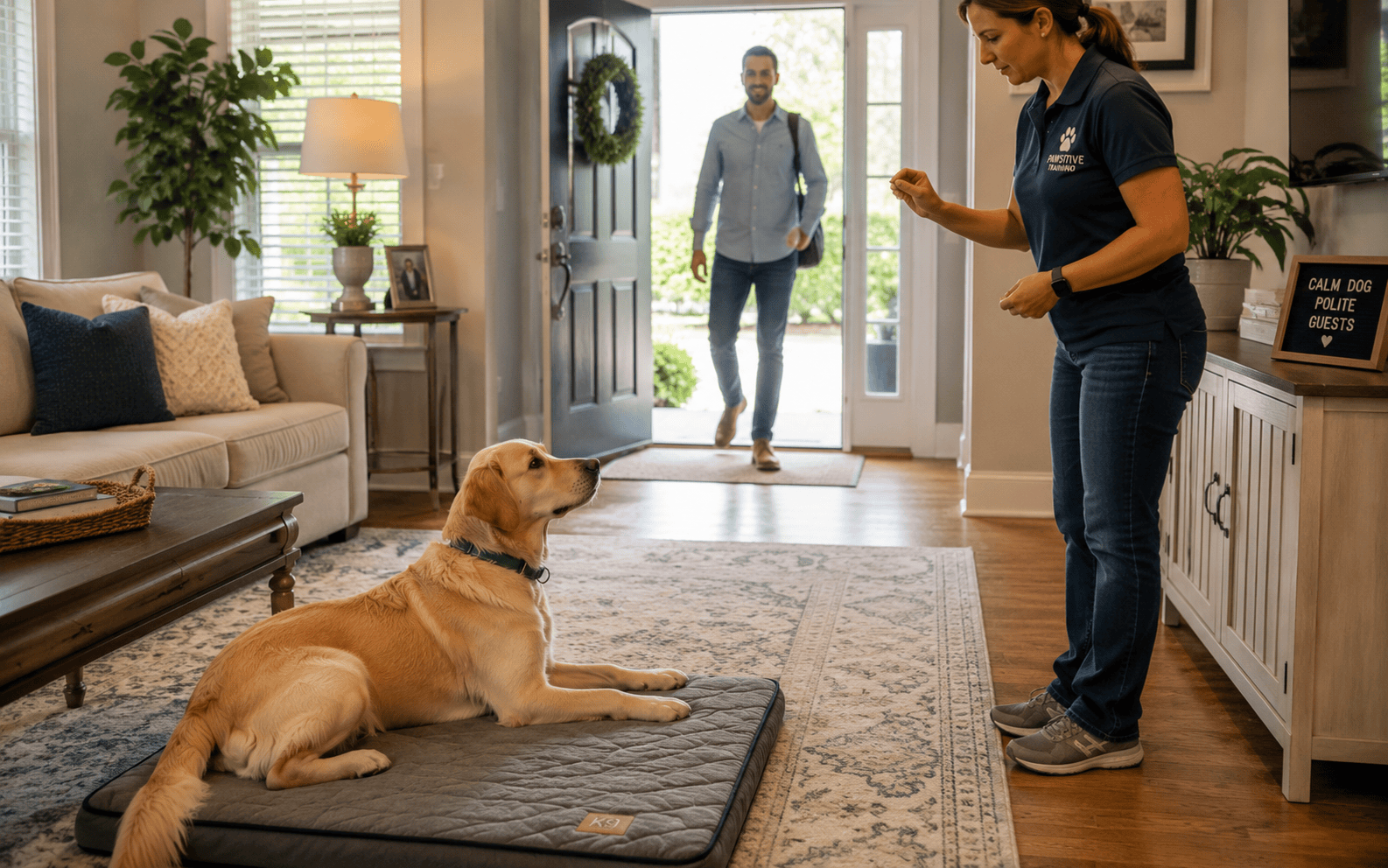
Start training “place” in a distraction-free environment before you ever involve guests. Use high-value rewards like small pieces of chicken or real beef. Build duration gradually, starting with five seconds and working up to several minutes over days. Once your dog can hold the position reliably with you moving around the room, introduce mild distractions, and eventually, a real guest entering the front door.
Obedience dog training programs typically cover the “place” command in depth because it transfers across dozens of real-life situations beyond just guest arrivals.
Sit-Stay for Greetings
A dog cannot jump on someone and sit simultaneously. Teaching a firm sit-stay for greetings is one of the most practical incompatible behaviors you can build. Every time someone approaches, your dog sits and holds until the person finishes the greeting. No sit, no attention, no petting.
This requires buy-in from your guests. Give visitors a simple instruction before they come in: “Please don’t pet her until she’s sitting.” Most guests are happy to follow this rule once you explain it.
Recall Away from the Door
A fast, reliable recall is your safety net. If your dog breaks the sit or bolts toward the door, a strong recall brings them back without the interaction escalating. Practice this with high-value rewards, in short sessions, every single day.
Solving the Three Biggest Problems at the Door
Jumping on Guests
Jumping is reinforced every time a person makes eye contact, pushes the dog away, or says “no” with any emotional energy. Even negative attention is attention. The fix is complete and total removal of the reward. Turn your back, cross your arms, and wait for four paws on the floor. The instant the dog lands, deliver calm praise and a treat.
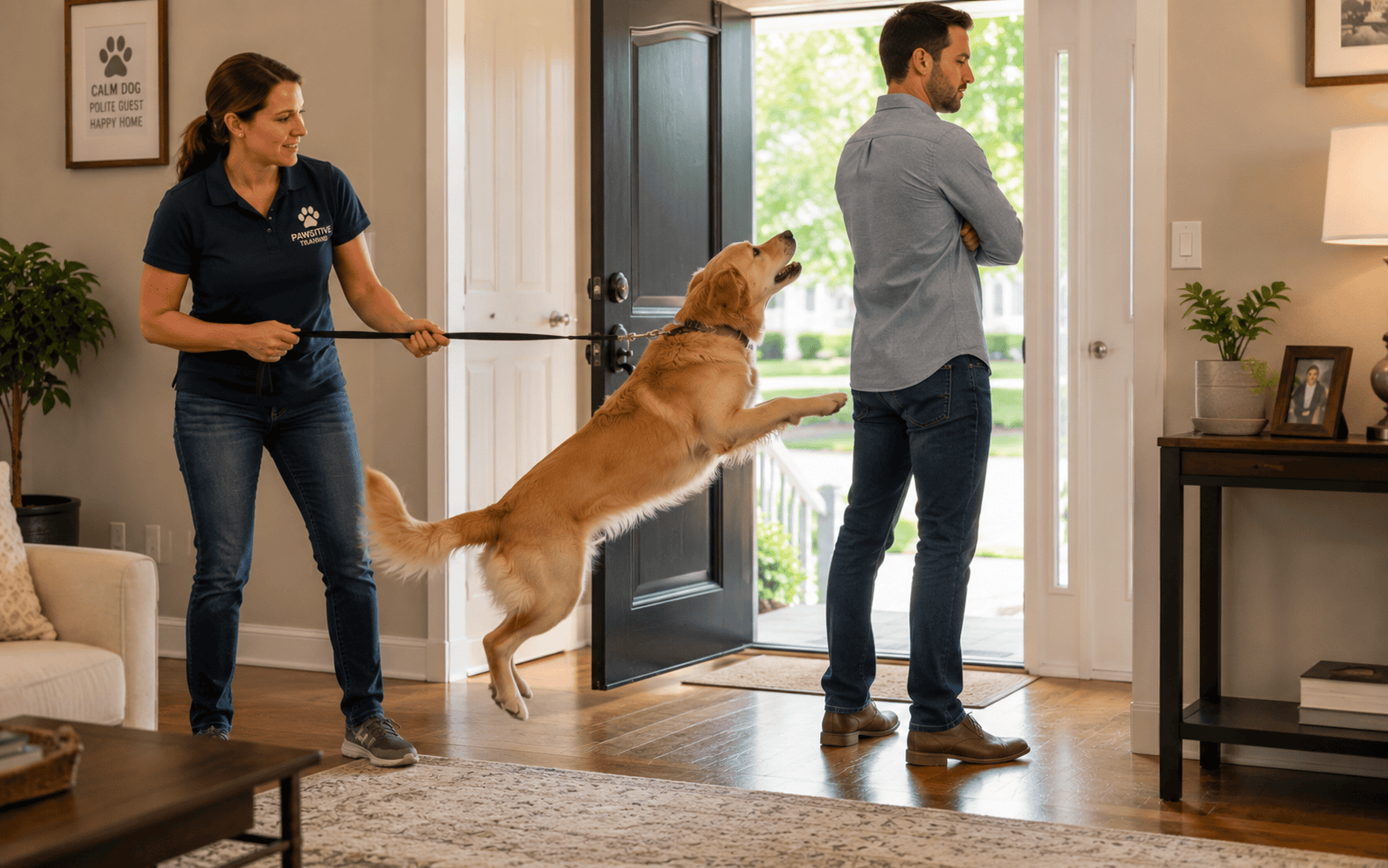
For detailed technique breakdowns, the article on how to train a dog not to jump covers specific steps, timing, and common mistakes owners make during this process.
The challenge is that jumping often gets worse before it gets better. This is called an extinction burst, and it is completely normal. Your dog is trying harder because the old behavior used to work. Stay consistent. The burst usually peaks within three to five days before the behavior drops significantly.
Door Dashing
Door dashing is not just an embarrassing behavioral problem. It is a safety issue that responds well to door dashing prevention dog training methods tailored to your dog’s specific impulse control level. A dog that bolts out an open front door risks being hit by a vehicle, getting lost, or injuring a guest who tries to catch them.
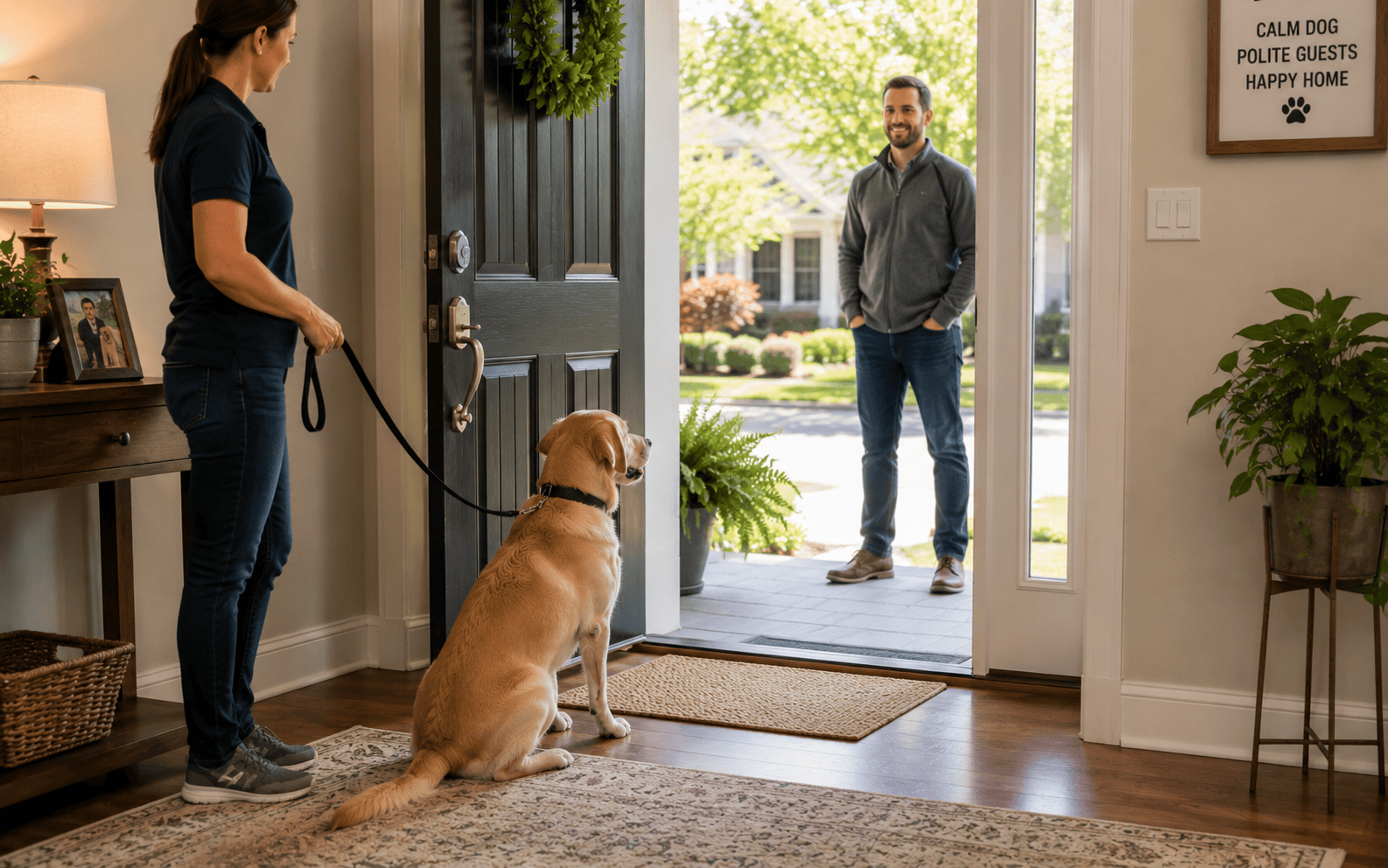
Training for this requires a combination of boundary work and impulse control. Teach your dog that the front door threshold is off-limits unless they are explicitly invited through. Use a leash during initial practice sessions so you can prevent rehearsal of the wrong behavior. Guests coming and going repeatedly during a training session is one of the most effective ways to build this skill quickly.
Professional programs focused on structured approaches take a deliberate path that many owners find significantly faster than trying to piece it together on their own.
Excessive Barking
Alert barking at a doorbell or knock is natural. Sustained barking that continues for minutes after the guest is inside the house is a habit that has been allowed to repeat unchecked. The approach here involves desensitizing the doorbell sound separately from actual guest arrivals.
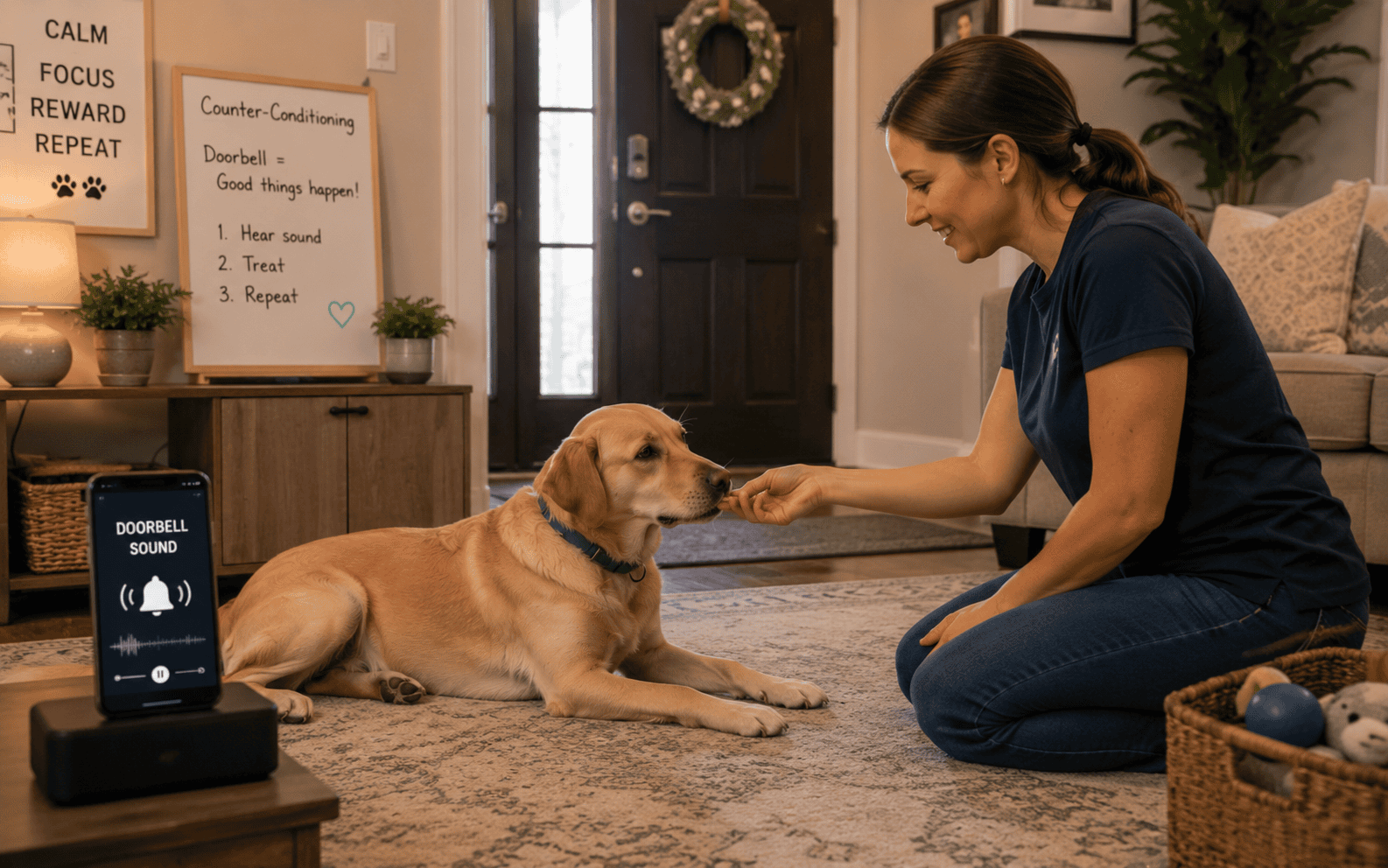
Record your doorbell or use a YouTube video. Play it at a low volume while feeding your dog small treats. Gradually increase the volume over sessions. The goal is to build a new association: doorbell equals something calm and pleasant, not a signal to go into guard mode.
| Problem Behavior | Root Cause | Primary Training Fix | Timeline to Improve |
| Jumping on guests | Excitement; past reinforcement | Ignore until 4 paws down, reward calm | 2-4 weeks consistent practice |
| Door dashing | Impulse control deficit | Threshold boundary training with leash | 3-6 weeks |
| Excessive barking | Doorbell as arousal trigger | Desensitization + counter-conditioning | 2-5 weeks |
| Mouthing guests | Play arousal, especially in puppies | Redirect to toy, remove attention | 1-3 weeks |
| Jumping on children | Smaller, more excitable target | Practice with controlled introductions | 3-6 weeks |
How to Practice When You Don’t Have Real Guests
One of the biggest obstacles to successful dog training for house guests is the lack of practice opportunities. You cannot manufacture guests on demand, and bad behavior usually only happens when you are unprepared.
Here are practical ways to simulate the scenario:
- Use a neighbor or friend as a “practice guest.” Brief them on their role: knock, wait, enter slowly, and follow your cues. Repeat the scenario 8 to 10 times in a single session.
- Record your doorbell and play it randomly throughout the day. This removes the predictability your dog currently relies on to ramp up arousal.
- Practice the “place” command every single day, not just when someone is at the door. The behavior needs to be automatic before you can rely on it under pressure.
- Stage rapid-fire arrivals. Have a family member leave and knock 10 minutes later, repeatedly. This increases repetitions without needing multiple volunteers.
If you have a dog with significant reactivity or a long history of reinforced jumping and dashing, working with a trainer who offers private dog training long island services gives you customized guidance and real-time feedback that self-directed practice cannot fully replace.
When to Bring In Professional Help
Not every dog progresses at the same pace. If your dog has been practicing problematic guest behaviors for years, the ingrained pattern is going to take longer to replace. Some indicators that professional support makes sense:
- Your dog’s behavior around guests has escalated to growling or snapping.
- You have worked on the behaviors for several weeks with little or no improvement.
- You live in a high-traffic home where guests come frequently and inconsistency keeps resetting progress.
- Your dog is large and the jumping or door dashing poses a real physical risk.
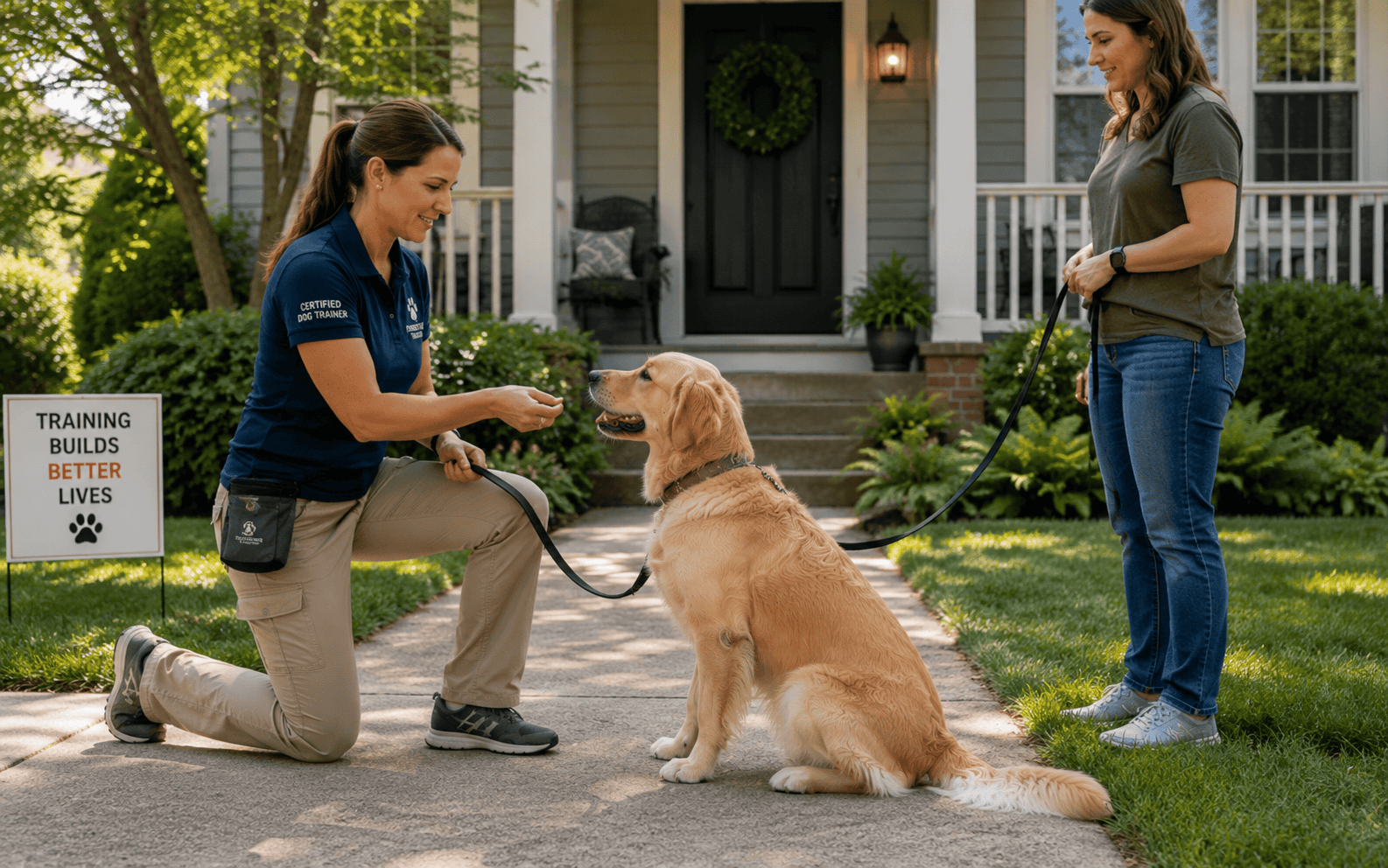
For dogs with severe issues, a structured residential program can produce faster results because the dog receives multiple training sessions per day in a controlled environment, building the new habits quickly before the dog returns home.
Things to Know
- Your guests are part of the training equation. A single guest who lets your dog jump all over them can set back weeks of progress in minutes.
- Puppies under six months have shorter attention spans and need shorter, more frequent sessions rather than long training blocks.
- High-arousal dogs often need physical exercise before a guest arrives to reduce baseline excitement. A 20- to 30-minute walk before visitors show up makes a measurable difference.
- Crates and baby gates are not cheating. Management tools are legitimate training aids that prevent rehearsal of the wrong behavior while your dog learns the correct one.
- Some breeds, including Labrador Retrievers, Vizslas, and Boxers, are genetically wired for high physical greetings and may require longer timelines to reach reliability.
- Never punish a dog for failing at the door. Punishment increases stress, which increases arousal, which makes the exact behaviors you want to reduce more likely to occur.
Ready to Stop Dreading the Doorbell?
The most actionable next step you can take today is to set up one practice session with a neighbor or friend acting as a staged guest. Run the scenario five to ten times, reward every correct behavior, and keep a short written note on what your dog did well and where they struggled. This single session gives you far more useful information than another hour of reading about training theory.
If you want professional support built around your home environment and your specific dog, reaching out to a trainer who specializes in real-life behavioral scenarios is the fastest path to a dog you are genuinely proud to show off when company arrives.
You May Also Read
Impulse Control Training for Dogs
Dog Training for Destructive Behavior
Mouthing and Nipping Puppy Training
Frequently Asked Questions
How long does it take to train a dog to behave around house guests?
Most dogs show noticeable improvement within two to four weeks of daily, consistent practice.
The timeline depends heavily on how long the problematic behavior has been reinforced and how often you can create realistic practice opportunities. Dogs with years of rehearsed jumping or barking typically take six to eight weeks to reach reliable performance.
Should I put my dog away when guests arrive, or keep training them through it?
Both approaches have a place, depending on where your dog is in the training process.
If your dog is in early stages and cannot yet hold a sit or stay for more than a few seconds, management with a crate or back room prevents the wrong behavior from being rehearsed. Once foundation skills are solid, bringing the dog into controlled guest scenarios is essential for real-world generalization.
My dog only misbehaves with certain guests, like kids or men. Is that normal?
Yes, this is common and reflects your dog’s specific socialization history.
Dogs generalize behavior less than humans do. A dog that is calm around adult women may have limited positive experience with children or men wearing hats. Targeted desensitization and controlled introductions with the specific type of person who triggers the behavior is the right approach.
Can older dogs learn guest manners, or is it too late?
Older dogs absolutely can learn new behaviors, though the process may take slightly longer.
Neuroplasticity does not disappear in adult dogs. What matters more than age is repetition and consistency. Many trainers report that adult dogs over five years old make excellent training candidates because they are often calmer and more food-motivated than adolescent dogs.
What do I do if my guest ignores my instructions and lets my dog jump on them anyway?
Calmly restate the instruction and, if the behavior continues, remove your dog from the situation.
One well-meaning but uninstructed guest is one of the most common reasons training stalls. You are not being rude by setting a clear expectation. Brief guests before they enter by saying something simple like: “We are working on his manners, please wait for four paws on the floor before you pet him.”
The Bottom Line on Dog Training for House Guests
Dog training for house guests is not about having a perfectly robotic animal. It is about giving your dog the skills to handle a genuinely exciting and stimulating situation in a way that keeps everyone safe and comfortable. The behaviors are learnable, the timeline is reasonable, and the payoff, a dog you can be proud of every time someone walks through your front door, is absolutely worth the consistent effort.
Start with one core skill this week, either “place,” sit-for-greeting, or threshold boundary work, and build from there. Give your dog clear feedback, set your guests up for success, and do not skip practice sessions. Every repetition your dog gets right brings them one step closer to being the dog everyone loves to visit.