
Key Takeaways
- Rottweilers are highly intelligent and respond best to positive reinforcement paired with clear, consistent boundaries — not fear-based methods.
- Early socialization (8–16 weeks) is non-negotiable. A poorly socialized Rottweiler is far harder to manage as an adult.
- Rottweilers need a calm, confident handler. They read hesitancy and will fill any leadership vacuum.
- Basic obedience commands (sit, stay, heel, down, come) should be established before 6 months old.
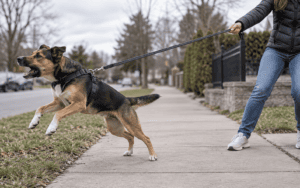
- If your Rottweiler shows signs of aggression or resource guarding, skip the DIY approach and bring in a professional trainer immediately.
A Rottweiler that trusts its owner and understands what’s expected of it is one of the most loyal, capable dogs you’ll ever share your life with. One that’s been poorly trained — or not trained at all — is a serious liability. These dogs average 80–135 lbs, were bred to move livestock and guard property, and have a bite force measured at roughly 328 PSI. There’s no middle ground here. Training isn’t optional; it’s the foundation of the entire relationship.
This guide covers everything you need to know about how to train a Rottweiler, whether you’re starting with an 8-week-old puppy or trying to establish better structure with an adult dog.
What Makes Rottweiler Training Different
Rottweilers aren’t difficult dogs to train, they’re demanding ones. There’s a meaningful difference.
They were developed as working dogs: herding cattle, pulling carts, guarding property. That history produced a dog with high intelligence, strong working drive, and an innate desire to have a job. When that energy isn’t channeled through training and structured activity, it surfaces as destructive behavior, excessive barking, or dominance-testing.
Key traits that shape how you train a Rottweiler:
- High food motivation — treats work exceptionally well as a reward mechanism
- Strong pack instinct — they look for leadership; if you don’t provide it, they’ll assume the role themselves
- Natural wariness of strangers — normal for the breed, but requires early and consistent socialization to keep it from becoming reactivity or aggression
- Sensitivity to harsh handling — correction-heavy training often backfires, producing a dog that shuts down or becomes defensive
The dogs I’ve seen struggle most in training were handled by owners who confused harshness with authority. Rottweilers need confident, fair leadership, not intimidation.
Start Here: Socialization Is the Foundation
Before you work on a single command, socialization needs to be your obsession during the first four months of your Rottweiler’s life.
The critical socialization window is approximately 3–16 weeks. What your Rottweiler encounters during this period shapes how it responds to the world for the rest of its life. Miss this window, and you’ll spend years managing anxiety and reactivity that could have been prevented in a matter of weeks.
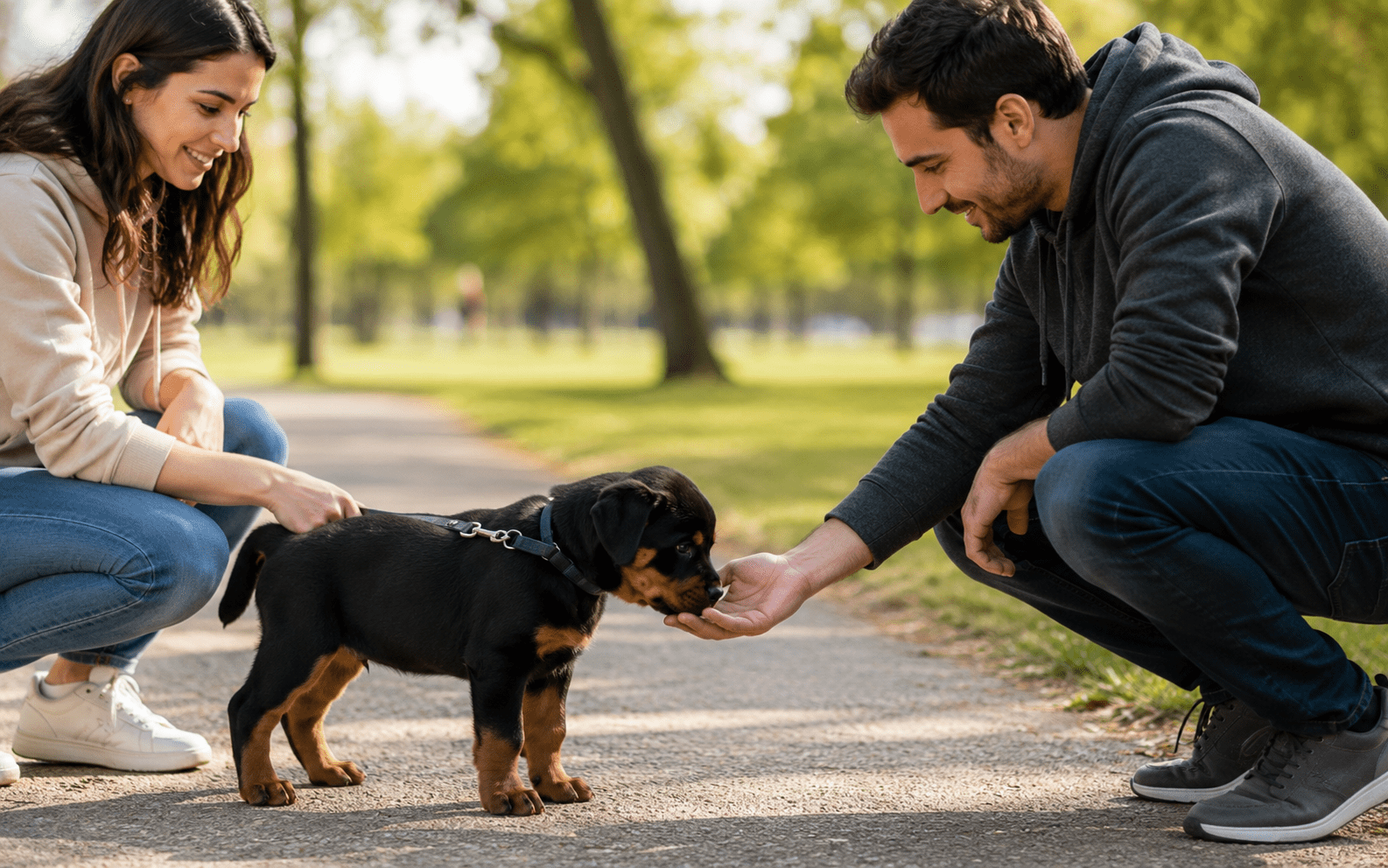
What to expose your Rottweiler puppy to:
- Other dogs of different sizes, ages, and energy levels (in controlled settings)
- Children, men, women, people wearing hats or uniforms
- Urban environments: traffic noise, crowds, skateboards, bicycles
- Veterinary and grooming handling: ears, paws, mouth
- Crates, cars, and various floor surfaces
Each positive experience builds a neural pathway that says: this is normal, not a threat. The goal isn’t to overwhelm, it’s to create broad, positive associations.
If your Rottweiler is already showing signs that socialization was incomplete — reactivity toward strangers, stiffening around other dogs, guarding behavior — read our guide on how dog trainers approach behavior modification for aggressive dogs before attempting to address these issues on your own.
Core Obedience Commands Every Rottweiler Must Know
Once socialization is underway, obedience training begins — and it begins early. The goal by 6 months is a dog that reliably responds to five foundational commands: sit, down, stay, come, and heel.
Sit
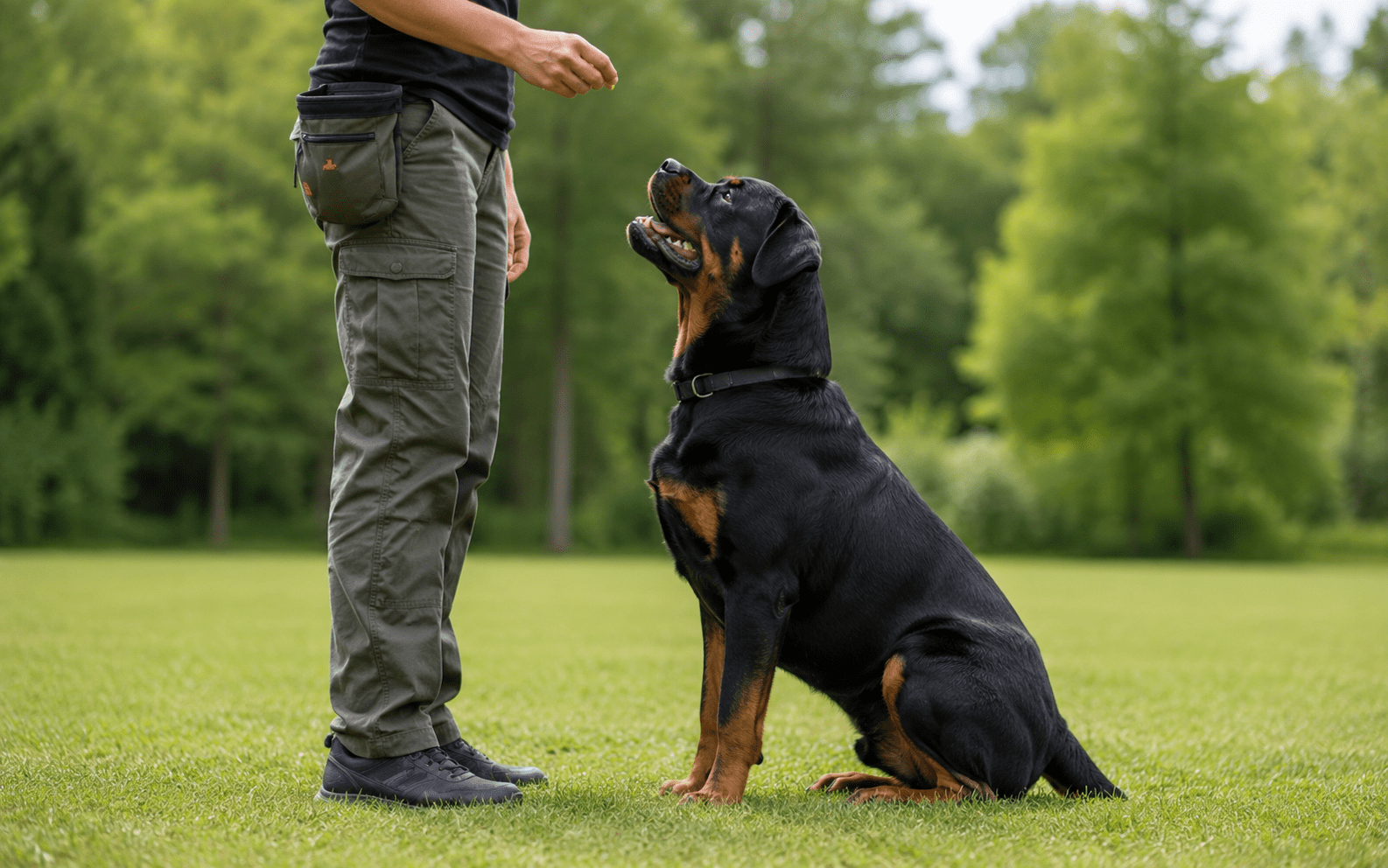
The sit is always the entry point. It’s simple, rewarding, and establishes the pattern of “I do this, I get rewarded” that everything else builds on.
- Hold a treat just above your Rottweiler’s nose and slowly move it back over their head.
- As their nose goes up, their hindquarters go down naturally.
- The moment they sit, say “sit,” mark with a click or a verbal “yes,” and deliver the treat.
- Practice in short 5-minute sessions, 2–3 times daily.
Never repeat the command multiple times. One cue, one behavior, one reward. Repeating “sit sit sit” teaches your dog to wait for the third repetition.
Down
Once sit is solid, down follows the same pattern:
- Ask for a sit first.
- Hold a treat at nose level, then slowly lower it toward the ground between their paws.
- Mark and reward the moment elbows hit the ground.
Stay
Stay is built in three dimensions: duration, distance, and distraction. Don’t add all three at once.
- Week 1: Ask for a sit, say “stay,” wait 3 seconds, reward without moving.
- Week 2: Add a few steps back before returning to reward.
- Week 3: Introduce mild distractions.
A solid stay is one of the highest-value commands you can teach. It creates impulse control — and Rottweilers need impulse control.
Heel
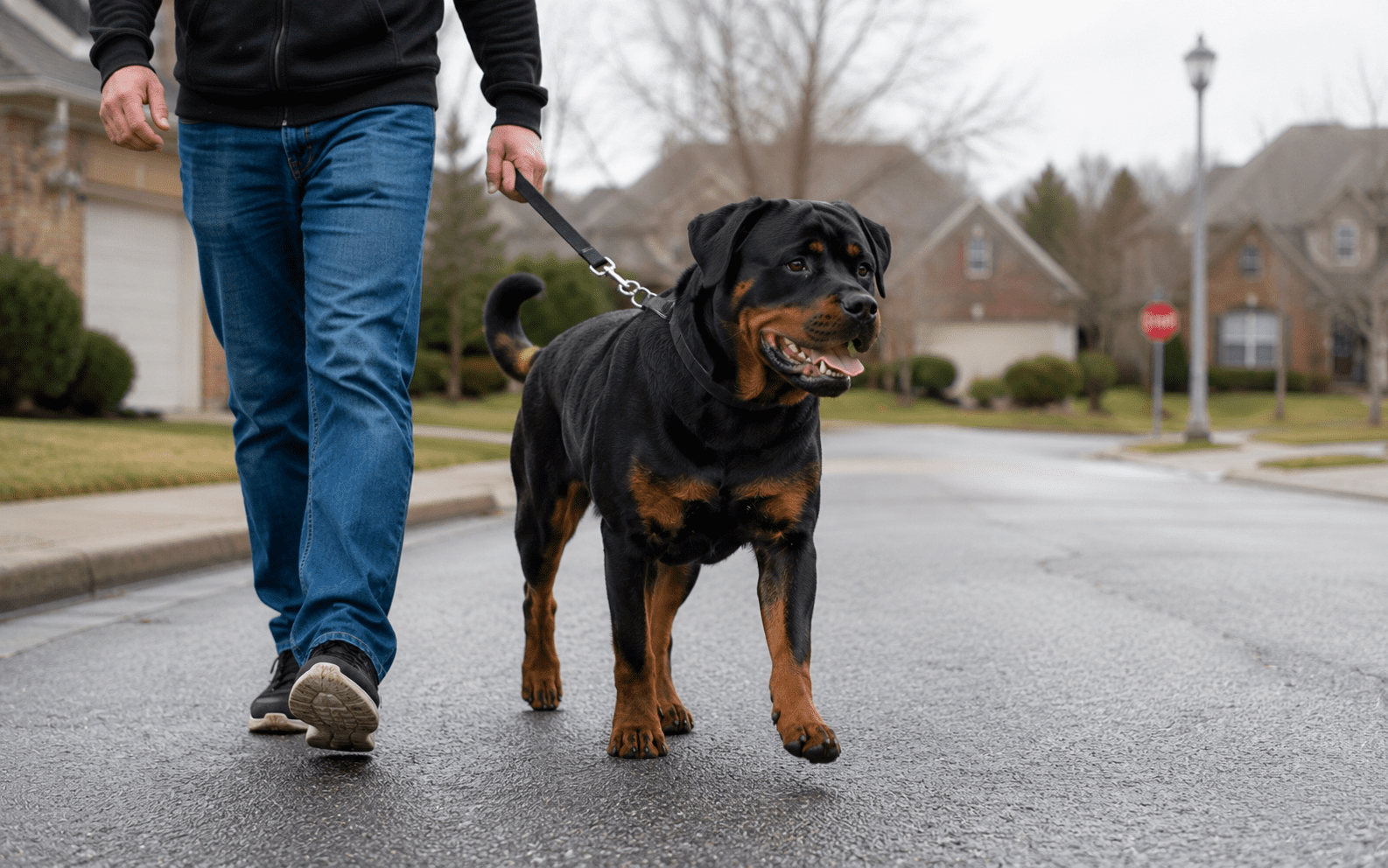
The heel is where most owners skip ahead and regret it. Teaching a dog this size to walk politely on a leash isn’t just about comfort — it’s about control.
Start inside or in a low-distraction environment. Use treats held at your hip to reward your Rottweiler for staying in position as you walk. The moment they forge ahead, stop walking. No yanking, no dragging — just a complete freeze. The moment they return to your side, reward and walk again.
Our guide on effective ways to train your dog covers leash work in more depth and applies directly to large breed training.
Come (Recall)
Come, also called recall, is a safety command. It needs to be the most reliable command your Rottweiler knows.
- Never call your dog to you for something they find unpleasant (bath, nail trim).
- Always make “come” the best thing that can happen to them: big praise, high-value treat, enthusiastic energy.
- Practice in low-distraction environments before expecting it to work at the dog park.
Crate Training and Structure at Home
A crate is not a punishment. For a Rottweiler, it’s a management tool and a den. Dogs with a natural denning instinct — which Rottweilers have — often seek out enclosed spaces voluntarily once they associate the crate with safety and rest.

How to introduce the crate:
- Place the crate in a low-traffic area of the house with the door open.
- Toss treats or meals inside to create positive associations before you ever close the door.
- Once your dog is going in voluntarily, begin closing the door for brief periods (10–30 seconds), then opening and rewarding calmly.
- Gradually extend duration — never more than 4 hours for a puppy during the day.
Crates also prevent the destructive chewing that peaks in adolescent Rottweilers (roughly 6–18 months). If you’re dealing with a chewer, this guide on effective strategies to stop destructive chewing is worth reading alongside this one.
Routine matters as much as the crate itself. Rottweilers thrive on predictable schedules. Feed at the same times, walk at the same times, train at the same times. Predictability reduces anxiety and makes training faster.
Managing Adolescence: The 6–18 Month Challenge
This is where a lot of owners hit a wall. The puppy that was responding beautifully at 4 months suddenly seems to “forget” everything at 8 months. They push boundaries, pull harder on the leash, and test every command.
This is normal Rottweiler adolescence, and it’s also when many dogs end up surrendered to shelters.
What’s happening:
- Hormonal surges affect behavior and focus
- Your Rottweiler is physically stronger but not yet emotionally mature
- The dog is actively testing whether the rules are still real
What to do:
- Double down on consistency — this is not the time to let things slide
- Increase mental stimulation through training games, food puzzles, and scent work
- Ensure daily physical exercise (minimum 45–60 minutes for an adolescent Rottweiler)
- Revisit foundational commands in new environments to proof reliability
The dogs that sail through adolescence aren’t just lucky, their owners maintained structure and expectations when it got harder, not easier.
Common Mistakes Owners Make When Training Rottweilers
Using punishment-based correction as a primary tool. Prong collars and e-collars are sometimes recommended online as a shortcut for large breed training. Used incorrectly, which is most of the time, they suppress behavior without addressing the root cause. The result is a dog that appears compliant until stressed, then reacts unpredictably. If you’re considering aversive tools, work with a credentialed trainer who can guide proper use.
Training only at home. A command your Rottweiler knows in your living room is a suggestion at the dog park. Behavior needs to be proofed in multiple environments and distraction levels before it’s genuinely reliable.
Skipping training after the basics. Many owners achieve “sit, down, stay” and call it done. Rottweilers need ongoing mental work. A dog without a job invents its own, usually something you won’t like.
Misreading breed traits as aggression. Rottweilers are aloof with strangers by nature. A dog that stands calmly between its owner and an unknown person isn’t necessarily aggressive, it may be exhibiting normal guarding instinct. The difference matters, and misidentifying it leads to overcorrection of perfectly normal behavior.
Inconsistency between family members. If one person allows your Rottweiler on the furniture and another doesn’t, the dog isn’t confused, the humans are. Rules need to apply universally.
Step-by-Step Framework: Building a Well-Trained Rottweiler
Week 1–4 (Puppy Arrival to Early Training):
- Begin crate training from day one
- Establish feeding, walk, and sleep schedule
- Start socialization exposure immediately
- Introduce name recognition and basic sit
Month 2–3:
- Add down, stay, and come to daily sessions
- Begin leash manners work (heel) in low-distraction areas
- Continue socialization — new people, places, sounds weekly
- Introduce basic impulse control: wait before meals, sit before going outside
Month 4–6:
- Begin proofing commands in new locations
- Introduce place/mat training (a designated “go to your spot” command)
- Add duration and distance to stay
- Enroll in a group obedience class for socialized training exposure
Month 6–12:
- Maintain all commands daily — never assume they’re permanent without practice
- Add enrichment activities: nosework, agility fundamentals, trick training
- If any concerning behaviors emerge, consult a professional trainer before they escalate
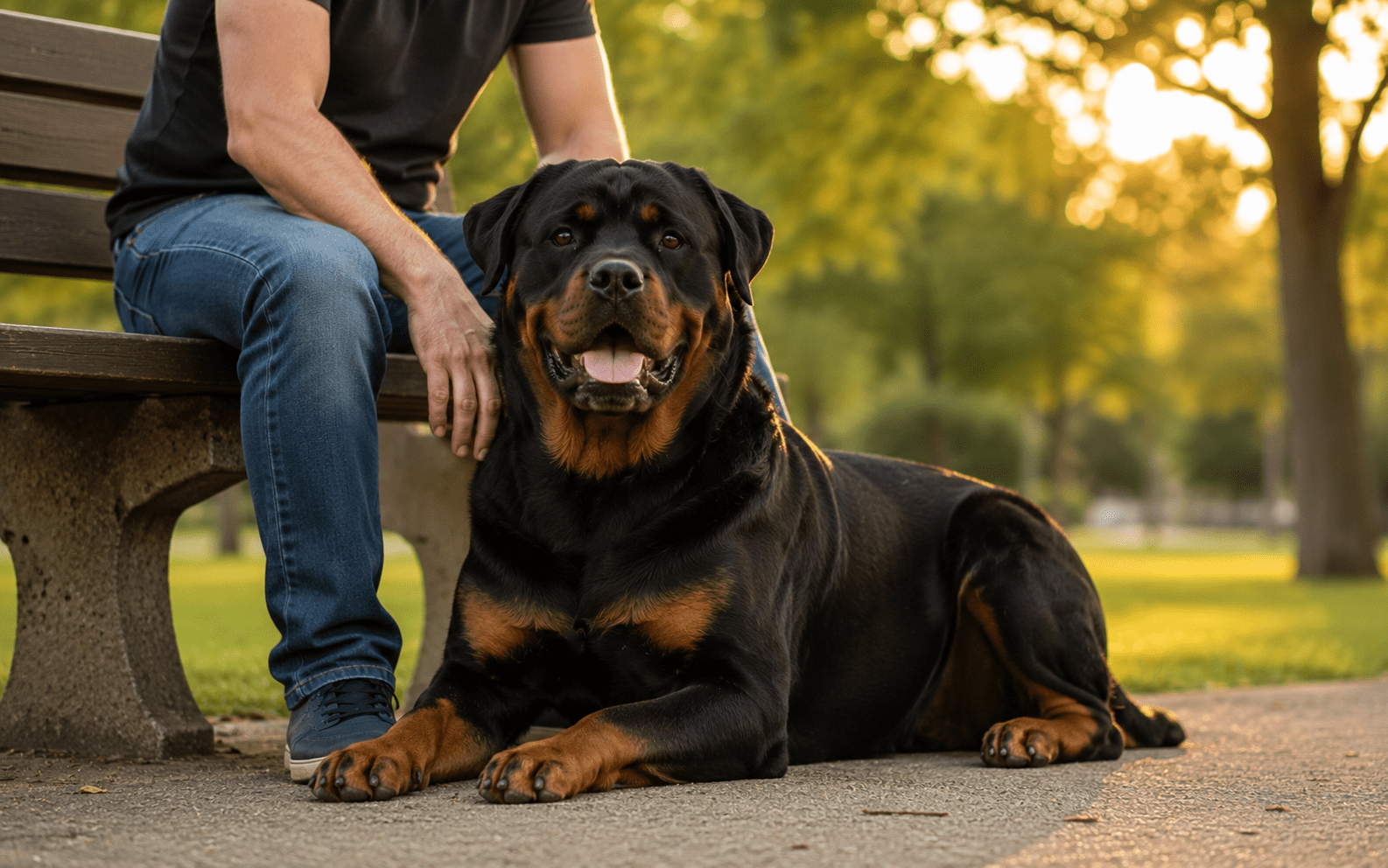
For Rottweiler owners who want hands-on professional guidance, exploring options like board and train programs in New York or private dog training on Long Island can accelerate progress significantly — especially for dogs showing strong-willed or reactive tendencies.
FAQ: How to Train a Rottweiler
At what age should I start training my Rottweiler?
The moment you bring your puppy home — typically around 8 weeks old. Young puppies learn fast, tire quickly, and don’t yet have the physical size to make undesirable behaviors dangerous. Waiting until 6 months is one of the most common mistakes new Rottweiler owners make.
Are Rottweilers hard to train?
Rottweilers are not hard to train — they’re highly intelligent and food-motivated, which makes them excellent students. What makes them challenging is that they require consistent, confident handling. They don’t respond well to wishy-washy leadership. An owner who is clear, calm, and consistent will find a Rottweiler surprisingly easy to work with.
Can I train my Rottweiler myself, or do I need a professional?
Many owners successfully train their Rottweilers using the techniques in this guide. However, if your dog is showing signs of resource guarding, dog-directed aggression, or handler-directed aggression, professional intervention is strongly recommended before those behaviors become entrenched. This is especially true for first-time Rottweiler owners.
How much exercise does my Rottweiler need for training to be effective?
A physically under-exercised Rottweiler is nearly impossible to train effectively. Adult Rottweilers need 45–60 minutes of genuine exercise daily — not just a slow walk around the block. Train after exercise when your dog is mentally open and physically settled.
My Rottweiler ignores me in public but listens at home. What’s wrong?
Nothing is wrong with the dog — the commands haven’t been proofed in public environments. This is an extremely common issue. Start working in low-distraction outdoor environments (an empty parking lot, a quiet trail) and gradually add complexity. Consistency across environments is what creates a reliable dog.
Conclusion: Training Is an Investment, Not an Event
How to train a Rottweiler comes down to three things done consistently over time: socialization, structure, and positive reinforcement with clear expectations. There’s no shortcut and no finish line, a well-trained Rottweiler is the result of daily investment across months and years.
The owners who succeed with this breed understand that the work pays back in full. A trained Rottweiler is calm, confident, and trustworthy in public. They’re a dog you can take anywhere, a companion that enhances your life rather than complicates it.
If you’re ready to invest in professional help to get there faster and with more confidence, our team works with Rottweiler owners across Long Island and New York. Explore our obedience dog training programs or reach out to discuss in-home dog training on Long Island — where we come to your environment and train your dog in the exact context where it matters most.