
Summary:
The Five Essential Commands Every Dog Must Master
The foundation of dog obedience centers on five critical commands: Sit, Stay, Down, Come, and Heel. These aren’t just party tricks—they’re safety tools and communication bridges that every dog needs to navigate the world successfully.
A well-behaved dog starts with a well-trained owner. Before diving into specific techniques, understand that consistency in your approach matters more than perfection in execution. Your dog’s unique personality determines which motivators work best—some respond to treats, others to praise, toys, or play.
Teaching "Sit" and "Stay" - Building Impulse Control
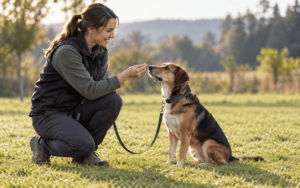
The “sit” command serves as your dog’s foundation for impulse control and attention. Start in a quiet space with minimal distractions, holding a treat close to your dog’s nose and slowly lifting it over their head. As their bottom naturally touches the ground, say “sit” and immediately reward them.
Once your dog consistently sits on command, introduce “stay” by holding your palm out in a stop gesture while taking a small step backward. The time it takes to see results varies depending on your dog’s age, breed, and specific training goals, though many dogs show improvement in basic obedience within a few weeks.
Start with very short durations—even two seconds counts as success initially. The key lies in building gradually rather than expecting immediate perfection. Practice in different locations once your dog masters the basics at home. Working through behavioral and environmental issues in your everyday environment, then gradually introducing controlled distractions like other dogs, people, and children, creates reliable responses.
Remember that every successful repetition builds confidence, while inconsistency can undo weeks of progress. Keep training sessions short but frequent—five minutes twice daily often produces better results than one exhausting thirty-minute session.
Mastering "Come" and "Heel" for Safety and Control
The “come” command potentially saves your dog’s life, making it the most crucial skill they’ll ever learn. Never call your dog to come for something they perceive as negative—this destroys their willingness to respond when it truly matters.
Start recall training in a secure, enclosed area using an enthusiastic voice and high-value rewards. Begin with short distances and gradually increase the challenge as your dog’s response becomes more reliable. This becomes especially important when addressing undesirable behavior like running off, which puts dogs at risk of getting run over.
The heel command teaches your dog to walk beside you, making walks easier and more comfortable for both you and your dog. Unlike loose leash walking, heeling requires your dog to maintain a specific position at your side, typically with their shoulder aligned with your leg.
Leash reactivity, leash aggression, and pulling are among the most common problems dog owners encounter, but teaching proper heel position helps dogs stay calm so you can enjoy more time with them outside. Start indoors without distractions, rewarding your dog for staying in the correct position as you take just a few steps.
The progression from indoor heeling to outdoor reliability requires patience and systematic exposure to increasing levels of distraction. Most dogs need weeks of consistent practice before they can heel reliably past other dogs or through busy areas.
Advanced Training Techniques and Troubleshooting Common Problems
Teaching basic commands like “come,” “sit,” “off,” and “leave it” works at any canine age and with any family member willing to maintain consistency. However, many dogs struggle with specific challenges that require targeted approaches.
Understanding who your dog is and why they do the things they do allows you to train using reward-based methods, enjoyable exercises and play, while addressing sometimes inconvenient behaviors. This individualized approach recognizes that cookie-cutter training methods often fail because they don’t account for each dog’s unique personality and learning style.
Addressing Behavioral Issues During Command Training
Common behavioral issues like separation anxiety, fear issues, nervousness, jumping on people, excessive chewing and barking, counter surfing, growling, and snapping often interfere with command training. These behaviors don’t disappear simply because you’re teaching commands—they require integrated solutions.
Many owners attempt to separate obedience training from behavior modification, but the most effective approach addresses both simultaneously. For example, a dog who jumps on guests needs to learn “sit” and “stay,” but also requires work on impulse control and greeting manners.
Success stories demonstrate dramatic improvements when training addresses root causes—dogs can go from not being able to walk around other dogs to walking through busy farmers markets without reacting. This transformation happens when command training incorporates behavior modification techniques that address the underlying emotional state driving problematic behaviors.
The timeline for seeing results varies significantly based on the complexity of issues you’re addressing. Simple obedience might show improvement within weeks, while complex behavioral issues may require months of consistent work. Professional dog training Long Island often accelerates this process by identifying and addressing root causes more efficiently.
When to Seek Professional Dog Training Help
Dogs and their owners progress more quickly with one-on-one training because it provides more time with the trainer, fewer distractions, and allows both owner and dog to learn at their own pace with full trainer attention. This individualized approach becomes especially important when dealing with complex behavioral challenges.
Consider professional help when your dog shows aggression, extreme fear, or when your own frustration levels interfere with consistent training. Many owners who were hesitant due to finances found professional training “worth every penny” after spending hundreds of dollars on ineffective home trainers and months of putting off the decision.
We focus 100% on you and your dog’s unique situation, addressing behavioral problems from a holistic standpoint, whether that’s barking, nipping, separation anxiety, or other issues. Unlike group classes that come with distractions and multiple dogs with behavioral issues, we can control the environment and introduce distractions systematically.
Board and train programs offer another solution for dogs with serious behavioral issues or busy owners who lack time for daily training sessions. These intensive programs can address multiple issues simultaneously while providing the consistency many dogs need to break problematic patterns.
Building a Foundation for Lifelong Success
Comprehensive training covers essential commands like sit, stay, heel, and the “place” command to enhance control in any situation, with a focus on long-term success that ensures your dog’s training sticks for life. The commands you teach today become the communication system you’ll rely on for years to come.
Whether your goal is enjoying a calm, peaceful life with your dog or helping them reach their full potential, success comes from excellent training services based on positive and holistic methods. Remember that training never truly ends—it evolves into an ongoing relationship built on clear communication and mutual respect.
If you’re feeling overwhelmed by the training process or your dog isn’t responding to your efforts, we at K9 Mania Dog Training can help you build the foundation your dog needs for lifelong success.