Starting dog training before bringing home a puppy gives your new companion the best possible foundation for a lifetime of good behavior. The work you do in the days and weeks before your puppy walks through your front door is just as important as anything you’ll do after.
Key Takeaways
- Puppy training starts before pickup day, not after the chaos begins.
- Setting house rules, buying the right equipment, and choosing a training method in advance saves weeks of frustration.
- Socialization windows are time-sensitive; knowing the developmental stages helps you act fast.
- Your home environment directly shapes your puppy’s habits and confidence.
- Professional trainers can be engaged before your puppy arrives to build your own skills first.
- Consistency between all household members is one of the biggest predictors of training success.
Why the Pre-Arrival Period Is More Important Than Most People Realize
Most new puppy owners spend their pre-arrival energy buying beds, toys, and food bowls. Those things matter, but they are secondary to something far more impactful: having a clear, agreed-upon training plan before your puppy sets a single paw inside your home.
Dogs are creatures of pattern and association. From the very first moment your puppy enters your house, it is learning what behavior earns attention, what spaces it can access, and how the humans in the home respond to its actions. If you have not decided how you are going to handle jumping, furniture access, crate use, and feeding schedules before arrival, you will make those decisions reactively, and that inconsistency becomes the foundation of every bad habit you will spend months trying to undo.
Think of it this way: a puppy that is allowed on the couch on day one because “it’s too cute to say no” will not understand why the rule changes on day thirty. Dogs do not generalize rules well unless those rules are applied consistently from the start. Pre-arrival planning is what makes consistency possible.
Things to Know
- Puppies have a critical socialization window between 3 and 14 weeks of age. Missing this window makes fear-based behavior much harder to correct later.
- Household agreement on rules is not optional. If one person allows jumping while another corrects it, the puppy learns that the behavior works sometimes, which is the exact condition that makes habits most persistent.
- The crate is a tool, not a punishment. Introducing it properly before your puppy arrives, including making it a comfortable and familiar-smelling space, reduces the nightly crying significantly.
- Your puppy’s breed matters more than many owners admit. A Border Collie and a Basset Hound have drastically different energy levels, motivations, and training speeds.
- Many puppies come from breeders or shelters with zero formal training exposure. You are starting from scratch unless you confirm otherwise.
- New puppy owners often underestimate how quickly the first 48 hours set behavioral tone. That first night, first morning, and first mealtime are all training sessions whether you intend them to be or not.
Building the Training Framework Before Day One
Agreeing on House Rules as a Household
Before your puppy arrives, every person in your home needs to sit down and answer the following questions together:
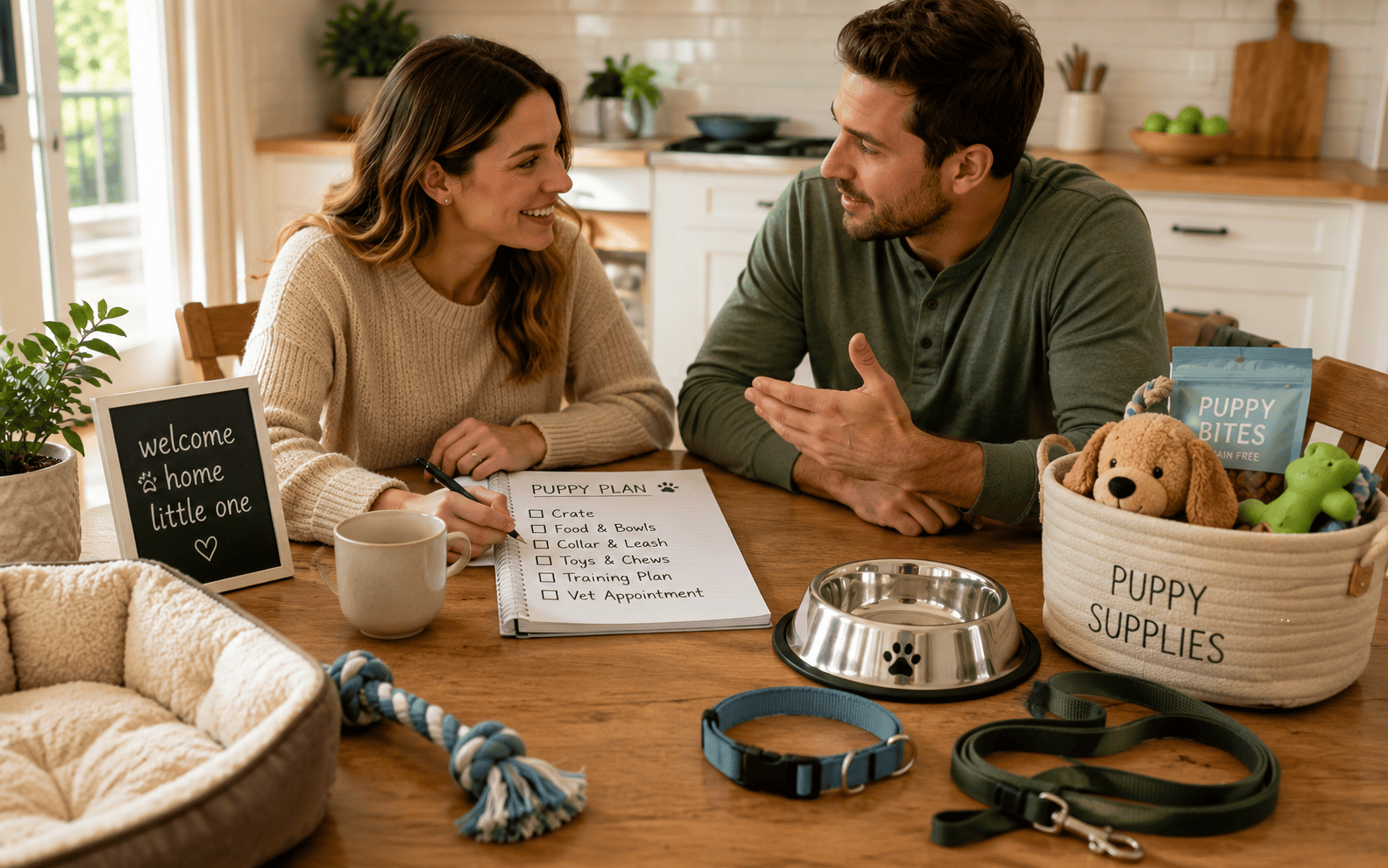
- Is the puppy allowed on furniture? If so, which pieces?
- Where will the puppy sleep? In a crate? In a bedroom? In a common area?
- Who is responsible for morning and evening feeding?
- What is the command word for “no” or “stop”? Will everyone use the same word?
- How will you handle guests who want to encourage jumping or rough play?
These conversations feel overly formal until you skip them and spend three months arguing about why the dog keeps begging at the table. Setting ground rules in advance is one of the most practical steps you can take. You can also read through 10 valuable tips for new dog owners to fill in any gaps before your puppy comes home.
Choosing Your Training Philosophy
There are several training approaches used by professional trainers and owners alike. The most widely recommended by modern trainers is positive reinforcement, which rewards desired behaviors with treats, praise, or play rather than correcting unwanted behaviors with physical pressure or punishment. Research consistently supports this method as the most effective for building reliable, long-term behavior in dogs.
That said, some trainers use balanced training methods that combine reinforcement with corrections, particularly for specific behavioral challenges. What matters most is that you choose one approach, understand it well, and apply it consistently. Switching between methods confuses dogs and slows progress significantly.
Buying the Right Equipment Before Arrival
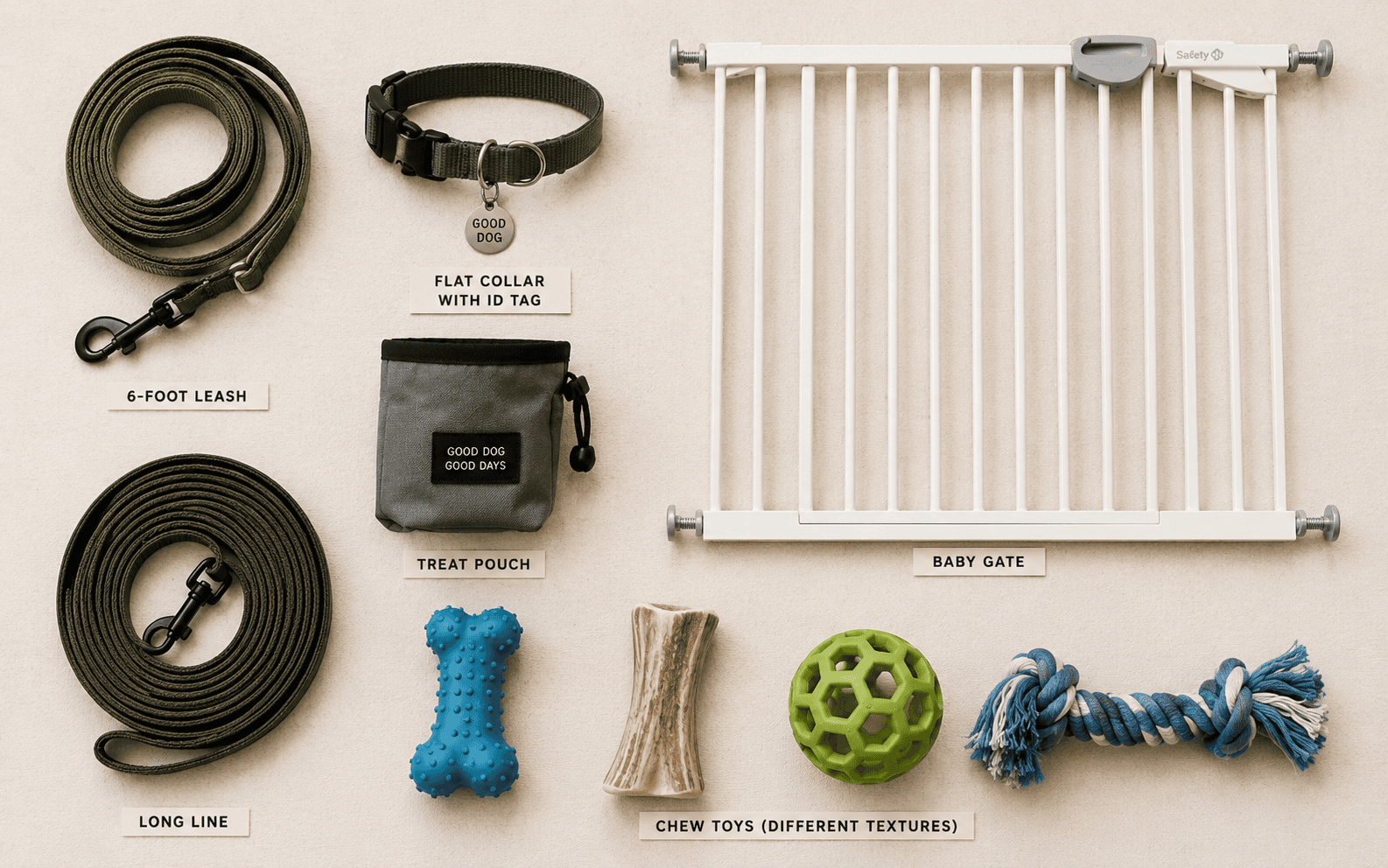
Having the correct tools on hand before pickup day lets you implement your plan immediately rather than scrambling. Here is a breakdown of what you will need and what each item does:
| Equipment | Purpose | Notes |
| Crate (wire or plastic) | Safe space and house training | Size to adult dimensions, block extra space with a divider |
| 6-foot leash | Leash manners and control | Avoid retractable leashes for training |
| Flat collar with ID tag | Safety and light leash use | Correct size for breed at 8-10 weeks |
| Treat pouch | Hands-free reward delivery | Essential for positive reinforcement |
| Baby gates | Space management | Block off rooms you are not ready to supervise |
| Long line (15-30 feet) | Recall training outdoors | More useful than a retractable leash |
| Chew toys (multiple types) | Redirect mouthing and biting | Have at least 3-4 textures available |
Understanding Developmental Stages Before Your Puppy Arrives
One of the highest-value things you can do before your puppy arrives is study how puppies actually develop. Behavior that seems random often follows predictable patterns tied to age and neurological maturity.
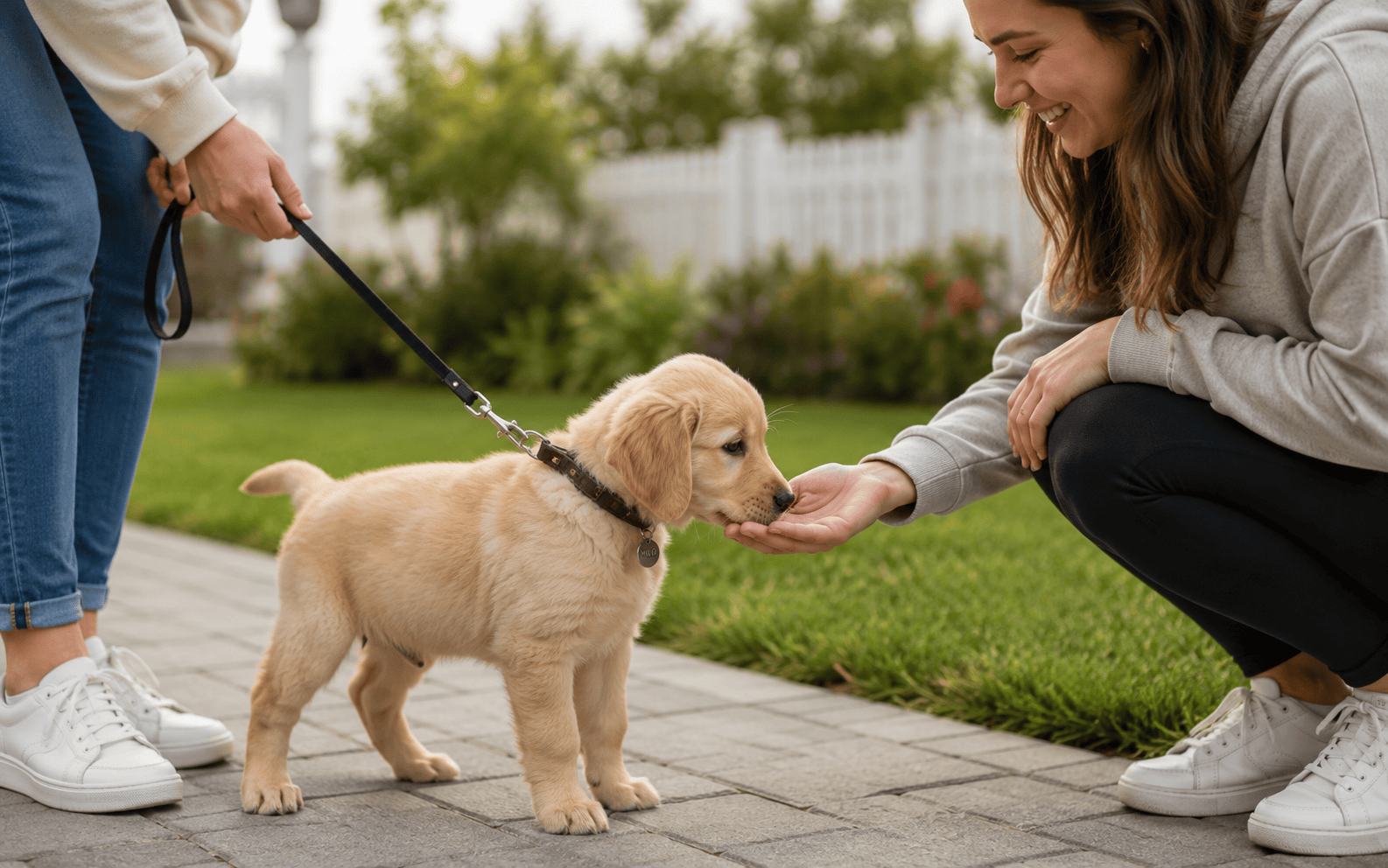
Between 3 and 5 weeks, puppies learn social behavior primarily from their mother and littermates. By the time they reach you at 8 weeks, they are entering a fear imprint period where negative experiences leave deeper impressions than at almost any other stage of life. Between 8 and 12 weeks is also the prime socialization window, when controlled exposure to new people, surfaces, sounds, and environments has a lasting positive effect.
Understanding this timeline helps you prioritize correctly. You will not waste the first two weeks “waiting for your puppy to settle in” while the socialization window closes. Your complete guide to the developmental stages of puppy behavior gives you a detailed breakdown of each phase so you can plan your exposure and training calendar accordingly.
How to Practice Basic Commands Before Your Puppy Is Even Home
This might sound strange, but you can and should practice your own training mechanics before your puppy arrives. Good timing is the single most important skill in dog training, and most people are terrible at it when they start.
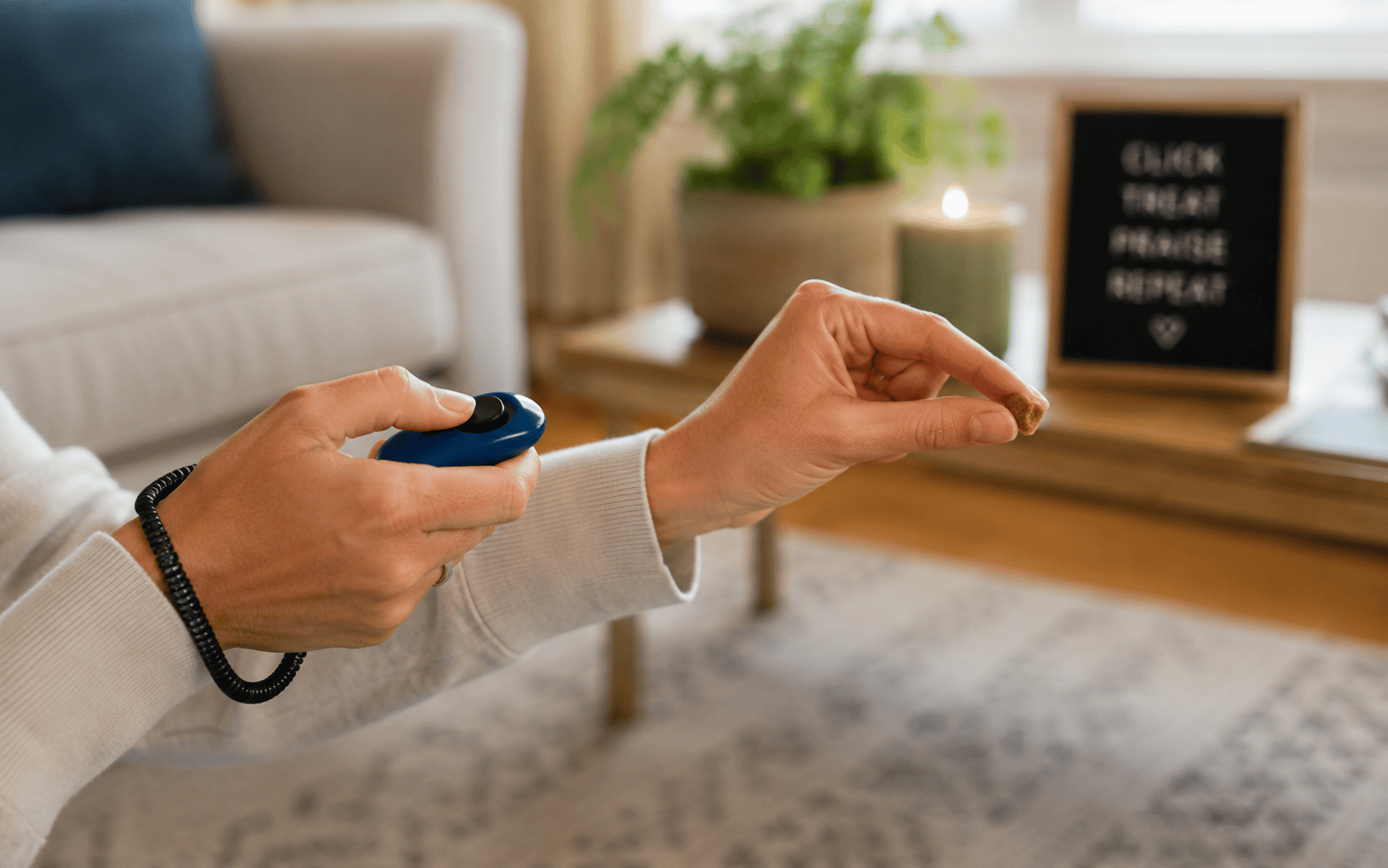
Practice marking the moment you want to reward. If you are using a clicker, click it the second you would theoretically see the desired behavior. If you are using a verbal marker like “yes,” practice saying it quickly and consistently. Drop a treat within one second of your marker. This sounds trivial until you are standing in your living room at 9 p.m. with an excited puppy and your timing is off by three seconds every time.
You can also practice the physical mechanics of luring: holding a treat between your fingers, moving your hand in a specific direction to guide a dog into a sit or down position. Run through these movements without a dog first. It builds muscle memory that makes you far more effective on day one.
Professional Training Options to Consider Before Pickup Day
You do not have to wait until your puppy is home, and misbehaving, to contact a professional trainer. Many experienced trainers offer consultations or owner-education sessions before your puppy arrives, which gives you the skills to train your dog effectively from the very first day.
If you are in the New York area, in home dog training long island brings the trainer directly to your space, which is particularly useful before your puppy arrives because the trainer can assess your home setup, identify hazards, and help you arrange your environment for training success.
For owners who want a deeper structure, private dog training long island offers one-on-one sessions tailored specifically to your household’s needs, your puppy’s breed, and your personal training goals. This is a strong option if you are a first-time dog owner or if you are bringing home a breed known for independence or high energy.
Some owners also explore board and train long island for older puppies or dogs that need intensive early structure. While board and train is typically more relevant after your dog is home, understanding what is available helps you plan your longer-term training roadmap before the puppy arrives.
If your goals include a reliably well-behaved adult dog, obedience dog training programs provide the structured skill-building that informal home training often misses, covering commands, leash manners, and real-world behavior in a systematic way.
Setting Up Your Home as a Training Environment
Your physical environment is an often overlooked part of dog training before bringing home a puppy. The layout of your home either supports or undermines the habits you are trying to build.
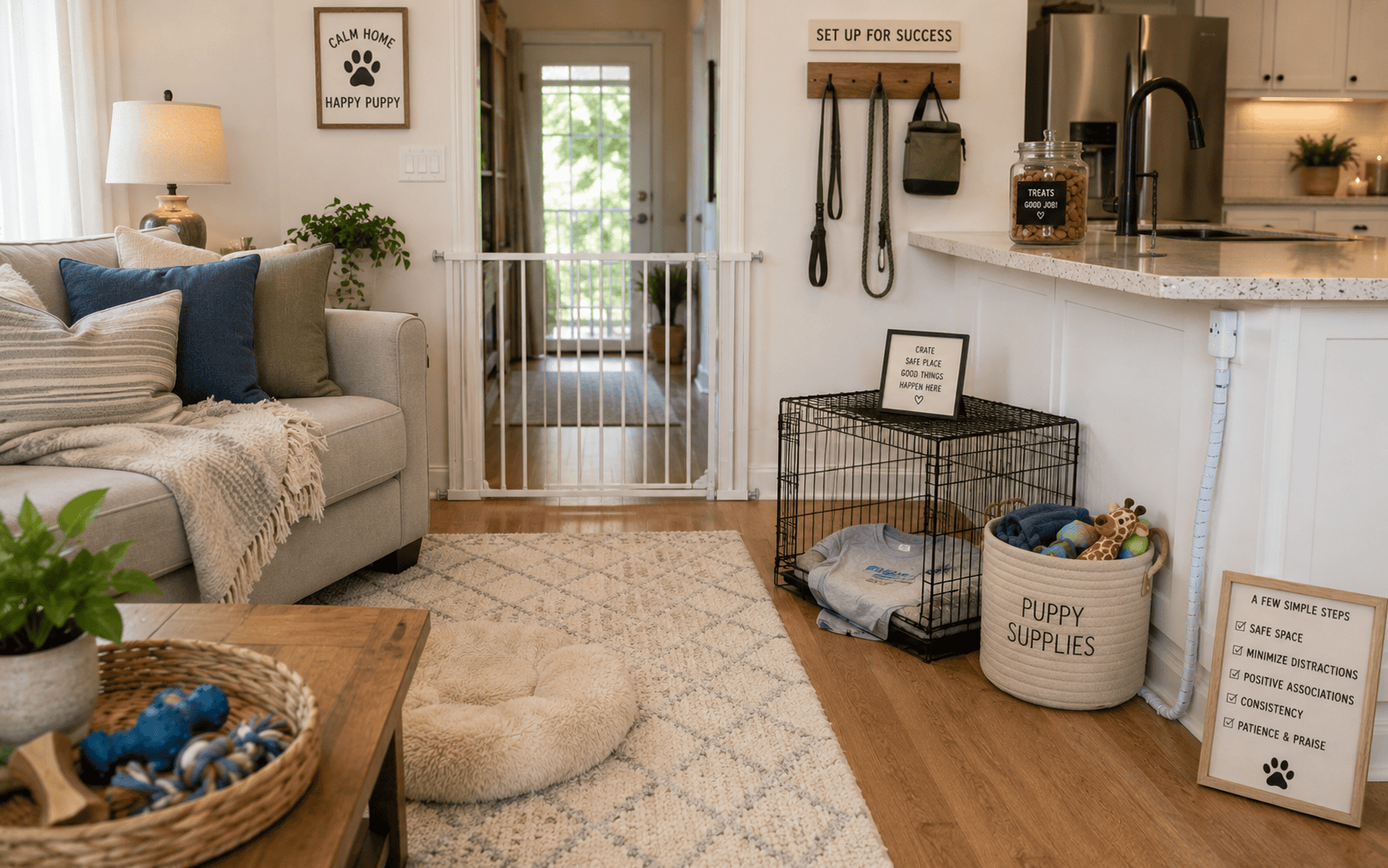
Here is how to set up your space before pickup day:
- Define the puppy zone. Use baby gates to limit your puppy to one or two rooms where supervision is easy. This prevents accidents, destructive chewing, and reinforces that certain spaces require earned access.
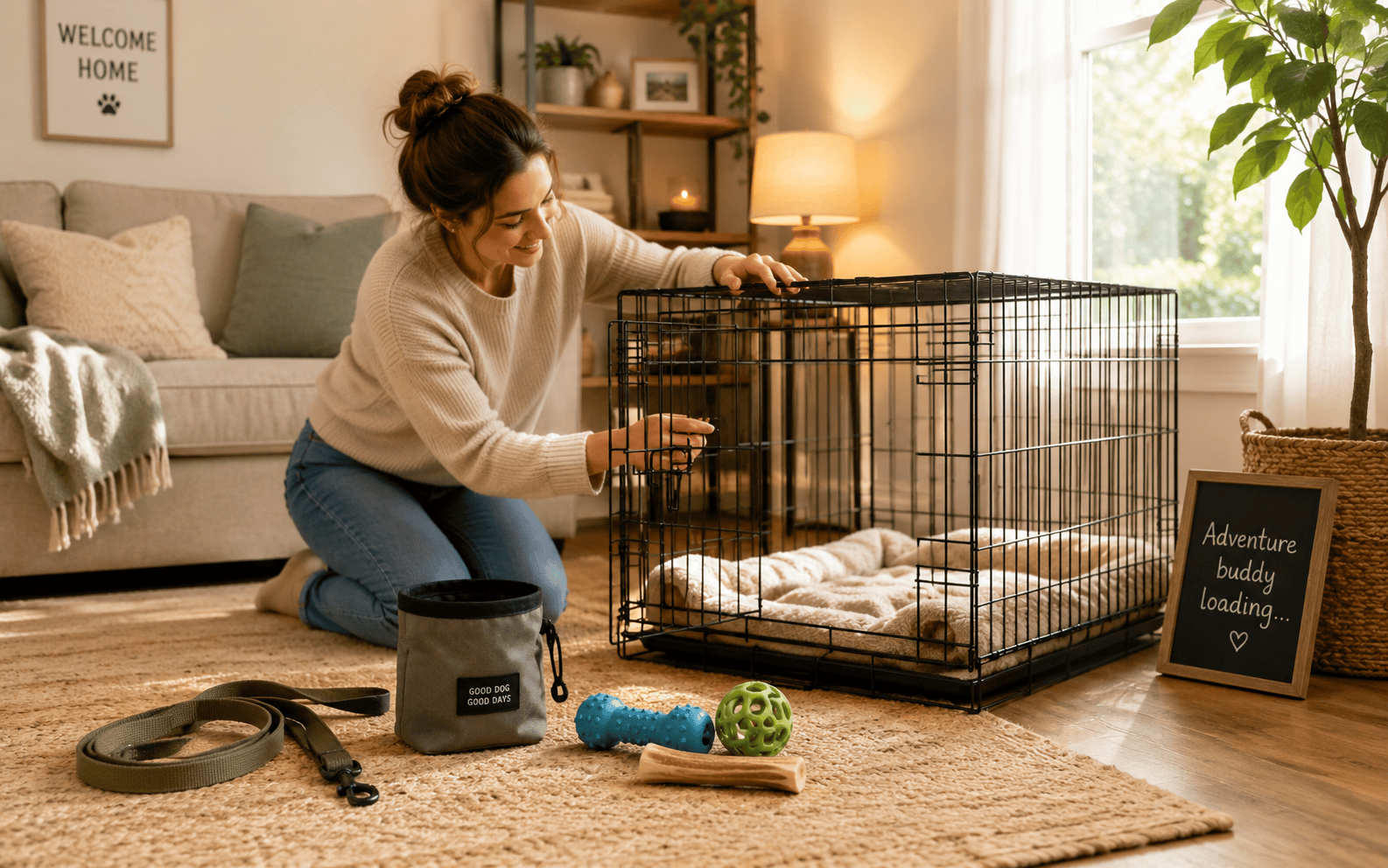
- Set up the crate in a social area. Place the crate in a spot where the family spends time, such as a living room or kitchen. Isolation makes crate training harder. Put a worn t-shirt inside so the crate smells like you before your puppy ever sees it.
- Remove hazards at puppy height. Power cords, houseplants, small objects, and loose rugs are all targets for a curious puppy. Do a floor-level walk-through of every accessible room.
- Stock training treats in accessible spots. Keep small, soft treats on countertops in every room your puppy will access. The fewer steps between the behavior and the reward, the better your timing will be.
- Designate a potty spot outdoors. Pick a specific area outside and commit to it. Puppies learn to associate surface and location with the elimination behavior. Consistency here accelerates house training dramatically.
Ready to Train Before Your Puppy Arrives?
Take one concrete action today: schedule a pre-arrival consultation with a professional trainer. You do not need to wait for a problem to develop before reaching out. A single session focused on your home setup, your household rules, and your chosen training method can compress weeks of trial and error into a single productive conversation. Reach out to a trainer in your area now, while you still have the time and mental bandwidth to prepare properly.
You May Also Read
Mouthing and Nipping Puppy Training
Obedience Training for Aggressive Dogs
Frequently Asked Questions
How early should I start dog training before bringing home a puppy?
Ideally, you should begin your preparation two to four weeks before your puppy’s pickup date.
This gives you enough time to puppy-proof your home, agree on house rules, purchase the right equipment, and optionally consult with a professional trainer. Starting earlier is never a problem; starting the day of pickup often is.
Can I train my puppy on my own, or do I need a professional?
Many owners successfully train their puppies independently, but professional guidance significantly improves speed and accuracy.
A trainer helps you avoid the most common timing and technique mistakes that slow progress. Even one or two sessions with a professional early on can make a substantial difference in your results.
What is the most important thing to teach a puppy first?
Your puppy’s name recognition and crate acceptance are the two most impactful skills to establish in the first week.
Name recognition builds the foundation for every command that follows, and crate acceptance makes house training, safe confinement, and overnight sleep exponentially easier. Both can be introduced within the first 24 to 48 hours.
At what age can puppies start formal training?
Puppies can begin basic training as early as 7 to 8 weeks old, which is typically when they arrive in a new home.
Short sessions of 3 to 5 minutes are appropriate at this age. Puppies have limited attention spans, so frequent, brief sessions outperform longer ones significantly.
How do I handle a puppy that bites or mouths constantly?
Consistent redirection to appropriate chew toys, combined with brief social withdrawal when biting occurs, is the most effective approach.
Never use physical punishment for mouthing, as it can increase arousal and fear responses. Keeping multiple chew toys within reach in every room lets you redirect instantly and consistently.
The Bottom Line on Dog Training Before Bringing Home a Puppy
Dog training before bringing home a puppy is not about having a perfectly behaved dog on day one. It is about showing up prepared so that every interaction from the moment your puppy arrives is intentional, consistent, and building toward the dog you want a year from now. The owners who do this preparation are the ones who reach out to trainers later with questions, not emergencies.
Use the weeks before your pickup date to study your puppy’s breed, set your household rules, arrange your home, and connect with a professional if you have access to one. The investment is modest. The payoff, measured in years of life with a confident, well-behaved dog, is significant. Start now, before the puppy is in your arms and the learning curve gets steep.